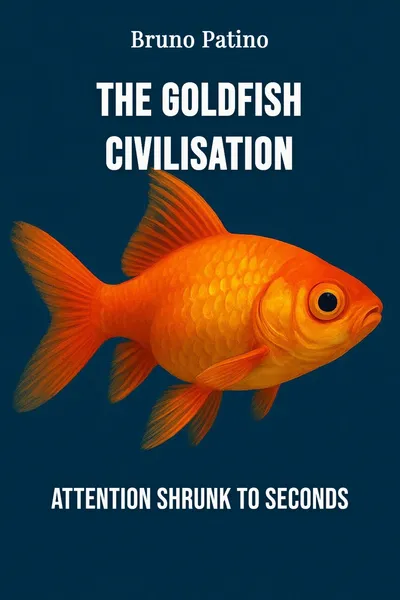
The Goldfish Civilisation
Attention shrunk to seconds
Description
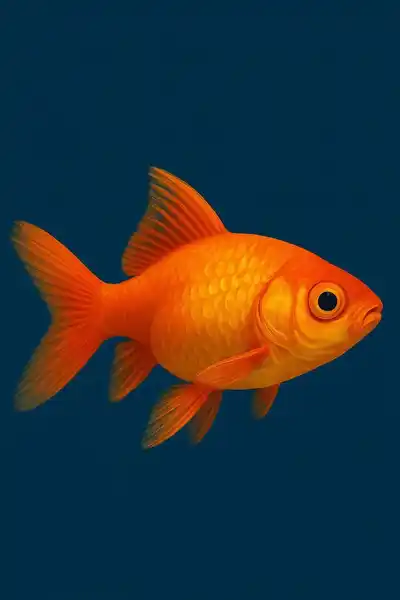
In 2015, a Microsoft Canada report circulated a figure that would travel faster than almost any statistic of the decade: the average human attention span, it claimed, had fallen to eight seconds — one second shorter than that of a goldfish. The number was shaky, the comparison dubious, the goldfish itself slandered by biologists who insist the animal remembers rather well. And yet the image stuck, because it named something people already felt in their own hands. The French journalist Bruno Patino, a media executive who had spent his career inside television and digital newsrooms, took that unreliable figure and did something more useful with it than defend or debunk it. He made it the title of a book.
La Civilisation du poisson rouge, published in 2019, is not really about goldfish, and not really about the eight seconds. It is about what Patino watched happen from the inside — the deliberate construction of devices and services engineered to capture, hold, and monetise human attention, minute by minute, swipe by swipe. Patino is not a technophobe shouting from the sidelines. He ran digital strategy at Le Monde, helped build France Télévisions' online presence, and sat close enough to the machinery to describe how it actually works. That proximity is what gives the book its unease: this is a confession as much as a warning.
The goldfish, in Patino's telling, is us — circling a bowl of infinite content, memory reset every few seconds, always almost satisfied and never quite. He is interested less in scolding anyone for their screen time than in asking who built the bowl, and why, and whether a society whose citizens can no longer hold a thought for long can still govern itself. The question runs underneath the whole book, and it is sharper than any statistic.
The question we’re asking : What happens to a society when human attention is engineered into the scarcest, most valuable resource on the market?What we’ll see : How a shaky statistic became a mirror, and how Patino traces the machinery behind our shrinking attention back to the people who designed it.
Table of contents
01 Chapter 1 — The nine-second goldfish
Patino begins where most of us do: with the feeling. The sense that we open a phone to check one thing and surface twenty minutes later, unsure what we were looking for, having read nothing to the end. The goldfish is his figure for that state. Confined to a bowl, it swims in circles, and by the time it completes a lap the world looks new again because the memory of the previous lap has faded. We scroll the same way — endless laps through feeds that refresh faster than we can finish a thought, each new item erasing the last.
The eight-second statistic that gave him his title is, Patino cheerfully admits, not to be trusted. It came from a consultancy report, got attributed to Microsoft, and was never backed by the kind of research that would survive scrutiny. The goldfish itself has a better memory than the legend allows. But he keeps the image anyway, because its power was never scientific. It spread because millions of people recognised themselves in it before they could say why — which is its own kind of evidence.

02 Chapter 2 — An economy that sells our attention
The services we treat as free, Patino points out, are nothing of the kind. We pay with the one resource that cannot be manufactured: the hours we are awake and looking. The business model of the great platforms is not to sell us anything. It is to sell advertisers access to our eyes, and to do that they must first hold those eyes for as long as possible. Everything we call a feature — the infinite feed, the autoplay, the notification — exists to serve that single commercial purpose.
This is what economists had already named the attention economy: in a world drowning in content, the scarce thing is no longer information but the capacity to attend to it. Herbert Simon saw this coming as early as the 1970s, when he observed that a wealth of information creates a poverty of attention. Patino takes that insight and watches it become an industry. The platforms compete not for our money but for our minutes, and the firm that wins is the one whose design makes us hardest to pull away.
03 Chapter 3 — Addiction by design, not by accident
The uncomfortable core of the book is that none of this is a side effect. The features that fragment our attention were not bugs that slipped past careful engineers. They were chosen, tested, and refined precisely because they work. Patino draws on the admissions of the designers themselves — among them figures from Silicon Valley's own ranks who later described, with something like remorse, the techniques they had deployed to keep users hooked.
The method they borrowed is old, and brutal in its simplicity. B.F. Skinner showed decades ago that the most compulsive behaviour comes not from a reliable reward but from an unpredictable one — the variable schedule that keeps a lab animal pressing a lever on the chance that this time something will come. The pull-to-refresh gesture, Patino notes, is a slot machine in the palm. We swipe down not knowing whether the feed will serve up something delightful or nothing at all, and the uncertainty itself is the hook.
04 Chapter 4 — When a free society learns to look away
Step back from the swiping and the dopamine, and Patino's real worry comes into view. His book is not finally about productivity or screen time or whether we read enough novels. It is about democracy. A free society rests on the assumption that citizens can attend to complex arguments, weigh competing claims, and hold a thought long enough to form a judgement. Strip that capacity away, second by second, and you hollow out the thing self-government depends on, even while every formal institution stays standing.
The attention economy, in his account, does not censor. It does something subtler and harder to resist: it floods. It does not forbid the difficult idea; it buries it under an endless stream of easier, faster, more emotionally charged ones, and lets our re-engineered impatience do the rest. A population that cannot sit with nuance will reward whatever is loudest, most outraged, most immediately gratifying — and the design, optimised for engagement, obligingly serves exactly that. Outrage holds attention better than deliberation, so outrage is what gets amplified.
05 Conclusion
The goldfish was never the point, and neither were the eight seconds. Patino took a statistic he knew to be shaky and used it as a mirror, because the image did what the number could not: it let a whole civilisation glimpse itself circling the bowl. By the end of the book, the figure has done its work and quietly dissolved, leaving behind the harder picture it was always pointing at — devices tuned to our weaknesses, an economy that sells our minutes to the highest bidder, and the slow erosion of the attention a free people needs to govern itself.
Related books