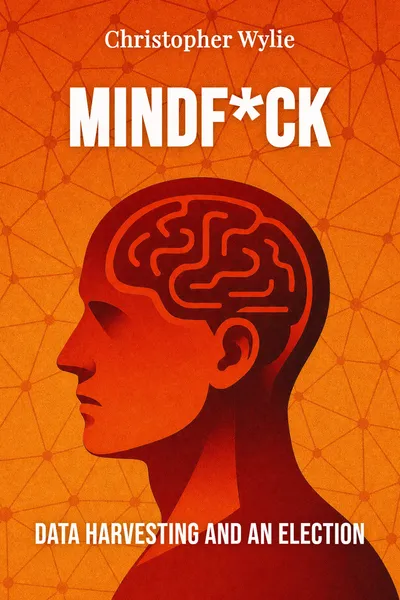
Mindf*ck
Data harvesting and an election
Description
In 2013, a twenty-four-year-old Canadian with a nose for data and a taste for pink hair walked into the offices of a London defence contractor called SCL Group. Christopher Wylie had dropped out of law school, taught himself the statistics of political microtargeting, and arrived convinced that elections were about to be fought on a terrain almost nobody understood yet: the human personality, measured and mapped at a scale that had never existed before. Within months he was helping to spin up a sister company funded by the American billionaire Robert Mercer and steered by Steve Bannon. Its name was Cambridge Analytica.
The idea was deceptively simple. If you could score millions of people on their psychological traits — how anxious, how open, how impulsive, how prone to conspiracy — you could stop broadcasting one message to everyone and start whispering a different message to each person, tuned to the exact lever that moved them. The raw material for those scores turned out to be sitting in plain sight, inside Facebook profiles, harvested through a personality quiz that quietly scooped up the data of friends who had never consented to anything. What began as a research project became an engine pointed at voters.
Wylie built much of that engine, then watched what it was used for and walked away to blow the whistle. His account, told from inside the room, is less a tale of futuristic technology than of ordinary tools turned toward an unsettling purpose. It is the story of how a small firm convinced itself, and its clients, that it could reach past people's arguments and operate directly on their fears.
The question we’re asking : How did a handful of researchers turn personality data into a political weapon, and what did it actually let them do to voters?What we’ll see : The making of Cambridge Analytica from the inside — the ambition, the data pipeline, the campaigns, and the quiet revolution in how persuasion now works.
Table of contents
01 Chapter 1 — A pink-haired kid walks into a data firm
Christopher Wylie did not look like a man who would end up at the centre of a global scandal. He was young, queer, Canadian, partially colour-blind, and had spent his teenage years as a self-taught coder before working on the fringes of Canadian and British politics. What made him useful was an obsession most people in campaigns found abstract: the belief that voters were not rational agents to be persuaded with better policies, but psychological profiles to be read and matched. He had been chasing the academic literature on personality — the so-called Big Five traits — long before anyone thought it could swing an election.
SCL Group, where he landed, was an odd place to start. It had done psychological-operations work for militaries and governments, studying how to shift behaviour in conflict zones and unstable states. The language was borrowed from warfare: target audiences, information dominance, behavioural change. Wylie's insight, and the firm's, was that the same toolkit could be aimed at democracies. The techniques designed to destabilise a population abroad could, with the right data, be pointed at ordinary citizens choosing how to vote at home.

02 Chapter 2 — Building the psychological arsenal
The intellectual core of the operation was a model psychologists call OCEAN, scoring individuals on openness, conscientiousness, extraversion, agreeableness, and neuroticism. On their own these are tame academic categories. What made them dangerous was the discovery, pursued by researchers at Cambridge University and elsewhere, that a person's traits could be predicted with surprising accuracy from nothing more than their digital footprint — the things they liked, shared, and clicked. You did not need to ask people who they were. You could infer it.
Wylie's job was to turn that inference into a working machine. If a model could guess that someone scored high on neuroticism and low on openness, a campaign could then test which images, words, and fears actually moved that type of person, and serve them accordingly. An anxious, order-loving voter might respond to messages about threat and security. An impulsive, novelty-seeking one might respond to something else entirely. The content was not the point; the match between content and psychology was the point.
03 Chapter 3 — The Facebook pipeline and the data nobody missed
The solution came through a researcher named Aleksandr Kogan, who built a personality-quiz app that paid users small sums to take a test. Taking the quiz was presented as academic research. What users were not told, in any way they would notice, was that the app did not just collect their answers. It reached into their Facebook accounts and pulled their data — and, crucially, the data of all their friends, who had never installed anything and never agreed to anything. A few hundred thousand quiz-takers became a gateway to tens of millions of profiles.
At the time, Facebook's platform rules permitted apps to harvest friend data in exactly this way. The design flaw was not a hack; it was a feature of how the platform worked, exploited at scale. From roughly a quarter of a million people who actually took the quiz, the pipeline eventually reached the personal data of somewhere around eighty-seven million users, by Facebook's later admission. That reservoir of likes, posts, and connections became the fuel for the trait models — the raw material that turned psychographic theory into something operational.
04 Chapter 4 — What it means to be targeted by your own mind
Strip away the villains and the scandal, and Wylie's account points at something more durable than any single company: a shift in what persuasion even is. For most of democratic history, campaigns argued. They made a case, loudly, to as many people as possible, and trusted citizens to weigh it. Psychographic targeting breaks that model. It does not argue with you. It models you, works out which emotional lever moves you, and pulls it — privately, invisibly, differently for every person. The same election, experienced by millions, becomes millions of separate manipulations.
That is the genuinely new thing here, and it is why Cambridge Analytica mattered beyond its own brief life. The firm demonstrated, at scale, that you could reach past a voter's reasoning and operate on their temperament. Mass communication once had a built-in safeguard: because everyone saw roughly the same message, a lie could be caught, challenged, fact-checked in public. When each person receives a message tuned to their private fears, there is no shared text to contest. Manipulation becomes personal, and therefore invisible, and therefore very hard to resist.
05 Conclusion
Wylie left the firm, carried the documents, and chose to speak. The scandal that followed brought down Cambridge Analytica, dragged Facebook before legislators, and put psychographic targeting into the public vocabulary for the first time. From the inside, though, his story is less about a company that broke the rules than about an industry quietly learning that the rules never really covered what it was doing. The data was there. The models worked. The consent was a formality nobody read.
Related books