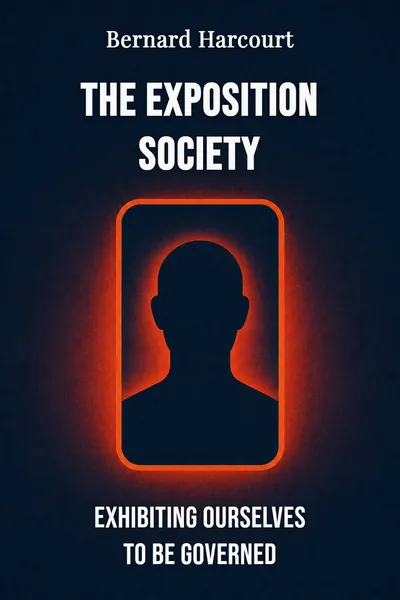
The Exposition Society
Exhibiting ourselves to be governed
Description
In 2013, a former intelligence contractor named Edward Snowden handed journalists a cache of documents showing that the US government was collecting phone records and internet traffic on a scale almost nobody had imagined. The reaction followed a script written decades earlier. Commentators reached for George Orwell, for Big Brother, for the image of a state apparatus prying open private lives against their will. The surveillance state had been caught, and the language of coercion was ready to describe it. Then a curious thing happened: the outrage faded, the apps kept growing, and within a few years more people than ever were posting their locations, their faces, their meals, their heartbeats, and their political convictions, voluntarily, to platforms they knew were watching.
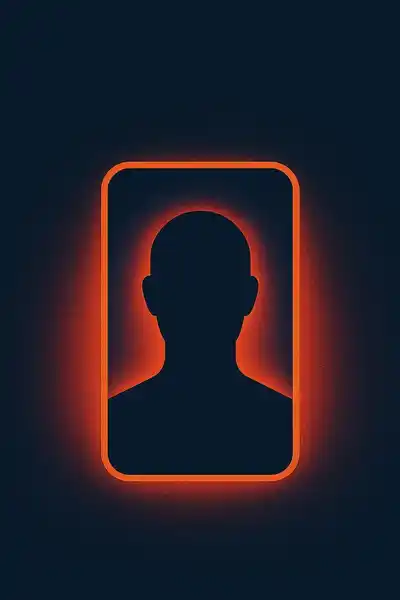
That gap is where the legal scholar Bernard Harcourt plants his book The Exposition Society. His argument is that the Orwellian frame, and even the softer Foucauldian one, misses what has actually happened. We are not primarily being forced to reveal ourselves. We are revealing ourselves, eagerly, constantly, for pleasure and connection and status. The old model imagined power as a one-way mirror with the citizen on the exposed side. Harcourt thinks the mirror has dissolved into something stranger: a space where watching and being watched have fused, where exhibition feels like freedom, and where the most effective control costs nothing to enforce because we supply it.
The book, published in 2015, sits at the seam between political theory and the texture of ordinary digital life. It is less interested in any single scandal than in why the scandals keep failing to change our behavior. Harcourt's wager is that the vocabulary we inherited for talking about surveillance has gone quietly obsolete, and that until we find a new one, we will keep mistaking a cage we decorate ourselves for an intrusion we could simply refuse.
The question we’re asking : If nobody is forcing us to expose ourselves, why does voluntary visibility work so well as a form of control?What we’ll see : How a legal theorist rewrites the story of surveillance, moving from the prison to the platform, from fear to desire.
Table of contents
01 Chapter 1 — The panopticon nobody built
For most of the twentieth century, the master image of surveillance was architectural. Jeremy Bentham had sketched it in the 1790s: a circular prison, the panopticon, with a central tower from which a single guard could see into every cell. The genius of the design was that the prisoners could never tell whether they were being watched at any given moment, so they had to behave as if they always were. Michel Foucault, in the 1970s, turned this blueprint into a theory of modern power. Discipline worked not by punishing bodies after the fact but by installing the watchtower inside the mind, so that each of us became our own guard.
Harcourt takes Foucault seriously, and then argues that the metaphor has quietly stopped fitting. The panopticon assumes a wall between watcher and watched, and it assumes that the watched would rather not be seen. Both assumptions have collapsed. Nobody built the digital watchtower against our resistance. We queued up to install it, paid for the devices, learned the interfaces, and felt genuinely good about the results. The architecture that holds us now was not imposed from a central authority. It was assembled, click by click, by the people it holds.

02 Chapter 2 — From extraction to seduction
If the old model was coercion, Harcourt's name for the new one circles around a different verb: seduction. The platforms do not extract our data at gunpoint. They make exposure feel like the most natural, rewarding thing in the world. A notification, a like, a count of views, a streak to maintain, a story that vanishes in twenty-four hours unless we keep feeding it. Each of these is a small invitation to show more, and each delivers a small pulse of recognition in return. The genius of the design is that the reward and the extraction are the same gesture. We cannot be seen by our friends without also being seen by the system that monetizes us.
Harcourt is careful to say this is not a trick played on fools. The desire to be witnessed is old and deep, and the platforms did not invent it. What they did was build an infrastructure that answers that desire with unprecedented efficiency, at a scale and speed no prior arrangement could match. Confession, display, performance, the hunger for an audience, these are human constants. The new thing is a commercial apparatus that harvests them as its raw material and sells the results back as advertising, prediction, and influence.
03 Chapter 3 — The digital double that testifies against us
Every act of exposure leaves a residue, and Harcourt is interested in what accumulates. Over years of posting, searching, liking, and moving through tracked space, each of us generates a vast dossier: a data double that lives in servers we will never visit, assembled from fragments we offered freely. This double is not quite us. It is a statistical portrait built for prediction, and it has a strange legal and political life of its own, one we rarely consent to directly.
The crucial point is that the double can be turned against the original. Data we produced for pleasure, for connection, for mundane convenience, can later be read by employers, insurers, police, border agents, and courts in contexts we never imagined when we produced it. A location trail posted to show friends where we were on holiday becomes evidence of a pattern. A search made in a moment of curiosity becomes a motive. Harcourt notes how the material of self-expression quietly converts into the material of governance, with no single moment at which anyone decided to make the switch.
04 Chapter 4 — When transparency became the opposite of freedom
Step back from the mechanics and Harcourt's deeper claim comes into focus: the decisive shift is not that we are watched but that we want to be. This is where his analysis parts company with the whole tradition that came before it. Orwell feared the boot on the face. Foucault described the internalized guard. Both still assumed a subject who, left alone, would prefer not to be exposed. The exposition society rests on a subject who feels incomplete without an audience, for whom invisibility reads not as safety but as a kind of non-existence. Control no longer has to overcome our desire. It travels on it.
This forces a hard reckoning with the word transparency, which the digital age has treated almost as a synonym for virtue. We were told that openness would hold power accountable, that sunlight disinfects, that having nothing to hide meant having nothing to fear. Harcourt turns this inside out. In the exposition society, transparency has become the condition of governability rather than its antidote. The more we reveal, the more legible we become to the systems that would shape us, and the ideal of total openness, far from liberating, describes the perfect subject of soft control.
05 Conclusion
Return to the Snowden moment, and the strange quiet that followed it. The revelations were real, the outrage sincere, and the behavior barely moved. Harcourt's book explains why: we were never only the victims of surveillance, we were its most productive authors, and no scandal about a watching state could shake a habit rooted in our own wanting. The documents exposed the tower, but the tower was never the point. The point was that we had already filled the cells, and furnished them, and would rather not leave.
Related books