The Information
How information shapes us all
Description
In 1948, a mathematician at Bell Labs named Claude Shannon published a paper with a modest title, "A Mathematical Theory of Communication," and quietly redrew the map of the twentieth century. Shannon proposed that a message — any message, a love letter, a stock quote, a photograph, a strand of DNA — could be measured. Not judged for its beauty or its truth, but counted, in a unit he helped name: the bit. Meaning was set aside. What mattered was how much uncertainty a signal removed. It was one of those ideas that sounds almost too plain to matter, until we notice that everything we now touch — the phone, the feed, the genome, the cloud — runs on it.
James Gleick, the writer behind Chaos and Genius, takes that quiet paper as the hinge of a much longer story. His book, The Information, published in 2011, treats information itself as a character, one that existed long before anyone had a word for it and grew more powerful the more we learned to name and measure it. He reaches back to African talking drums and forward to Wikipedia, and along the way the abstraction Shannon defined turns out to underlie language, physics, and life.
The through-line is a claim that keeps gathering weight as the chapters accumulate. We have not just built better tools for handling messages; we have come to see the world as made of information, down to the gene and the elementary particle. That shift changes what it means to know something, to remember, to be swamped. Gleick's book is an attempt to make sense of the water we now swim in without noticing it.
The question we’re asking : How did information go from a vague everyday word to the measurable substance that physicists, biologists, and engineers now build their worlds around?What we’ll see : A journey from talking drums to Shannon's bit, and what it means to live once information becomes the thing everything else is made of.
Table of contents
01 Chapter 1 — Drums that carried whole sentences
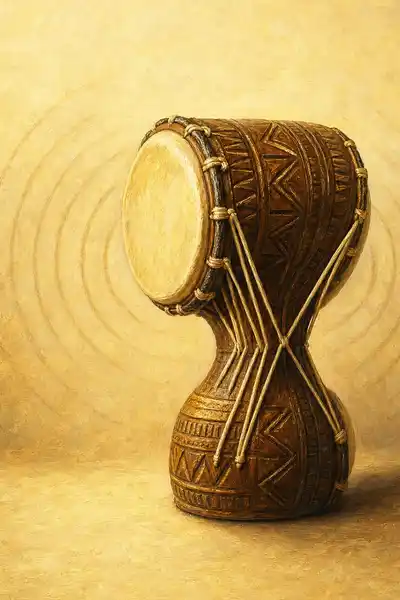
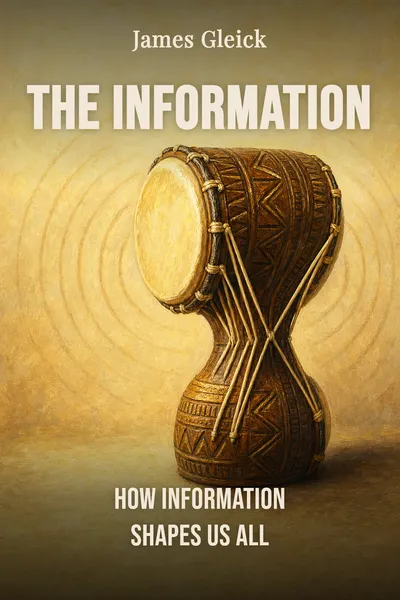
Gleick opens not with a computer but with a sound. In the nineteenth century, European missionaries and colonial officers in central Africa kept reporting the same eerie thing: news traveled ahead of them. Before a traveler reached the next village, the village already knew he was coming, how many were in his party, sometimes why. The messenger was a drum. Outsiders assumed it was a crude code, a few thumps standing for prearranged signals. It was something far stranger and more sophisticated.
The Kele people and others were not tapping out an alphabet. They were speaking. Their spoken language is tonal — the pitch of a syllable changes its sense — and the drums reproduced those pitches. But tone alone is thin: strip words down to high and low and you get dozens of words collapsing into the same pattern. The drummers solved this the way the whole book will suggest information always solves it: with redundancy. Instead of the bare word for moon, a drummer plays a long stock phrase, the moon that looks down at the earth. The extra words rebuild the meaning that the loss of consonants stripped away.

02 Chapter 2 — Claude Shannon and the birth of the bit
The heart of the book is a single quiet man. Claude Shannon grew up in Michigan, tinkered with barbed-wire telegraphs and radio-controlled boats, and arrived at MIT and then Bell Labs with a knack for seeing the logic under the wires. His 1948 paper is the pivot on which Gleick's narrative turns, because it did something no one had quite managed: it separated information from meaning and made what was left measurable.
Shannon's move was almost brazen in its indifference. The engineer's job, he wrote, has nothing to do with whether a message is wise or true. The point is only to reproduce at one end a message chosen at the other. What mattered was uncertainty. A message is informative to the degree that it resolves doubt about what will come next. If we already know what a signal will say, it tells us nothing. From this he derived a way to count information in bits — binary digits, each one the answer to a yes-or-no question — and the word, coined by a colleague named John Tukey, entered the language through Shannon's page.
03 Chapter 3 — Words, genes, and the machines that copied them
Once information had a unit, it began showing up everywhere. Language itself looks different through Shannon's lens. English is enormously redundant — you can drop most vowels from a sentence and still read it — and that redundancy is exactly what lets us understand each other across a bad phone line or a noisy room. Shannon even ran experiments guessing the next letter in a text to estimate how much a given language could, in principle, be compressed.
The book loops backward to show that Shannon had ancestors. Charles Babbage designed calculating engines of brass and steel never fully built, and his collaborator Ada Lovelace grasped, earlier than almost anyone, that such a machine might manipulate symbols rather than merely crunch numbers — that it could handle anything expressible as information. Samuel Morse squeezed the English language onto a wire by studying letter frequencies and giving the commonest letters the shortest codes, a compression trick a century before compression had a theory. These were people reaching, without the word, for the thing Shannon would finally name.
04 Chapter 4 — Living in the flood
Having chased information from drums to genes, Gleick steps back to ask what happens when the thing we have learned to measure becomes the very substance of the world we live in. His answer is unsettling in its calm. We do not merely use information now; we are submerged in it. The book was published as information overload had curdled from novelty into permanent condition, and Gleick treats the flood not as a temporary glitch but as the natural consequence of everything the earlier chapters describe. Make information cheap to copy and transmit, drive the cost of a bit toward nothing, and it will multiply until it fills every available space, including our attention.
The deeper claim is that this is not new, only newly extreme. Every leap in information — writing, the printing press, the telegraph — produced its own panic about too much to know. Gleick reminds us that Plato fretted writing would ruin recollection, and that each generation since has feared the same drowning. What Shannon's world adds is scale without precedent. When the marginal cost of another copy is zero, abundance is not a stage we pass through on the way to enough. It is the endpoint.
05 Conclusion
The story circles back to that unassuming 1948 paper. Shannon set out to solve an engineer's problem — how to push messages down a wire without losing them to noise — and in doing so gave the century a new lens for almost everything. By setting meaning aside and counting only choice and uncertainty, he made information something we could measure and reason about with precision. Gleick's achievement is to show that this was less an invention than a recognition: the drummers, the code-makers, and the geneticists had all been circling the same truth without a name for it. The bit was waiting to be found.
Related books