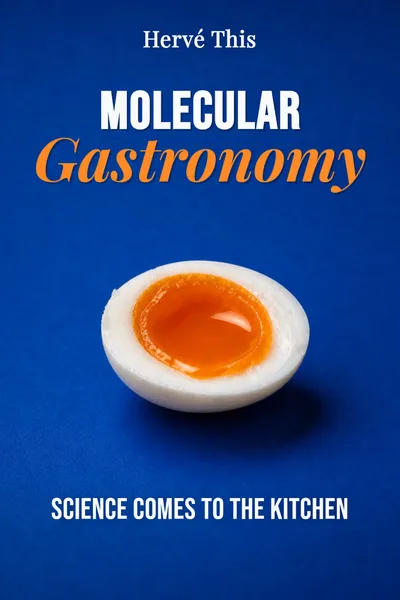
Molecular Gastronomy
Science comes to the kitchen
Description
Somewhere in a Paris kitchen in the late 1980s, a physical chemist named Hervé This decided to make a cheese soufflé exactly the way the recipe told him to, and it collapsed. So he made it again, changing one thing. Then again. He had been collecting what he called culinary "precisions" for a while — those little imperatives that trail every classic recipe like folklore. Add the salt only at the end. Never let the egg whites touch a trace of yolk. Sear the meat to "seal in the juices." Nobody around him could say why these rules existed, or whether they were even true. This, who spent his days measuring things for a living, found that unbearable in the most productive way.
Out of that irritation grew a discipline. In 1988, This and the Oxford physicist Nicholas Kurti gave it a name — molecular gastronomy — and set out to do something oddly overdue: treat the transformations that happen in a pot the way a laboratory treats any other chemical reaction. What is actually happening when a mayonnaise thickens, when a stock clarifies, when a meringue holds its shape? For most of human history, cooks knew how without knowing why. This wanted the why, not to replace the cook, but to see what the cook had been doing all along.
His book, also titled Molecular Gastronomy, is the record of that inquiry — part detective work on grandmothers' maxims, part manifesto for a kitchen equipped like a lab. It is playful and rigorous at once, the work of a man who is both a serious chemist and, in France, a television regular who cooks on camera. What it offers is less a set of recipes than a new pair of glasses for looking at the most ordinary thing we do every day.
The question we’re asking : What happens when someone finally asks why the kitchen's oldest rules work — and tests them?What we’ll see : How a chemist turned the stovetop into an experiment, and what that does to the way we think about cooking.
Table of contents
01 Chapter 1 — The man who put a thermometer in the stockpot
Hervé This is an unusual figure to have founded a field. He is a chemist by training, attached to France's national agricultural research institute, and for years the only person on earth holding a doctorate in molecular gastronomy — a subject he had to invent before he could earn a degree in it. He is also a familiar face on French television, a bestselling author, and the longtime scientific collaborator of Pierre Gagnaire, one of the most inventive chefs of his generation. That combination matters, because it keeps his work from tipping into either dry chemistry or celebrity cooking. He stays in the space between.
The origin story he tells is almost too tidy to be true, but he swears by it. A recipe for a cheese soufflé instructed him to add the egg yolks two at a time. Why two? The recipe did not say, and neither could anyone he asked. So he started writing down these unexplained instructions wherever he found them — in cookbooks, from chefs, from his own mother — and eventually accumulated thousands of them. He called them culinary precisions: the accumulated rules of thumb that cooks pass down as certainties without ever having verified.

02 Chapter 2 — The rules grandmothers swore by, tested one by one
The heart of the book is a long, patient audit of received culinary wisdom, and it is genuinely surprising how much of that wisdom does not survive contact with a thermometer. Take the most famous instruction in the meat cook's catechism: sear the surface to "seal in the juices." It is repeated everywhere, taught in kitchens, printed in recipes. It is also false. Searing does not seal anything; a seared roast loses as much moisture as an unseared one, sometimes more. What searing does do is produce flavor and color through browning reactions on the surface — which is a perfectly good reason to sear. The reason given, though, is a myth.
Other precisions turn out to hold, and the pleasure of the book is that This does not simply debunk. He sorts. Adding a little salt to egg whites, resting a batter, the fear that a single drop of yolk will keep whites from whipping — each gets its day in the experimental dock, and each is either upheld, qualified, or dismissed on evidence rather than authority. The point is not that grandmothers were foolish. Many of their rules encode real chemistry they had discovered through repetition without being able to name it. The point is that we had stopped being able to tell the true rules from the superstitions.
03 Chapter 3 — From dissecting dishes to inventing new ones
Testing the old rules was only ever half of the project. Once you understand what is happening in a dish at the level of molecules, you gain the ability to change it deliberately — and This is not shy about the invention that follows. If a sauce is a suspension of one substance in another, then knowing the physics of that suspension tells you what else could be suspended, and in what. The kitchen stops being a place where you follow instructions and becomes a place where you can predict outcomes and design new ones.
This is where his partnership with Pierre Gagnaire becomes more than decoration. The two worked together for years, This supplying the science and Gagnaire the palate and the daring, producing dishes built on principles rather than precedent. Whipped sauces that behave like nothing in the classical repertoire. Textures achieved by understanding how proteins set or how water holds gas. The laboratory instruments This champions — precise thermometers, controlled water baths, the tools to measure rather than guess — are not there to make food more technological for its own sake. They are there to give the cook the same control a chemist takes for granted.
04 Chapter 4 — Cooking as the last craft without a science
Step back from the soufflés and the seared roasts, and what This is really pointing at is a strange gap in human knowledge. We built a science of the stars before we built a science of the sauce. Astronomy, mechanics, chemistry itself — all were formalized while the transformations happening three times a day in every kitchen on earth remained a folk art, handed down as maxims and defended by tradition. Cooking may be the most universal thing humans do, and it was almost the last thing we subjected to systematic inquiry. That lag is the quiet scandal at the center of his work.
Part of the reason is snobbery about where knowledge is allowed to live. The kitchen was domestic, often women's work, associated with the body rather than the mind, and therefore assumed to contain no real knowledge worth the trouble of testing. This inverts that assumption without sentimentality. The kitchen is not merely a place that could be studied; it is a place dense with unexamined chemistry, a laboratory that has been running continuously for millennia while no one bothered to write down the results.
05 Conclusion
The cheese soufflé that started it all was never really about the soufflé. It was about a chemist who could not accept an instruction he could not explain, and who had the odd persistence to spend a career explaining it. Out of thousands of collected precisions, tested one at a time, Hervé This assembled something that had not existed before: a science of what happens when we cook, built alongside chefs rather than against them, and delivered with the lightness of a man who genuinely enjoys eating.
Related books