Conceptual Physics
Teaching physics without equations
Description
There is a particular kind of dread that attaches to the word physics. For a lot of people it arrives in high school, sits down next to a whiteboard full of symbols, and never quite leaves. The formulas come first, the meaning comes later if at all, and by the time the semester ends the whole thing has fused into a single memory of being told that a falling object accelerates at 9.8 meters per second squared without ever being told why anyone should care. Paul Hewitt knew that dread from the inside. Before he taught physics, he flunked it.
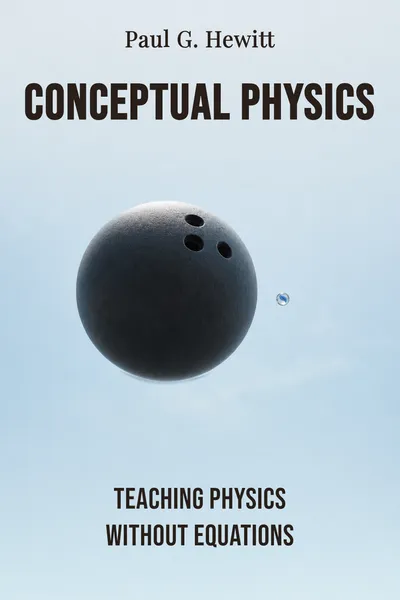
Hewitt was a sign painter and an amateur boxer before he was a professor. He came to physics late, as an adult, and the first time around it beat him. What rescued him was not a better memory for equations but a teacher who let him see the ideas before doing the math — who let him feel why a bowling ball and a marble hit the ground together before asking him to prove it. That reversal became the whole of his career. In 1971 he turned it into a textbook called Conceptual Physics, and it went on to become the best-selling introductory physics book in America, taught for decades, revised again and again, most recently into a Ninth Edition that folds video and interactive media into the same idea he started with.
The pitch sounds almost too simple: teach the concepts first, and save the equations for people who want them. But that small inversion carries a claim about who physics is for, and what it means to actually understand the world you move through every day rather than merely compute it.
The question we’re asking : Can physics be genuinely taught — not just described — without leading with the mathematics?What we’ll see : How one teacher's failure became a method, and what it costs and gains to put understanding ahead of the equation.
Table of contents
01 Chapter 1 — The student who learned physics after failing it
Paul Hewitt did not take the standard route into science. He grew up in Massachusetts, boxed as a young man, and made his living for years as a commercial sign painter, lettering storefronts and billboards by hand. Physics came to him in his late twenties, when he enrolled in college and ran straight into the wall that so many students hit: a course built around symbols, unit conversions, and problem sets, with the actual behavior of the physical world buried somewhere underneath. He did badly. The experience could have ended there, the way it ends for millions of people who conclude they are simply not science people.
What changed things was a friend and mentor, the physicist Burl Grey, whom Hewitt had worked alongside painting signs. The two of them argued about tension in the ropes holding their scaffolding, and Grey walked him through the forces at play not with formulas but with reasoning about pushes and pulls he could feel in his own hands. Hewitt describes the moment as a kind of door opening. The physics was suddenly about something — about the rope, the weight, the way the load shifted — rather than about manipulating letters on a page.

02 Chapter 2 — Understanding before the number
The core move of the book is easy to state and surprisingly radical in a physics classroom: get the concept clear first, then bring in the equation as a shorthand for something already understood. Hewitt treats a formula not as the starting point of learning but as its compression — a compact way of writing down a relationship you can already see. Newton's second law, force equals mass times acceleration, is not offered as a rule to memorize but as the written form of an intuition the reader has been led to build about how hard it is to change the motion of heavy things.
To get there, Hewitt relies on concrete scenes rather than abstract statements. Why does a heavy truck and a light car, dropped together, fall at the same rate? Why do you feel pressed into your seat when a plane accelerates down the runway? Why does a spinning skater speed up when she pulls her arms in? The book keeps returning to situations a reader has actually lived through, and asks them to reason about what will happen next. The famous device is the check-your-neighbor question, a prediction posed mid-explanation that a student answers before the answer is given.
03 Chapter 3 — The order that changed the sequence
Hewitt did not only reorder concept and equation; he reordered the physics itself. Traditional introductory courses often open with kinematics — the mathematical description of motion — and only later reach the forces that cause it. Conceptual Physics tends to lead with mechanics grounded in Newton's laws, in the felt reality of pushes and pulls, before moving outward through properties of matter, heat, sound, light, electricity, and eventually into atomic and relativistic ideas. The sequence is built so that each topic rests on a picture the reader has already formed, not on a technique they were made to master first.
This is where the newer editions earn their keep. The Ninth Edition arrives not as a static book but as a package: the printed text is stitched together with video demonstrations, animations, and interactive tutorials. A page describing why a heavier object doesn't fall faster can now point to a clip of Hewitt himself dropping objects, or to a simulation a student can nudge and rerun. The demonstration, long the beating heart of a good physics lecture, gets carried into the reading itself.
04 Chapter 4 — A physics for people who won't become physicists
Step back from the classroom and the deeper argument of the book comes into view. Physics education has long served a double function that mostly goes unexamined. It trains the small minority who will go on to become scientists and engineers, and it filters everyone else out, often early, often for good. The equation-first course does both jobs at once, and the filtering half tends to win: it decides who counts as a science person and quietly excuses the rest from ever understanding the machinery of the world they live in.
Hewitt's method rests on a refusal of that split. His premise is that the concepts of physics — inertia, energy, the fact that momentum is conserved, why the sky is blue — are part of general literacy, not specialist property. A citizen who grasps energy conservation reads claims about power grids and diets and perpetual-motion schemes differently. Someone who understands radiation and half-lives evaluates a news story about a reactor differently. The point is not to produce physicists but to produce people who are not helpless before the physical claims that shape public life.
05 Conclusion
The book that began as one man's classroom notes has outlasted most of the courses that ignored it, running through edition after edition and carrying the same conviction it started with: that a person can genuinely understand why the world behaves as it does before, and sometimes without, doing the arithmetic. The Ninth Edition's video and interactive layers are not a departure from that idea but its fullest expression — the demonstration Hewitt used to stage with his own hands, now available on the page.
Related books