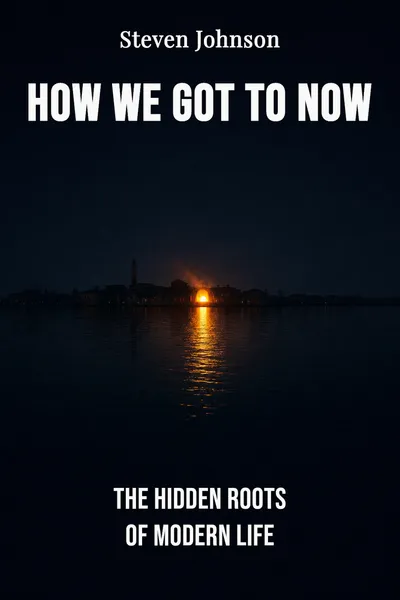
How We Got to Now
The hidden roots of modern life
Description
Somewhere around the year 1200, glassmakers fleeing a series of fires in Venice were relocated to the nearby island of Murano, where their furnaces couldn't burn down the city. Penned together on that small strip of land, competing and copying and refining, they turned a rough utilitarian material into something clear enough to see through. Nobody in that workshop was trying to invent the microscope, the telescope, the internet, or the selfie. They were trying to make better drinking cups. Yet the line from those Murano furnaces runs, improbably but traceably, straight to the camera in our pocket and the fiber-optic cable under the ocean.
That kind of line is what Steven Johnson chases in How We Got to Now, published in 2014 alongside a PBS television series. Johnson is a science-and-technology writer with a taste for the long view, and here he picks six everyday things — glass, cold, sound, cleanliness, time, and light — and asks where they actually came from. The answer is never a single heroic inventor having a single flash of genius. It's a tangle: a small change in one field nudges a distant one, which nudges another, until the world looks nothing like it did.
He has a name for this. He calls it the hummingbird effect — the way an innovation in one domain triggers changes in fields that seem to have nothing to do with it, the way the evolution of flowers ended up reshaping the wing of a bird. It's a gentle idea with sharp consequences, because it upends the way we usually tell the story of progress.
The question we’re asking : Where do the everyday things around us actually come from, and why does no single inventor ever get the whole credit?What we’ll see : How six ordinary innovations quietly rewired everything downstream of them, and why Johnson thinks history works less like a relay race than a web.
Table of contents
01 Chapter 1 — The book that follows the hummingbird
Johnson opens with a puzzle from nature. Flowers evolved to attract pollinators; in response, one bird — the hummingbird — developed the ability to hover and beat its wings in a figure-eight pattern, a piece of aeronautical engineering no other bird performs. The point is that a change in plant reproduction reshaped the skeleton of a bird. Neither side planned it. Johnson borrows this as his organizing metaphor: real innovation rarely stays in its lane, and its most important effects usually land somewhere its inventors never looked.
This is a deliberate rejection of the great-man version of history, the one where Gutenberg or Edison sits alone in a room and hands the future to the rest of us. Johnson isn't dismissing individual genius. He's saying it's the wrong unit of analysis. Ideas arrive when the surrounding conditions are ready for them, which is why the same invention so often appears in several places at once. He leans on the biologist Stuart Kauffman's phrase, the adjacent possible: at any moment, only certain next steps are actually reachable, and progress means opening one door that reveals a corridor of new doors nobody could see before.

02 Chapter 2 — A shard of glass, a whole modern eye
Glass is Johnson's first and clearest case, because its ripple effects are almost comically far-reaching. It begins, in his telling, with the silica of the Egyptian and later Roman world, and takes its decisive turn with those Venetian glassmakers exiled to Murano in 1291. Confined together, they iterated fast, and one of them, Angelo Barovier, worked out how to make cristallo — glass clear enough to be genuinely transparent rather than murky and tinted. A material you could truly see through changes what seeing itself can do.
The clear lens is the hinge. Ground into spectacles after the spread of printing had revealed how many people needed reading help, glass gave humans corrected vision. Ground more ambitiously, it gave them instruments. In the early 1600s Galileo pointed a telescope at the sky and demoted the Earth from the center of creation; a few decades later Antonie van Leeuwenhoek and Robert Hooke pointed the microscope the other way and revealed a universe of cells and microbes we'd been sharing our bodies with the whole time. Two pieces of shaped glass, and the scale of reality expanded in both directions.
03 Chapter 3 — Cold, clean, and the death of distance
If glass is about seeing, Johnson's chapters on cold and cleanliness are about escaping the limits of place and body. Cold begins with an eccentric New England entrepreneur named Frederic Tudor, who in the early 1800s decided to ship ice cut from frozen Massachusetts ponds to the tropics. Almost everyone thought he was mad, and for years he nearly went bankrupt — the first shipments melted, the buyers didn't exist yet, the debts piled up. But he was chasing something real: the ability to move cold around the world, and with it, to preserve what would otherwise rot.
Artificial refrigeration finished what Tudor started. Once you could manufacture cold rather than harvest it, you could freeze meat, store food, and — in one of Johnson's favorite examples — make cities like Chicago and later the American South and Southwest habitable at scale. Air conditioning didn't just cool rooms; it redrew the map of where people live and, through the resulting population shifts, arguably tilted the balance of American politics toward the Sun Belt. Cold also gave us frozen food, and the frozen-food chain fed the modern supermarket, which in turn reshaped how a whole society eats.
04 Chapter 4 — The networks nobody drew on purpose
Step back from glass and cold and clean water and a pattern emerges that Johnson clearly cares about more than any single gadget. Innovation is a network phenomenon. The reason the same breakthroughs keep appearing simultaneously in different places — the reason so many inventions have contested paternity — is that they aren't really the property of one mind. They're what becomes reachable once the surrounding pieces are in place. The adjacent possible opens for everyone at once, and someone walks through.
This has a humbling consequence for how we assign credit and blame. The people who set these chains in motion usually had no idea what they were starting. The Murano glassmakers weren't building the internet. Tudor wasn't trying to flip American electoral maps. The engineers who purified drinking water weren't chasing the population boom their success would enable. Consequence outran intention every single time, which means the argument of the book is not that clever individuals steer history but that history is largely made of side effects.
05 Conclusion
Return to Murano, and the glassmakers hunched over their furnaces trying to outdo each other on drinking cups. Nothing about that scene announces the microscope or the fiber-optic cable, and that's exactly Johnson's point. The things that most reshaped modern life didn't arrive as thunderclaps of genius but as small refinements whose consequences leaked, generation after generation, into fields their makers never imagined. Glass, cold, sound, clean water, time, and light are the quiet infrastructure we walk on without noticing.
Related books