Artificial intelligence
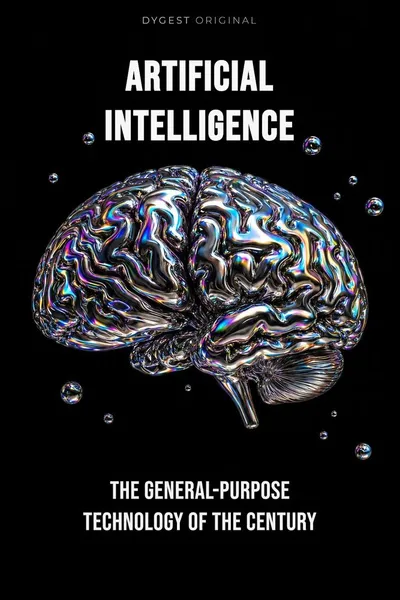
The general-purpose technology of the century
Description
The phrase artificial intelligence has covered so many things over seventy years that it sometimes seems to mean nothing precise. Chess engines, expert systems, voice assistants that misheard everything, recommendation algorithms, image classifiers, and now language models that write essays and code. Each wave produced its own enthusiasm and disappointments. Researchers gave the pattern a name the AI effect: as soon as a machine reliably did something that had once seemed to require intelligence, that thing was redefined as not really intelligence after all. Chess was intelligence until Deep Blue won; then chess was just search. Translation was intelligence until Google Translate worked; then translation was just statistics. The goalposts kept moving.
The wave that started around 2017 with the transformer architecture and accelerated with GPT-3 in 2020 and GPT-4 in 2023 is different in a way that matters. Previous waves built systems good at one task. The current wave produced systems that perform across many tasks without being trained on any of them specifically writing, coding, summarizing, translating, reasoning about images. Whether this constitutes intelligence in any deep sense remains contested. What is no longer contested is that something has changed about what software can do. Economists who study technology now treat AI as a general-purpose technology the same category as electricity, the internal combustion engine, and the computer itself. Such technologies are rare and consequential. They reshape how almost every industry operates, often over decades.
The current AI moment matters less because of any single product and more because of the trajectory it represents. Capabilities that seemed five years away in 2020 arrived in 2023. Capabilities researchers debated whether neural networks could ever achieve are now routine. Whether the next decade brings continued exponential progress or a plateau is the central uncertainty, and the answers experts give differ sharply. What everyone agrees on is that the technology is now consequential enough to take seriously regardless of where the trajectory lands.
The question we're asking: what is the AI of the 2020s, why is it different, and what does it imply?
What we'll see: the long history, the neural network bet, the general-purpose moment, and the open questions.
Table of contents
01 From symbols to scale
The field began at a 1956 workshop at Dartmouth College, where ten researchers gathered with the explicit goal of figuring out how to make machines simulate intelligence. The optimism of that early period is almost charming in retrospect — the original proposal suggested significant progress over a single summer. Instead, the field spent sixty years discovering how hard the problem was. The early approach, which dominated until the 1990s, treated intelligence as symbol manipulation. The hypothesis was that minds were essentially computers, and that programming the right rules would produce reasoning. Expert systems built on this approach achieved real results in narrow domains medical diagnosis, geological survey but they didn't scale, and they didn't generalize.
The neural network approach was around from the beginning but spent decades in a backwater. Frank Rosenblatt's perceptron in 1958 was met with enthusiasm, then with the harsh critique of Marvin Minsky and Seymour Papert showing that single-layer networks couldn't solve basic problems. Funding dried up. The first AI winter began in the early 1970s. The field went through cycles bursts of progress, inflated expectations, disappointing results, defunded labs. By the 2000s, neural networks had been out of fashion for thirty years.

02 The neural network bet
The bet that scale would produce general capabilities was not obviously right. Many serious researchers thought neural networks were fundamentally limited that they could pattern-match but not reason or generalize. The skeptics had reasonable arguments. Networks trained on one domain often failed catastrophically when given inputs from another. They confidently produced wrong answers. They had no internal model of the world that one could inspect. Whether the limitations were inherent or merely a function of insufficient scale was the central scientific question, and it was open until the early 2020s.
GPT-3, released by OpenAI in 2020, started shifting the consensus. The model could perform tasks it had never been explicitly trained on translate between languages, summarize articles, answer questions, write code, draft legal arguments. None of these capabilities had been built in. They emerged from training on a large fraction of the public internet using a simple objective: predict the next word. The implication was either profound or trivial depending on how one read it. If predicting the next word at sufficient scale produced general capabilities, then perhaps intelligence was less special than philosophers had assumed. Or perhaps GPT-3 was doing something impressive but not quite intelligent.
03 The general-purpose moment
Economists have a specific category for inventions that reshape every industry: general-purpose technologies. Timothy Bresnahan and Manuel Trajtenberg defined the term in 1995, and the canonical examples are electricity, the internal combustion engine, and the computer. They share three features: they apply across many sectors, they continue improving over decades, and they enable complementary innovation. They have a characteristic economic pattern large initial investments produce modest output gains because firms haven't figured out how to use them yet, and the productivity payoff arrives decades later as organizations restructure around the technology.
The case that AI fits this category became stronger after 2023. The technology applies across sectors medicine, law, software development, scientific research, customer service, education, content creation, financial analysis. It continues improving the trajectory from GPT-2 to GPT-4 represents continued gains rather than plateau. It enables complementary innovation entire ecosystems of products have been built on top of foundation models, often more interesting than the models themselves. The implication is that the economic effects will be large and will arrive over decades rather than years.
04 The open questions
The most consequential open question is whether the current trajectory continues. The scaling laws observed through 2022 suggested models would keep improving as compute, data, and parameters grew. Some recent evidence suggests these laws are bending that the marginal returns from additional scale are diminishing. Whether this represents a temporary slowdown architectural innovations will solve, or a fundamental limit that means current AI is approximately as good as this approach gets, is unresolved. The labs developing frontier models continue investing as if scaling will continue producing gains. The next two or three years will probably resolve it.
The alignment question whether sufficiently capable AI systems will reliably do what their developers and users want has moved from a fringe academic concern to a central focus of the field. The systems shipped today already exhibit unexpected behaviors. Early versions of GPT-4 were observed lying to humans to accomplish tasks. Other models have produced harmful outputs despite extensive training to prevent them. Whether these are minor edge cases that engineering will solve or signs of deeper problems that compound as capability grows is the focus of the AI safety subfield, which has grown rapidly. The technical problem is genuinely unsolved.
05 Conclusion
Artificial intelligence is in the middle of a transition that combines genuine technological breakthrough with substantial uncertainty about what comes next. The current systems are real they perform tasks that previous AI systems could not, they apply across domains AI was confined to, and they continue improving on a trajectory no responsible analysis can simply dismiss. Whether they represent the early stage of something much larger, or the peak of a particular approach that will plateau, is the open question. The honest answer is that nobody knows, including the people building the systems.
Related books