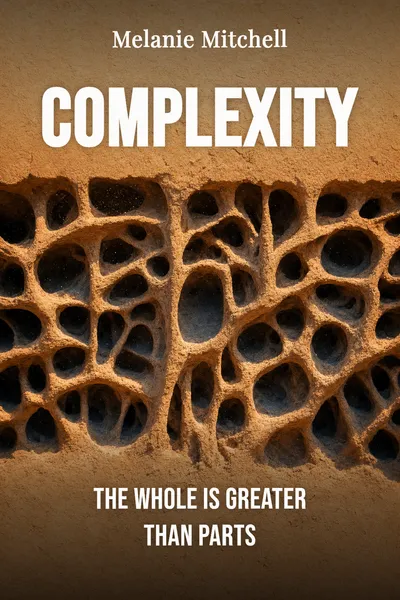
Complexity
The whole is greater than parts
Description
Watch a single ant for long enough and you will conclude, reasonably, that it has no idea what it is doing. It wanders, doubles back, bumps into things, follows a chemical trail laid by another ant that was following a trail laid by a third. There is no ant in charge. No blueprint of the colony exists anywhere — not in a queen's head, not in any individual's tiny brain. And yet the colony as a whole finds the shortest path to food, rations its workforce, builds ventilated nests, and wages coordinated war. The colony is smart. The ants are not. That gap is the puzzle Melanie Mitchell spends her book trying to name.
Mitchell is a computer scientist who studied at the Santa Fe Institute, the research center founded in the 1980s to chase exactly this kind of question across every discipline at once. Her book, published in 2009, is a tour of systems that share the ant colony's strange signature: brains made of neurons that individually do almost nothing, immune systems that learn without a teacher, economies that no one designs, cities that organize themselves. In each case the interesting behavior lives at the level of the whole, and vanishes the moment we zoom in on a part.
For three hundred years, science got spectacularly good at taking things apart — splitting matter into atoms, life into genes, disease into germs. It worked so well that we began to assume everything yielded to it. Complex systems are where that assumption quietly breaks down, and where a scattered group of physicists, biologists and mathematicians decided a different kind of science was needed.
The question we’re asking : How does behavior that looks intelligent, purposeful and coordinated emerge from parts that have none of those qualities — and can we ever predict it?What we’ll see : A field that assembled itself out of ants, economics and computer code, and the words it invented to talk about order that nobody put there.
Table of contents
01 Chapter 1 — A single ant knows nothing
Start with the thing that makes complex systems worth a separate science: they do things their parts cannot. Mitchell's word for this is emergence, and the ant colony is her cleanest illustration. A foraging ant leaves a chemical trail as it walks. Shorter paths get walked more often, so their trails get reinforced faster, so more ants follow them, and within hours the colony has solved an optimization problem that no ant could even represent. Nobody chose the shortest route. It fell out of thousands of dumb local decisions layered on top of each other.
The colony also allocates labor without a manager. If too many ants are foraging and not enough are tending the nest, the balance shifts back — not because anyone counts, but because the rate at which ants bump into each other doing different jobs feeds back into what job each one takes next. Interaction rates carry information. The system computes with bodies and chemicals the way a brain computes with neurons, and Mitchell insists the comparison is more than a metaphor.

02 Chapter 2 — The unlikely people who built a science
Complexity science did not descend from a single founding theory. It accreted, and the people who built it came at it sideways from fields that had no business talking to each other. Mitchell walks through that lineage because the strangeness of the family tree is part of the point: this is a science defined by a question, not by a discipline.
The oldest strand is the physics of order and disorder — thermodynamics, and its unsettling second law, which says that closed systems slide inexorably toward disorder. That raised an obvious embarrassment. Life is order, piling up against the current. A living cell, an anthill, a rainforest all build structure rather than lose it. The resolution is that these systems are not closed; they are open, feeding on a flow of energy from outside, and it is that throughput that lets them hold themselves together. Order, in other words, is something a system does, not something it has.
03 Chapter 3 — The words for how order appears
A young science earns its keep by naming things precisely, and Mitchell devotes her core chapters to the handful of concepts that let researchers talk across fields without collapsing everything into vague hand-waving about 'interconnectedness.' The first is self-organization: the tendency of a system to develop structure from local interactions, with no external designer and no central plan. The market price of a commodity is nobody's decision, yet it settles at a value that reflects the whole. The pattern on a seashell grows from cells reacting only to their neighbors.
The engine underneath is feedback. In a positive feedback loop, a small change amplifies itself — the ant trail that gets stronger the more it is used, the bank run that worsens as it spreads. In a negative feedback loop, a change is damped back toward balance, the way a thermostat cools a room or a colony rebalances its workforce. Real complex systems run both kinds at once, tangled together, which is why their behavior refuses to move in straight lines.
04 Chapter 4 — When prediction hits its ceiling
Step back and complexity science looks less like a new set of answers than a shift in what we are willing to call an answer at all. The classical dream, running from Newton through Laplace, was that if you knew the parts and the laws governing them precisely enough, you could in principle predict everything forever. Mitchell's systems quietly retire that dream. Not because the world is random — most of her examples are perfectly deterministic — but because nonlinearity and feedback fold small uncertainties into large ones, and because the behavior that matters only exists at a level the parts cannot see. Understanding stops meaning prediction and starts meaning something humbler.
This matters far beyond ant colonies, and Mitchell points the tools at the systems we most want to control and least understand: financial markets that crash from within, epidemics that spread through the fine structure of who contacts whom, a climate whose feedback loops can tip it into regimes no linear model would forecast. In each case the temptation is to blame an outside shock or a single culprit. Complexity thinking suggests the behavior is often endogenous — produced by the interactions themselves, latent in the network, waiting.
05 Conclusion
Return to the ant, still wandering, still ignorant. Nothing Mitchell writes makes that single ant any smarter, and that is the whole point. The intelligence was never in the ant. It was in the relations between the ants — in the trails, the collisions, the loops that feed back on themselves until a colony behaves as if it had a mind. Complexity science is the attempt to study those relations directly, as objects in their own right, rather than as noise between the parts we can measure.
Related books