Greek and Roman Artillery
Ancient siege weapons decoded
Description
Somewhere in the third century BC, in the arsenals of Alexandria and Rhodes, engineers were doing arithmetic that would not look out of place in a modern workshop. They were sizing catapults. To hit a given range with a stone of a given weight, they calculated the diameter of the hole through which the twisted spring passed — and from that single number, everything else about the machine followed. The frame, the arms, the ropes, the recoil. One measurement dictated the whole weapon. This was not folklore passed hand to hand. It was written down, revised, and taught.
For most of the intervening two thousand years, that knowledge sat half-buried in a handful of difficult Greek and Latin texts by writers named Heron, Philon, Vitruvius, and a few others — technical manuals nobody could quite reconstruct from. The machines themselves rotted. Wood, sinew, hair and rope leave almost nothing in the ground. What we have of ancient artillery is, overwhelmingly, paper: descriptions, formulas, arguments between engineers who disagreed about the best proportions. The weapon exists mainly as instructions for building it.
E. W. Marsden's Greek and Roman Artillery is the scholarship that made those instructions legible again — translating the treatises, checking the mathematics, and asking what these people actually built. It treats the catapult not as a curiosity but as a genuine engineering tradition, one that ran experiments, standardised parts, and got measurably better over three centuries. Reading it, the ancient siege engine stops being a movie prop and becomes something more demanding: a machine designed by number.
The question we’re asking : How do we know how ancient catapults were built, when almost none survive?What we’ll see : How a lost technology is reconstructed from the manuals its engineers left behind — and what those manuals reveal about ancient science.
Table of contents
01 Chapter 1 — The engineer who wrote it all down
The first thing Marsden has to establish is that ancient artillery came with a literature. It was not a trade of illiterate carpenters guarding secrets. From roughly the mid-third century BC onward, engineers wrote treatises on how to build these machines, and enough of that writing survived — through Byzantine copyists and Arabic transmission — for a modern reader to work with. The names recur: Ktesibios and Philon of Byzantium in the Hellenistic period, Heron of Alexandria somewhat later, and on the Roman side Vitruvius, whose famous book on architecture devotes real space to catapults.
These texts are not easy company. They were written by specialists for specialists, they use terms whose meaning had already drifted by late antiquity, and the surviving manuscripts are riddled with copying errors, especially in the numbers — which is exactly where accuracy matters most. A scribe who miscopies a poem produces a bad line. A scribe who miscopies a proportion produces a machine that cannot be built. Marsden's work is partly detective work: reconstructing what the original figures must have been by checking them against each other and against the geometry they imply.

02 Chapter 2 — Torsion, or how the spring became a weapon
The heart of the whole subject is a single idea: torsion. Early catapults, the ones that appeared around Syracuse in the early fourth century BC under Dionysius, worked like oversized crossbows — a bow of composite construction, bent by a mechanism, storing energy in the flex of the material. That was the belly-bow, and it had a ceiling. There is only so much energy you can put into a bent bow before it snaps or stops improving.
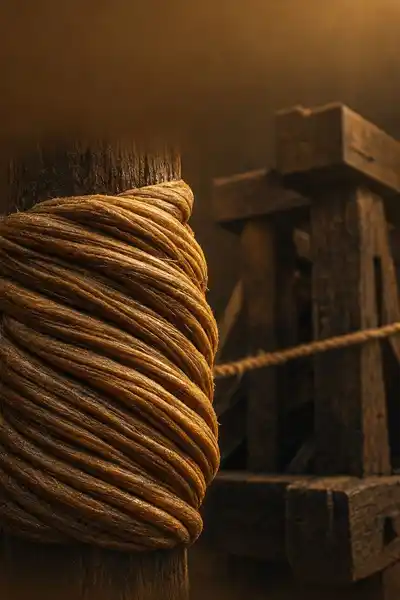
The breakthrough was to abandon the bow entirely and store energy in twisted rope instead. In a torsion engine, each arm is not part of a bow at all; it is planted in a thick vertical skein of springy cord, and the whole skein is wound to enormous tension. Pulling the arm back twists the skein harder still; releasing it lets the skein snap the arm forward. The energy lives in the twist. This is why the material of the springs mattered so much, and why Marsden pays close attention to it: the cord was made of sinew or of hair — women's hair was prized, and cities under siege are recorded stripping it for the arsenals — because those fibres store and return torsional energy better than plant rope.
03 Chapter 3 — The formula hidden in the bore
Here is where the ancient engineers do something that still surprises. They reduced the design of an entire stone-throwing catapult to a single governing dimension: the diameter of the hole in the frame through which the torsion skein passed. Get that number right, and the rest of the machine scaled from it by fixed ratios — the length of the arms, the size of the frame, the weight the engine could throw. Everything was expressed as a multiple of the bore.
The rule for stone-throwers was a formula for that diameter based on the weight of the projectile. Because the calculation involved a cube root, and cube roots are awkward, the treatises even preserve a method for approximating it — a practical dodge for engineers who needed a workable answer in the field rather than a proof. For bolt-shooters the governing measure was tied instead to the length of the bolt. In both cases the principle is the same: identify the one variable that drives performance, and standardise everything else around it.
04 Chapter 4 — What the treatises actually preserve
Step back from the timber and the sinew, and the deeper subject of Marsden's work comes into view: what it means for a whole technology to survive as text. Nearly every physical catapult of the ancient world has vanished — a few metal fittings, some torsion-frame washers dug from Roman frontier sites, and little else. If the treatises had not been copied, recopied and eventually printed, we would know that catapults existed and almost nothing about how they worked. The knowledge outlived its objects by living in language.
That fact reframes ancient warfare itself. It is tempting to imagine pre-modern armies as masses of muscle and improvisation, with cleverness reserved for a few named geniuses. The artillery treatises say otherwise. They show a settled profession with its own vocabulary, its own quarrels, its own standard proportions, and its own memory carried in writing rather than only in the hands of craftsmen. Ancient siege war had an engineering literature in the full sense — reference works you could consult to build a weapon you had never seen.
05 Conclusion
The catapults are gone. What Marsden hands back is the thing that made them possible: the reasoning, cleaned of copying errors and set out so that the design system underneath is visible again. A stone-thrower sized from the diameter of its own spring-hole, arms driven by twisted hair, proportions fixed to a standard an arsenal could reproduce — all of it recovered from a few battered manuscripts and the geometry hiding inside their numbers.
Related books