
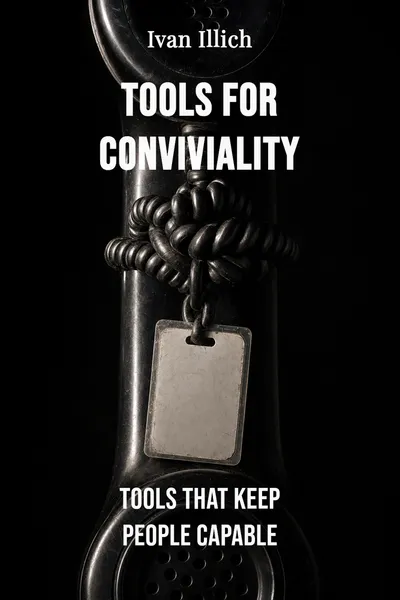
Tools for Conviviality
Tools that keep people capable
Description
In 1973, an Austrian-born thinker named Ivan Illich published a short, dense book called Tools for Conviviality. He had spent years watching institutions he admired — schools, hospitals, highways — grow past the point where they helped anyone. A former priest who had walked away from the Church, Illich had a gift for turning a comfortable assumption inside out. His question in this book was disarmingly simple: at what point does a tool stop serving us and start running us? He was writing at the height of the postwar faith in growth, when more roads, more medicine and more schooling looked like unambiguous progress. He suspected the opposite.
The word he chose, conviviality, sounds like dinner parties. He meant something harder-edged. A convivial tool is one that leaves the person using it in charge — free to do the work in their own way, for their own reasons, without a certificate or a corporation standing between them and the task. A telephone is convivial in that sense; a subway is not. Illich argued that every tool crosses two thresholds as it grows. Past the first, it stops being useless. Past the second, it stops being tolerable.
That second threshold is where the book lives. Illich claimed that modern medicine, modern transport and modern schooling had all sailed past it — that they had reached a scale where they produced the very miseries they promised to cure. Sicker patients, slower cities, duller minds. It reads as provocation, and it was meant to. But underneath the polemic sits a careful argument about what tools do to the people who use them, and about who gets to decide when enough is enough.
The question we’re asking : When does a tool that was built to help us quietly turn into one that governs us instead?What we’ll see : How Illich draws the line between tools that keep people capable and tools that make them dependent — and why he thought most modern institutions had crossed it.
Table of contents
01Chapter 1 — The two watersheds of a good tool
Illich builds the whole book on a picture: a tool rising through two watersheds, two points where its meaning flips. He borrowed the image from the history of modern medicine, which he read as the clearest case. Before roughly 1913, he argued, a patient walking into a doctor's office had, on average, less than even odds of being helped rather than harmed. Medicine was mostly ceremony. Then, over a few decades, real advances arrived — antisepsis, vaccines, antibiotics — and medicine crossed its first watershed. It began, genuinely and measurably, to save lives. This is the watershed everyone celebrates. It is real, and Illich never denies it.
His interest is in what happens next. A tool that works tends not to stop at working. It expands, professionalizes, builds institutions around itself, and keeps growing on the momentum of its early success. Somewhere in that expansion it crosses a second watershed, less visible than the first, where the tool starts to defeat its own purpose. Medicine past this point, Illich argued, produces its own diseases — infections caught in hospitals, harm done by unnecessary treatment, whole populations taught to feel that their bodies are unmanageable without professional supervision.

02Chapter 2 — What a tool does to the people who use it
The distinction Illich cares about most is not between simple tools and complex ones. A convivial society, he insists, is not one that has thrown away its machines. The distinction is about what a tool does to the person holding it. A convivial tool extends the reach of the individual — it lets someone act on their own intention, in their own way, and stop when they choose. An industrial tool, by contrast, tends to enroll the user into a system that dictates the terms. The question is always the same: who is in charge, the person or the apparatus?
His examples are deliberately homely. A bicycle is convivial. Anyone can learn to ride one, repair it with cheap parts, and go where they like without a license, a fare, or a timetable. It multiplies human power without subordinating the rider to an institution. A telephone, at least the one he knew, was convivial too: you could say anything you liked down the line, and the network did not decide who you were allowed to become. These tools leave a wide margin of freedom, and they leave it to everyone more or less equally.
03Chapter 3 — The second watershed, where the cure turns
Illich gives the reversal a name he uses throughout the book: counterproductivity. It is the state a tool reaches when, past its second watershed, adding more of it produces less of what it was supposed to deliver. More medicine yields more sickness. More traffic engineering yields more congestion and slower journeys. More schooling yields more people convinced they are uneducated. The tool has not broken down; it is working exactly as designed, and the design has turned against its own purpose.
The mechanism is not mysterious. A tool that has crossed the second watershed starts consuming the very thing it was meant to provide. The medical system swallows so much of a society's wealth and attention that ordinary health — clean water, decent food, room to rest — gets crowded out by the fight against disease. The transport system built to save time ends up demanding so much time that the average speed of the whole society, once you count the hours worked to pay for the machines, collapses toward walking pace. Each system generates the scarcity it then promises to relieve.
04Chapter 4 — Naming the limits before they name us
Step back from the individual cases and Illich's real quarrel comes into view. It is not with doctors or engineers or teachers. It is with the assumption underneath all of them — that more of a good thing is always better, that growth has no natural stopping point, that a society need never ask how much is enough. That assumption, he argues, is what carries every useful tool past its second watershed. Convivial tools are simply tools kept below that threshold on purpose, by a society willing to decide where the threshold lies.
This makes the book, for all its talk of bicycles and telephones, a political argument rather than a technical one. Limits, in Illich's view, cannot be discovered by experts or optimized by the market. They have to be chosen, deliberately and publicly, by the people who will live inside them. Deciding that cars may not exceed a certain speed, that medicine may not consume more than a certain share of a community's life, that no profession may hold a monopoly on a basic human capacity — these are not engineering calculations. They are acts of self-government, and they are exactly the acts modern societies have taught themselves to avoid.
05Conclusion
Illich wrote Tools for Conviviality as the boom years were peaking, when almost no one wanted to hear that a good institution could grow itself into a harm. His two watersheds were a way of holding two truths at once: that modern tools have genuinely helped us, and that the same tools, past a hidden point, begin to take back more than they give. He never asked anyone to smash the machines. He asked that a society learn to recognize the second watershed and refuse to cross it — a far harder discipline than building the tools in the first place.
Related books