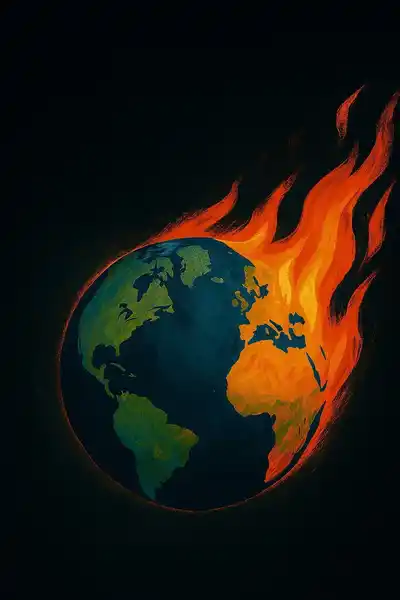
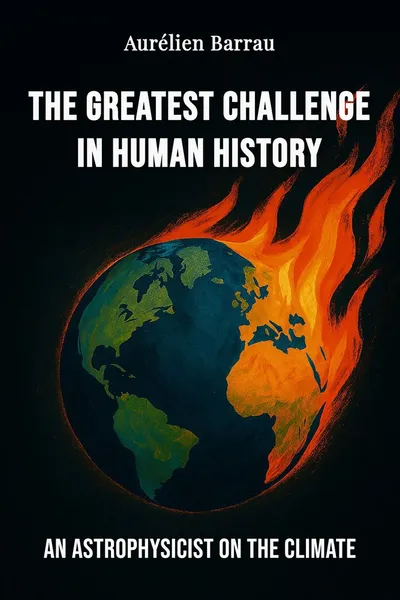
The Greatest Challenge in Human History
An astrophysicist on the climate
Description
Aurélien Barrau spends his professional life on questions that make the ecological crisis look almost intimate. He is an astrophysicist at the French national research center, working on black holes, multiverses, the deep structure of space and time. His usual scale is the cosmos — billions of years, distances no human will ever cross. And yet, in recent years, this is the man who has taken to lecture halls and cameras to say, with something close to alarm, that the survival of the living world is the most serious thing he has ever had to think about.
The book that carries that conviction is blunt from its title onward: he calls the ecological situation the greatest challenge in human history. Not one of many. The greatest. It is an unusual sentence coming from someone who studies the birth of the universe, and Barrau knows it. His argument is precisely that the scientific temperament — the habit of reading numbers without flinching, of refusing comforting stories — leaves no honest alternative. When the measurements are this clear, he suggests, staying calm is not lucidity. It is denial with better manners.
What gives the book its charge is the collision between two ways of speaking. There is the cold register of physics, where a curve is a curve and a threshold is a threshold. And there is the register of a man who has decided that neutrality, at this point, would be a form of complicity. Barrau refuses to separate the two. He treats the ecological emergency as a physical fact and a moral summons at once, and he asks what it would actually take to meet it.
The question we’re asking : What happens when someone trained to read the universe turns that same unblinking gaze on the state of the living world?What we’ll see : How a physicist's habits of measurement reframe the ecological emergency, and where that reframing leads once we follow it honestly.
Table of contents
01Chapter 1 — The physicist looks up from the equations
Barrau likes to remind readers where he normally stands. His field is fundamental physics, the study of things so large or so small that everyday intuition is useless. It is a discipline built on distrust of the obvious — you check, you measure, you let the data overrule what you wish were true. That training, he argues, is exactly what makes the ecological data impossible for him to set aside. A physicist who could face a black hole's mathematics but not a temperature curve would be a strange kind of scientist.
And the curves, read plainly, are not reassuring. Global average temperatures climbing, ice sheets thinning, species disappearing at rates the fossil record reserves for genuine mass extinctions. Barrau's point is not to recite the figures as spectacle but to insist that they be treated the way any scientist treats evidence: as constraints on what we are allowed to believe. We do not get to negotiate with a measurement because it frightens us.

02Chapter 2 — Not one crisis but the ground giving way
Much public conversation treats the climate as a single dial to be adjusted: bring carbon down, and the problem is managed. Barrau, thinking like a physicist about systems, resists that framing. Warming is one symptom among several of a deeper disturbance — the accelerating loss of biodiversity, the collapse of insect populations, the exhaustion of soils, the acidification of oceans. These are not separate files. They are the same system coming apart along several seams at once.
He is particularly insistent about the living world, the biosphere itself. A stable climate is not much use on a planet where the web of species that makes it habitable has unraveled. Barrau points to what researchers call the sixth mass extinction, the disappearance of life at a pace far above the natural background rate. For a scientist accustomed to cosmic timescales, the speed is what stuns him: geological events playing out inside a single human lifetime, driven by a single species.
03Chapter 3 — Why growth cannot be the answer to a problem growth created
The reassuring version of the future says technology and continued economic expansion will solve this: cleaner energy, smarter efficiency, innovation outrunning damage. Barrau treats that promise with a physicist's skepticism. Efficiency gains, historically, have tended to enable more consumption rather than less — we do more with each unit and then simply do vastly more overall. The total impact keeps climbing even as each step becomes tidier.
His deeper objection is structural. A model organized around perpetual growth on a finite planet runs into limits that are not ideological but physical. Matter and energy are conserved; there is no such thing as production without extraction, no consumption without waste. To expect endless material expansion to fix a crisis produced by material expansion is, in his reading, close to a category error — like trying to bail out a boat with a bucket that has the same hole.
04Chapter 4 — A civilization deciding what it is for
What lifts Barrau's book beyond another warning is where his argument finally points. If the crisis is civilizational rather than merely technical, then the response cannot be a set of adjustments bolted onto the existing project. It has to be a reconsideration of the project itself — what a society organizes itself around, what it counts as success, what it is willing to hold sacred. For a physicist, this is a striking place to end up: the numbers, followed honestly, lead out of physics and into philosophy.
He does not pretend this is easy or that he has the blueprint. What he insists on is the scale. The change he thinks is required is not marginal — a few percent here, a target there — but something closer to a change of paradigm, a shift in the metaphysics of a civilization. That word, metaphysics, is deliberate. Barrau argues that our relationship to the living world rests on assumptions we rarely examine: that nature is a resource, that value is what can be priced, that the human project is separate from the web of life rather than woven into it.
05Conclusion
There is something fitting in the fact that this alarm comes from an astrophysicist. A man who studies the vastness of space, who knows how rare and improbable a living planet is against the empty scale of the cosmos, is exactly the person to feel the strangeness of squandering the one we have. Barrau's cosmic perspective does not make the Earth feel small. It makes it feel almost unbearably precious, a thin film of life in an ocean of indifference.
Related books