The Forks Over Knives Plan
28 days to plant-based eating
Description
In 2011, a documentary called Forks Over Knives argued, over the space of ninety minutes, that most of the chronic diseases wrecking American health could be traced back to what people put on their plates — and largely reversed by changing it. The film followed two researchers, Caldwell Esselstyn and T. Colin Campbell, and landed at a moment when a lot of people were quietly wondering whether their doctors had run out of answers. It did what documentaries rarely do: it turned into a franchise. Cookbooks followed, then a magazine, then a meal-planning app. Somewhere in that expansion, a practical problem surfaced. Millions of viewers were convinced. Far fewer knew what to actually cook on a Tuesday night.
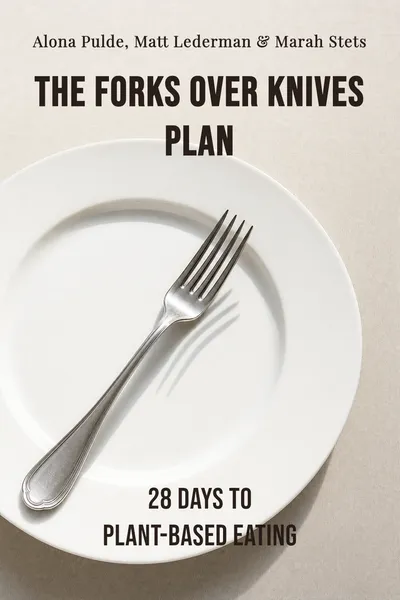
The Forks Over Knives Plan, published in 2014 by physicians Alona Pulde and Matt Lederman with writer Marah Stets, is the answer to that gap. It isn't a manifesto and it isn't a science lecture — those books already existed. It's a calendar. The whole thing is built around a single, oddly modest promise: give us twenty-eight days, and we'll walk you, meal by meal, into eating the way the film said you should. No willpower speeches, no before-and-after photos doing the heavy lifting. Just a four-week runway.
That framing is the interesting part. A diet book that spends its energy not on convincing you but on scheduling you is making a quiet bet about why people fail — and it isn't the bet most diet books make. The conviction, the authors assume, is already there. What's missing is the machinery of a Wednesday.
The question we’re asking : Why does a book that already won its readers over on argument still need to spend twenty-eight days on logistics?What we’ll see : How a hit documentary turned its case into a four-week runway, and what that runway quietly reveals about the way habits actually change.
Table of contents
01Chapter 1 — The film that became a franchise
Before there was a plan, there was a film, and the film had a thesis borrowed from two men who had spent their careers testing it. Caldwell Esselstyn, a former surgeon at the Cleveland Clinic, had run a small long-term study on patients with advanced heart disease, feeding them a diet with almost no added fat and no animal products, and watching some of their arterial damage stabilize or reverse. T. Colin Campbell, a Cornell nutritional biochemist, had spent decades on research — including the large China–Cornell–Oxford project — that he read as pointing toward whole plant foods and away from animal protein. Forks Over Knives braided their work into one argument: the Western diet is the disease, and the plate is the prescription.

02Chapter 2 — Whole food, and the word that matters most
The diet at the center of the book gets described in four words that do a lot of work: whole-food, plant-based. Each half matters, and the authors are careful about both. Plant-based is the part everyone hears — the meals are built from vegetables, fruits, whole grains, legumes, nuts and seeds, with animal products moved off the plate rather than reduced. But the word the authors lean on hardest is whole. The plan isn't just about swapping a steak for something from a plant; it's about eating foods close to the form they grew in, and treating heavily processed versions with suspicion even when they happen to be vegan.
This is where the plan quietly parts ways with a lot of what passes for healthy eating. A bag of chips can be plant-based. So can white bread, sugar, and the beige aisle of packaged snacks that market themselves as virtuous. The whole-food filter is what keeps the diet from collapsing into that. The authors want the potato, not the potato chip; the orange, not the juice. They also push, following Esselstyn's stricter line, to keep added oils low — even olive oil gets treated as a processed extract rather than a health food, which surprises readers who thought they were already doing this right.
03Chapter 3 — Twenty-eight days, not one heroic leap
The structural choice that defines the book is the number twenty-eight. Rather than telling readers to go whole-food, plant-based tomorrow morning — the kind of instruction that produces a dramatic Monday and a defeated Thursday — the authors break the change into four weeks with distinct jobs. The transition is staged, and the staging is the whole method. Each week the reader is asked to change a little more, so that by the end the new way of eating feels less like a leap taken and more like a floor already stood on.
The plan comes loaded with the machinery a transition actually needs: grocery lists, a pantry overhaul, day-by-day menus, and roughly a hundred recipes engineered to be forgiving rather than impressive. The authors spend real pages on the unglamorous stuff — how to stock a kitchen, how to read a label, how to handle the reliable friction points of eating out, traveling, or sitting at a family dinner where you're the only one doing this. These are the moments where good intentions usually die, and the book treats them as the main event rather than footnotes.
04Chapter 4 — The habit hiding inside the diet
Step back from the recipes and the grocery lists, and The Forks Over Knives Plan is making a claim that has almost nothing to do with nutrition and everything to do with how people change. Its real subject is the distance between believing something and doing it every day. The film had already won the argument for its audience; what remained was the far more stubborn problem of turning a conviction into a Tuesday. The book's answer is that we don't change a life by deciding harder. We change it by redesigning the small, repeated moments — the shopping trip, the pantry, the default dinner — until the new behavior becomes the path of least resistance.
This is why the twenty-eight-day frame matters more than any single meal in it. A month is long enough for a behavior to stop feeling like an event and start feeling like a routine, but short enough to promise as a commitment. The staging — change a little each week — spreads the effort across time so no single day carries the whole weight of transformation. It's the same insight that sits under most durable habit change: momentum beats motivation, and structure outlasts willpower, which is fickle by design.
05Conclusion
The Forks Over Knives Plan closes the loop that the 2011 film opened. The documentary made the case; the cookbooks answered what to cook; this book answers the question that had been sitting unaddressed the whole time — how a persuaded person becomes a changed one. Its answer is a calendar, a stocked pantry, and four weeks of forgiving structure, offered by two physicians who had watched too many patients agree with them and then go home to the same fridge.
Related books