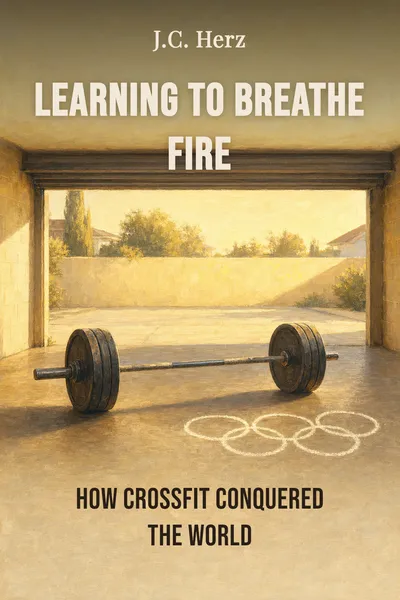
Learning to Breathe Fire
How CrossFit conquered the world
Description
In 1995, a former gymnast named Greg Glassman was training police officers and firefighters in Santa Cruz, California, and getting himself fired from commercial gyms for the way he did it. He didn't believe in the machines lined up along the mirrored walls — the leg-press, the seated row, the pec-deck — each one built to isolate a single muscle while the rest of the body sat idle. He put people on gymnastics rings, made them lift odd objects off the floor, timed them, and wrote the numbers on a whiteboard. Gym owners found it alarming. Their members found it, to their own surprise, addictive.
J.C. Herz opens "Learning to Breathe Fire" on this friction, and it turns out to be the whole story in miniature. What Glassman was doing looked reckless from inside the fitness industry and looked like the point from inside the workout. A few years later he started posting the day's routine on a plain website, for free, and something happened that no marketing department could have engineered: strangers in garages from Seattle to Sydney started doing the same brutal circuit on the same day, then reporting their times to each other. There was no product to buy. There was barely a company.
Herz, a technology and culture writer, treats CrossFit less as an exercise regimen than as a phenomenon that spread like open-source software and organized itself like a subculture. She wants to understand how a whiteboard, a stopwatch, and a barbell built a global network of thousands of gyms in barely a decade — and what that network satisfies in people that the treadmill never did.
The question we’re asking : How did a garage workout with no product to sell become a worldwide movement, and what exactly were people signing up for?What we’ll see : How a coach's contrarian method, a free website, and a startlingly generous business model turned suffering into belonging — and what the body was hungry for all along.
Table of contents
01Chapter 1 — A gymnastics coach with a grudge against machines
Glassman's argument, as Herz reconstructs it, started with a simple observation about how gyms actually worked. The whole apparatus of commercial fitness — the padded stations, the number dials, the one-muscle-at-a-time logic — had been engineered to be comfortable, safe, and, above all, profitable through volume. You could fill a room with machines and a hundred members could drift between them, headphones in, never really working hard, never talking to each other. The design succeeded commercially precisely because it was easy to walk away from. Glassman thought it had optimized away the thing that made training worth doing.
His alternative borrowed from the places where physical capacity actually got tested: gymnastics, Olympic weightlifting, sprinting, rowing. He wanted movements that used the whole body at once — the squat, the deadlift, the clean, the pull-up — the compound lifts and skills that a gymnast or a manual laborer would recognize as real work. The definition he eventually settled on was blunt: fitness is work capacity across broad time and modal domains. In plain terms, be good at a lot of physical things, not narrowly excellent at one. A powerlifter who couldn't run a mile was, by this standard, not fit.

02Chapter 2 — The video that turned a garage cult into a movement
In 2001, Glassman put the workout of the day online. Every morning a new routine appeared on CrossFit.com — the exercises, the reps, the target time — and anyone could do it, anywhere, for nothing. This was the decision Herz keeps returning to, because it was so counterintuitive as a business move. The core intellectual property of the whole enterprise was published, daily, for free. There was no login, no subscription, no locked content. If the method worked, people could steal it wholesale, and many did.
What Glassman understood, ahead of most of the fitness world, was that the free workout was not the product. It was the advertisement, the recruiting tool, and the shared ritual all at once. Strangers separated by oceans were doing identical workouts on identical days, which meant they had identical stories and identical numbers to compare. Message boards filled with people posting their times, arguing about form, egging each other on. A movement that could have been fragmented across ten thousand garages was synchronized by a single web page. Herz likens the dynamic to open-source code: give the source away, and a community assembles itself around improving and evangelizing it.
03Chapter 3 — The affiliate model, or how you scale by giving control away
Faced with people who wanted real gyms, Glassman made a choice that looks, in hindsight, like the engine of the whole expansion. He did not build a chain. He let people pay a modest annual fee to become a CrossFit "affiliate," use the name, and then run their own gym almost entirely as they saw fit. There was no corporate playbook dictating décor, no franchise rulebook on pricing, no standardized layout. An affiliate could program its own workouts, charge what the local market bore, and build whatever culture the owner and members wanted.
This is nearly the opposite of how a company usually scales. Herz points out that the value of a McDonald's franchise is uniformity — the burger is identical in every country because control is centralized. CrossFit's value was the reverse. Each box, as the gyms came to be called, was distinctive precisely because a coach owned it and stamped it with a personality. The affiliate paid for the brand and the credibility of the method, then supplied the thing headquarters could never mass-produce: a specific room, in a specific town, run by someone who knew every member's name.
04Chapter 4 — Why the body wanted something the treadmill never offered
Step back from the barbells and the affiliate spreadsheets, and Herz's larger claim comes into view. The modern fitness industry, she argues, had spent decades solving the wrong problem. It made exercise convenient, solitary, comfortable, and easy to quit — and then wondered why gym membership was something people bought in January and abandoned by March. The machines were engineered around the assumption that people want the least effort and the least friction. CrossFit succeeded by betting on the opposite: that people would show up for the hard thing if the hard thing was shared.
What the boxes supplied, underneath the workout, was a set of things industrial life had quietly stripped out. Measurable struggle, for one — a clear task, a real threshold, a number that proved you had done it, in a world where most work produces no visible result. And other bodies in the room, for another. Herz keeps circling back to the fact that people don't so much love the workout as love doing it with the same fifteen people at six in the morning, being missed when they're absent. The suffering is the price of admission to a tribe, and the tribe is the actual product.
05Conclusion
The story that began with a coach getting fired for putting cops on gymnastics rings ends with a network of thousands of gyms spanning the globe, none of them quite alike, all of them tracing back to a whiteboard, a stopwatch, and a free website. Herz's account keeps insisting that none of the obvious explanations — clever marketing, a proprietary machine, a celebrity endorsement — did the work. What did the work was Glassman's willingness to give the method away and then let other people own the rooms.
Related books