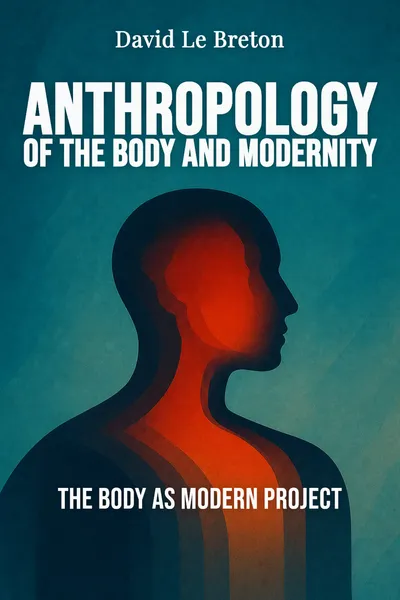
Anthropology of the Body and Modernity
The body as modern project
Description
When we sprain an ankle, we say "I have a body," as if the body were a thing we owned, a tool that occasionally lets us down. The phrasing feels obvious. It is also a very recent way of talking. For most of human history, and in many societies the sociologist David Le Breton spent his career describing, a person did not have a body — a person was a body, woven into the cosmos, into the group, into the invisible forces running through the world. The idea that the self sits inside a physical envelope, distinct from it and faintly superior to it, is not a natural fact. It is a cultural invention with a date and an address.
Le Breton's book, Anthropology of the Body and Modernity, published in France in 1990, takes that invention apart. His method is comparative: he lines up our everyday Western relationship to the body against societies where no such separation exists, and the contrast turns our own habits strange. In a village cosmology, the body is porous, continuous with the plants, the ancestors, the neighbors. In a modern city, the body is a boundary — the edge where the individual stops and everyone else begins. Somewhere between those two pictures, something was cut.
That cut is the whole story. Le Breton argues that the modern body is not simply the body better understood; it is a body that has been detached, isolated, turned into an object, and finally handed back to each of us as a task. We inherit it as raw material and spend our lives working on it. How did a thing nobody used to notice become the thing we think about most?
The question we’re asking : How did the body stop being the self and become a possession the modern individual has to manage?What we’ll see : Le Breton follows the body from a world where it was indistinguishable from the person to a modernity where it becomes isolated, objectified, and finally a project each of us is charged with building.
Table of contents
01 Chapter 1 — A body that used to be the whole world
Le Breton opens by dislodging the thing we take for granted: the body as a clear, bounded object. In many of the societies anthropologists have studied, there is no word that isolates "the body" the way French or English does. The person is not divided into a physical part and a mental or spiritual part. There is one continuous being, and that being leaks into everything around it. The flesh is made of the same stuff as the land, the rain, the dead, the names. To draw a hard line around the skin and call what is inside "me" would make no sense.
In these cosmologies the body is porous. Illness does not come from inside a sealed machine; it comes through a breach in relations — a broken obligation, a jealous neighbor, an offended ancestor. Healing is therefore social and symbolic before it is anatomical. You do not repair an organ, you repair a tie. Le Breton gathers example after example to show that the Western instinct to locate sickness in cells and tissues is itself a local belief, not a universal truth. It feels obvious to us only because we live inside it.

02 Chapter 2 — The modern cut that set the body apart
The decisive break, for Le Breton, happens in Europe between roughly the sixteenth and seventeenth centuries. Two developments do the work. The first is the rise of anatomical dissection, which treats the corpse as an object to be opened, mapped, and explained. Andreas Vesalius publishes his great atlas of human anatomy in 1543, and the body begins its long career as a thing laid out on a table, legible, separable from the person who once lived in it. The dead body becomes the model for understanding the living one.
The second development is philosophical. With Descartes in the first half of the seventeenth century, the human being is split cleanly in two: a thinking substance and an extended, mechanical one. The self becomes the mind; the body becomes a machine the mind owns and operates. This is the famous dualism, and Le Breton reads it less as an error to be corrected than as a cultural event with consequences. Once the self is the thinking part, the body is demoted to equipment — reliable when it works, a nuisance when it breaks, never quite us.
03 Chapter 3 — The individual stuck inside a border
The isolated body, Le Breton argues, is the hidden companion of the modern individual. You cannot have the self-contained person of liberal societies — the one who owns themselves, signs contracts, votes, belongs to no one — without a body that marks exactly where that person stops. The skin becomes a frontier. The body is the material proof that each of us is separate, countable, responsible for ourselves alone. Individualism and the bounded body are two sides of one coin.
This explains a cluster of modern feelings that would baffle the societies of the first chapter. The discomfort of being touched by a stranger in a crowd. The careful choreography of keeping distance in an elevator, in a queue, on a train. Le Breton reads these everyday manners as the constant policing of a border we barely notice. In a world where the body is the edge of the self, every unwanted contact is a small trespass, and we spend enormous energy managing the traffic at our own frontier.
04 Chapter 4 — The body we never stop building
Step back and the trajectory becomes clear. A body that was once the whole person, continuous with the world, has been cut loose, objectified, and handed to each of us as private property. Le Breton's final move is to describe what we do with that property once it is ours. If the body is no longer the self but a possession, then it becomes something to manage, improve, and display — a project. This is the condition he names most sharply: in modernity, the body is the last reliable territory of the self, and we treat it accordingly.
You can read the whole contemporary culture of the body through this lens. Fitness, dieting, cosmetic surgery, tattooing, running, the endless monitoring of weight and sleep and heart rate — these are not vanities layered on top of ordinary life. They are the logical outcome of a body that has become one's own to design. When the group no longer defines who we are, the body steps in as the surface on which we write identity. We sculpt it, decorate it, correct it, because it is the one thing left that feels unambiguously ours.
05 Conclusion
We started with the sprained ankle and the small, revealing phrase: "I have a body." Le Breton's book traces the long road that made that sentence sayable. The body that was once indistinguishable from the person, porous to the world and held by the group, was cut away by the anatomists and the philosophers, sealed behind the skin, and converted into the private marker of the modern individual. What felt like plain biology turned out to be the residue of a particular history.
Related books