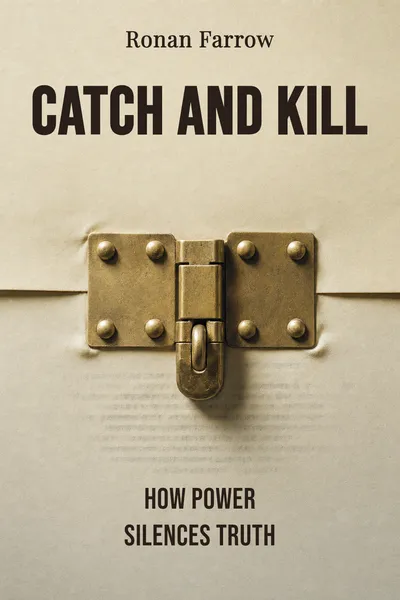
Catch and Kill
How power silences truth
Description
In the summer of 2017, a young NBC News reporter named Ronan Farrow was chasing a story that kept slipping out of his hands. The reporting had started as a routine piece about Hollywood, and it had drifted somewhere darker: toward one of the most powerful producers in the industry, a man whose name opened every door in the business, and whose conduct with women had been an open secret for decades. Farrow had audio. He had women willing to talk, some of them barely. And he had a network that, month after month, found reasons not to let the story run.
What Farrow describes in Catch and Kill, published in 2019, is not just the anatomy of a scoop. It is the account of what happened around the scoop — the lawyers who called his bosses, the private investigators who tailed him through Manhattan, the operatives from a firm staffed by former intelligence officers who posed as allies to get close to both the reporter and his sources. The story he thought he was reporting turned out to be wrapped inside a second story: the machinery built to make sure the first one never surfaced.
The phrase that gives the book its title comes from tabloid journalism. To "catch and kill" is to buy the exclusive rights to a damaging story precisely so it can be locked in a drawer and never told. Farrow found that logic operating far beyond the tabloids — inside newsrooms, law firms, and the quiet arrangements between the powerful and the people paid to protect them.
The question we’re asking : What does it actually take to bury a true story, and what does it take to get it out anyway?What we’ll see : How a single Hollywood investigation opened a window onto the surveillance, money and fear that keep abuse hidden — and onto the people who refused to stay quiet.
Table of contents
01Chapter 1 — The story nobody would air
The assignment that became Catch and Kill began almost by accident. Farrow was working on a broader NBC piece about sexual harassment in Hollywood, and one name kept surfacing in conversations — Harvey Weinstein, the co-founder of Miramax and later the Weinstein Company, a producer whose films had won hundreds of awards and whose temper and appetites were, among people in the industry, common knowledge. The whispers had a shape Farrow recognized: everybody seemed to know, and nobody would say it on the record.
The turning point was audio. In a 2015 sting run by the New York Police Department, a model named Ambra Gutierrez had worn a wire during a meeting with Weinstein, and the recording captured him pressuring her while half-admitting to having groped her the day before. The tape existed. The Manhattan district attorney's office had declined to prosecute. For Farrow, the recording was the kind of evidence that turns a rumor into a story a network can defend.

02Chapter 2 — The machinery of the kill
The phrase catch and kill names a specific transaction, and Farrow shows it working in real time. The National Enquirer's parent company, American Media Inc., run by David Pecker, had a documented practice of buying stories about powerful friends of the company in order to bury them. A source's account would be purchased under contract, the source would be bound to silence, and the story would simply disappear into a vault. The money was not for publication. It was for burial.
Weinstein's protection operated on the same principle at a grander scale. Over years, accusations had been settled through nondisclosure agreements — legal contracts that traded financial compensation for permanent silence. Women who had experienced assault or harassment signed documents that forbade them from ever describing what happened, often under threat of ruinous penalties. The NDA is a legitimate legal instrument, but Farrow shows how, stacked up over decades, it becomes a tool for laundering a pattern of abuse into a series of private, forgotten transactions.
03Chapter 3 — The spies who followed the reporter
The most cinematic thread of Catch and Kill is also its most disturbing, because it moves the story out of the newsroom and onto the street. As Farrow closed in, he began to notice things: the same faces in the same cafés, a sense of being watched, sources who grew frightened after private conversations. He was not imagining it. Weinstein had hired private intelligence firms, most notably Black Cube, an agency staffed largely by former Israeli military and intelligence operatives, to run a covert campaign against the reporting.
The tactics were the tradecraft of espionage applied to journalism. Operatives worked under false identities and elaborate cover stories. One agent, using the alias of a women's-rights advocate, approached the accuser Rose McGowan and won her trust over a series of meetings, recording their conversations while presenting herself as an ally. The same operative also arranged to meet Farrow himself, posing as a potential source, in order to learn what he knew. The people supposedly on the story's side were, in some cases, being managed by the people trying to kill it.
04Chapter 4 — What silence actually costs
Step back from Weinstein and a larger picture comes into view, which is really the point of the book. The producer was one man, and a spectacularly powerful one, but the machinery that shielded him was not built for him alone. Farrow describes a general-purpose infrastructure of protection — the settlement, the nondisclosure agreement, the friendly lawyer, the tabloid vault, the intelligence firm — that any sufficiently wealthy and connected person can rent. The scandal is not that Weinstein was unique. It is that the apparatus was routine.
This is why the book resonated beyond Hollywood. The same tools appear in Farrow's later reporting into other institutions, and the reader recognizes the pattern: an organization that would rather manage a problem quietly than confront it, professionals who make a living converting misconduct into silence, and a set of legal instruments that were designed for legitimate purposes and then repurposed to keep victims mute. The through-line from a studio backlot to a corporate legal department to a Washington operation is the same logic of containment.
05Conclusion
The New Yorker piece ran, then more accounts followed, and the wall Farrow had spent a year pushing against gave way almost at once. Weinstein was eventually tried and convicted, the practice of catch-and-kill was dragged into public view, and the covert operations he had commissioned became part of the record rather than a private threat. The tape that a network had judged unairable helped ignite a reckoning that reached far past Hollywood.
Related books