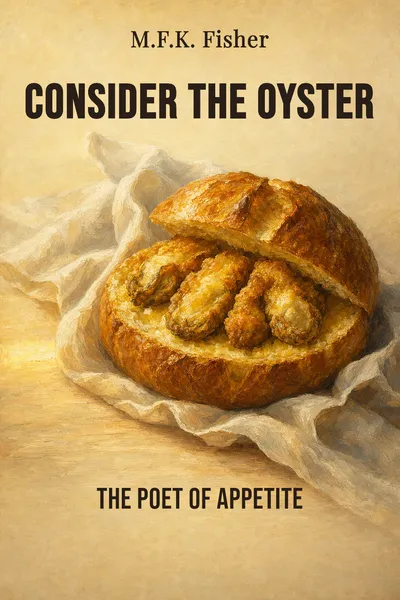
Consider the Oyster
The poet of appetite
Description
In 1941, a woman named Mary Frances Kennedy Fisher published a little book of about a hundred pages, in the middle of a war, about the oyster. Not oysters as an economic commodity, not oysters as marine biology, though both slip into the text. The oyster as a thing eaten — cold and raw off a Marseille cart, folded into a stew on a cold night, baked under a crust of breadcrumbs, dressed with spinach and called Rockefeller in a New Orleans restaurant that guarded the recipe. The book was called Consider the Oyster, and it took its title, and its tone of amused seriousness, from the way one might be asked to consider anything worth a long look.
Fisher was already writing food into a register that American letters had not much bothered with. Recipes appear in the book, but they are not the point; they arrive the way a good storyteller reaches for a detail. Between them she puts her mother as a girl in the 1890s, weak with delight over an oyster loaf smuggled into a girls' dormitory, and herself as a young woman abroad, meeting the raw oyster for the first time and deciding, against every instinct, to swallow it. The oyster becomes a way to talk about appetite itself — what we want, what we fear, what we let ourselves enjoy.
John Updike would later call her the poet of the appetites, and the phrase fits a book that treats a mollusk with the attention most writers reserve for love or death. The oyster, after all, leads what Fisher calls a dreadful but exciting life, changing sex, clinging to its rock, filtering the sea. To write about eating it well is to write about being alive and hungry, which is most of what there is to say about anyone.
The question we’re asking : How does a slim wartime book about a single shellfish become a meditation on appetite, pleasure, and fear?What we’ll see : We follow Fisher from a girls' dormitory to a Marseille cart, into the oyster's contradictions and its comforts, to see what she was really writing about.
Table of contents
01Chapter 1 — A book about a bivalve, and much more
Consider the Oyster is short by any measure, and Fisher never pretends it is a scientific treatise. She opens with the oyster's own biography, which turns out to be genuinely strange. The creature spends its first weeks drifting, then attaches itself to a rock or a shell and stays there for the rest of its life, filtering seawater, at the mercy of tides, boring sponges, starfish and drills that pry it open. It also changes sex, sometimes more than once. Fisher calls this existence dreadful but exciting, and the phrase does double duty: it describes the animal, and it describes the appetite of anyone who chooses to eat it.
From there the book fans out. There are chapters organized loosely around how an oyster meets its end — stewed, fried, roasted, baked, served raw on ice — and each is really an occasion to tell a story. Fisher moves between the practical and the reflective without seams. A recipe for oyster stew sits beside a memory; a note on Baltimore oyster cookery sits beside a joke. She writes, as she does everywhere, with the assumption that a reader is intelligent, hungry, and in no hurry.

02Chapter 2 — The strange cold succulence
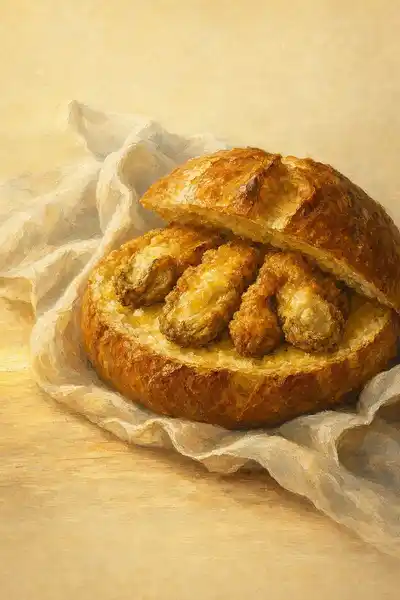
Two initiations anchor the book, and neither is really about food. The first belongs to Fisher's mother, Edith, recalled as a girl at a strict boarding school in the 1890s. The details are spare and vivid: the forbidden delight of an oyster loaf — a hollowed loaf of bread packed with fried oysters — carried in against the rules, and the pleasure of eating it in secret. Fisher tells it as a story about a young woman discovering that appetite could be its own small rebellion, a thing to be smuggled and savored rather than only endured.
The second initiation is her own, set abroad in the years she spent in France as a young married woman. Somewhere between Dijon and Marseille she meets the raw oyster for the first time, and she is honest about the resistance. There is something faintly appalling about swallowing a live, cold, gray thing off the half shell, and she does not pretend otherwise. She describes the moment as a decision — to override instinct, to let herself taste what she calls the strange cold succulence, and to find, on the far side of the hesitation, real pleasure.
03Chapter 3 — Between the aphrodisiac and the stomach-ache
The oyster arrives trailing a reputation, and Fisher meets it head on. It has long been called an aphrodisiac, food of Casanova and of wedding feasts, and she treats the claim with amused skepticism rather than either endorsement or scolding. She is more interested in the fact that we believe it than in whether it is true. The oyster's supposed power over desire is, for her, part of its mythology — one more way the creature has burrowed into human appetite, standing in for wanting itself.
Against that romance she sets the other, less flattering half of the oyster's reputation: its notorious capacity to make a person violently, memorably ill. A bad oyster is a genuine danger, and Fisher does not soften it. She writes about the gut-wrenching aftermath with the same candor she brought to the cold succulence of the good one, and the pairing is deliberate. The same food that promises pleasure can deliver misery, sometimes indistinguishably, sometimes on the same evening. To eat an oyster raw is to accept a small gamble.
04Chapter 4 — What it means to write about eating
Consider the Oyster looks, from the outside, like a minor book: a wartime trifle about a shellfish, barely a hundred pages. Its lasting importance is that it insisted food was a serious literary subject at a moment when almost no one in American letters agreed. Fisher's wager was that writing about what we eat is never only about eating. Behind hunger stand security and its absence; behind the oyster stew stands the wish to be warm and fed and safe, which in 1941 was not an abstract wish at all.
Fisher said as much elsewhere, in a line often quoted: that when she writes about hunger, she is really writing about love and the hunger for it, and warmth and the lack of it, because our three basic needs — for food, security and love — are so entangled that we cannot think of one without the others. Consider the Oyster is that idea worked out on a small canvas. The oyster is the pretext; appetite is the subject; and appetite, in her hands, turns out to be inseparable from fear, memory and desire.
05Conclusion
The book closes as it opened, with the creature on the plate — stewed, fried, roasted, dressed à la Rockefeller, or swallowed raw and cold with all its strange succulence intact. Fisher has walked us from her mother's smuggled oyster loaf to her own hesitation on a French coast, through the myths of desire and the real threat of illness, and she leaves us more or less where a good meal leaves us: satisfied, a little wiser about our own hunger, and glad to have taken the trouble.
Related books