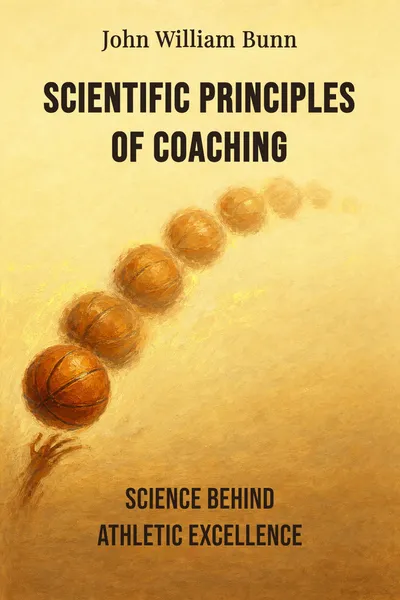
Scientific Principles of Coaching
Science behind athletic excellence
Description
For most of the twentieth century, coaching passed from one generation to the next the way a family recipe does — by imitation, by feel, by the authority of the man who had once played the game well. A drill was good because the coach who ran it had won. A technique was correct because that was how it had always been taught. When John William Bunn published Scientific Principles of Coaching, first appearing in the mid-twentieth century and revised across later editions, he set out to interrupt that inheritance. Bunn, a basketball coach and physical educator at Stanford and later Springfield College, wanted to know not just what worked, but why.
His answer was to treat the human athlete as something that could be studied rather than merely admired. A jump, a throw, a sprint — each of these is a body obeying the laws of physics, driven by muscles that fatigue on a schedule, guided by a nervous system that learns in measurable ways. Bunn's wager was that a coach armed with physiology, mechanics and psychology would make better decisions than a coach armed only with tradition and a good eye. The book reads less like a pep talk and more like a field manual for anyone serious about turning ordinary bodies into skilled ones.
What makes the book worth revisiting is how quietly radical the move was. Bunn did not promise a secret method or a shortcut to victory. He offered coaches a way of thinking — a discipline of asking where a movement comes from and what actually limits it. That posture, unremarkable now in an era of sports science labs, was in his time a small rebellion against the cult of the intuitive coach.
The question we’re asking : Can the craft of coaching be built on science rather than instinct, and what changes when it is?What we’ll see : How Bunn drew on the body, the mind and the mechanics of movement to turn coaching into a systematic study of human performance.
Table of contents
01 Chapter 1 — The coach who stopped guessing
Bunn's starting complaint was simple: too much coaching rested on unexamined habit. A technique survived because a successful athlete had once used it, not because anyone had checked whether it was the best way for a body to move. Fatigue was managed by hunch. Skills were drilled by repetition without much thought about how repetition actually builds a movement into the nervous system. The result, in Bunn's reading, was a field full of practitioners who could describe what they did but rarely explain it.
His alternative was to ask coaches to become students of the thing they were coaching — the human being in motion. That meant borrowing seriously from the sciences that studied that being. Physiology explained what the body could sustain and how it recovered. Mechanics explained why some movements were efficient and others wasteful. Psychology explained how skills were learned and why athletes performed differently under pressure. None of these were new sciences, but Bunn's contribution was to insist they belonged together on the practice field, not just in a laboratory.

02 Chapter 2 — The body as a working machine
The physiological core of the book treats the athlete's body as a system with knowable limits and knowable responses. Muscles contract, and in doing so they consume fuel and generate waste that accumulates as fatigue. The circulatory and respiratory systems supply oxygen and clear that waste, and their capacity can be enlarged through training. Bunn walks the coach through these mechanisms not to turn them into physiologists but to give them a working model of what happens inside an athlete during exertion and recovery.
From that model follow practical rules about how to train. If fatigue is a physiological event with a physiological cause, then conditioning has to be built gradually, allowing the body's supply systems to adapt to rising demand. Push too hard too soon and the body breaks down rather than builds up; too gently and it never adapts at all. Bunn's treatment of conditioning is essentially an argument for progression and rest as scientific necessities rather than as signs of a soft training regime. Recovery, in his telling, is where adaptation actually happens.
03 Chapter 3 — The mind the coach actually trains
Bunn is insistent that a body does not learn skills on its own; a nervous system does, and a nervous system is attached to a mind with moods, fears and motivations. The psychological portion of the book takes learning seriously as a process with its own principles. A skill is acquired through practice, but not all practice is equal. How a movement is broken down, how often it is repeated, how quickly the athlete gets feedback, whether the practice conditions resemble the real contest — all of these shape whether a skill sticks and whether it holds up when it matters.
The concept of learning here is close to habit formation. Repeated correctly, a movement becomes automatic, freeing the athlete's attention for the tactical demands of the game. Repeated incorrectly, a flaw becomes just as automatic and far harder to undo. This raises the stakes on early coaching: the first version of a skill an athlete learns is the one the nervous system tends to keep. Bunn uses this to argue against sloppy early practice and in favor of getting technique right before speed and intensity are added.
04 Chapter 4 — Where the drills come from
Stepping back, what Bunn is really proposing is a change in the coach's self-image. The traditional coach was an authority — a former player whose credibility came from having done the thing. Bunn's coach is closer to a practitioner of an applied science, someone whose credibility comes from understanding the principles that govern performance and applying them to the individual in front of them. The drills, the conditioning schedules, the corrections all descend from that understanding rather than from custom. A practice plan becomes an argument, not a ritual.
This reframing has a quiet consequence: it makes coaching teachable and transferable in a way that pure intuition never is. If good coaching is the application of physiology, mechanics and learning theory, then it can be studied, written down and passed to someone who never played at a high level. Bunn spent much of his career in physical education, and the book carries the ambition of that world — to turn a craft learned by apprenticeship into a discipline that can be taught in a classroom and improved by evidence over time.
05 Conclusion
The book that began as a quiet rebellion against the intuitive coach ended up sketching the shape of a whole field. Bunn asked coaches to treat the athlete as a body governed by physiology and mechanics, a mind that learns by knowable rules, and a person whose motivation can be understood rather than merely commanded. From that single posture — the demand to know why a movement works — follows everything else: conditioning built on adaptation, technique corrected through leverage and timing, skills drilled with an eye to how the nervous system actually forms habits.
Related books