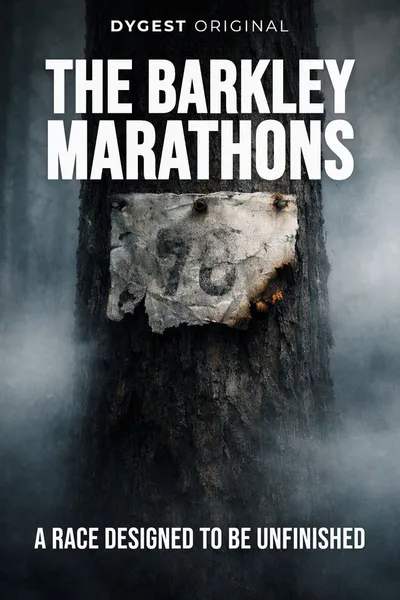
The Barkley Marathons
A race designed to be unfinished
Description
Somewhere in the hills of Frozen Head State Park in eastern Tennessee, at an hour nobody is told in advance, a man named Gary Cantrell lights a cigarette. That is the starting gun. There is no other. The runners around him have already done something strange to get here — written an essay, paid an entry fee of $1.60, brought an item he requested as a kind of toll, like a license plate from their home state or a pack of socks. They have been accepted into a race whose course they are not allowed to see beforehand, whose exact start they cannot predict, and which almost none of them will finish.
The Barkley Marathons has run in roughly its current form since the late 1980s, and across that span the finisher count sits in the low double digits. Entire years pass with nobody reaching the end inside the sixty-hour limit. The field is capped at around forty. The terrain is brutal, the navigation is by map and compass with no GPS allowed, and the checkpoints are paperback books hidden along the route, from which runners tear a page matching their bib number to prove they were there. On paper it reads like a prank. In practice it has become one of the most coveted failures in endurance sport.
What makes the thing worth looking at is not that it is hard. Plenty of races are hard. It is that this one appears to have been engineered, deliberately and with a certain mischief, so that finishing is the aberration. The difficulty is not a side effect of an ambitious course. It is the whole design philosophy, arranged by a man who seems genuinely delighted when the course wins. That inversion — a competition whose organizer roots against completion — is where it gets strange, and where it gets interesting.
The question we’re asking : Why would anyone design a race almost nobody can finish, and why do runners keep lining up for it?What we’ll see : We follow the Barkley from its odd origins through its rules and its brutal attrition, and arrive at what a race built to defeat us is quietly insisting on.
Table of contents
01 Chapter 1 — A race that hides from you
The origin story is almost too neat, so it's worth saying it's the version Cantrell himself tells. In 1977, James Earl Ray — the man who assassinated Martin Luther King Jr. — escaped from nearby Brushy Mountain State Penitentiary and spent about fifty-five hours in the surrounding woods before being recaptured. In that time he covered, depending on the account, somewhere around twelve miles. Cantrell, an ultrarunner with a taste for the absurd, reportedly scoffed that he could do a hundred. The Barkley, named after his running friend Barry Barkley, was his answer to his own boast — a course that would make twelve miles in those woods sound like an achievement.
That spirit of mockery never left the race. There is no website, no online registration, no sign-up form you can simply fill out. The process of getting in is itself a riddle, passed around by word of mouth and deliberately obscured. Applicants write what Cantrell has called an essay on why they should be allowed to suffer, and the accepted runners receive a letter of condolence rather than congratulation. One newcomer each year is tagged the 'human sacrifice,' the person Cantrell judges least likely to survive the first loop.

02 Chapter 2 — The rules nobody fully understands
The core mechanic is the books. Scattered along each loop, hidden under rocks, inside hollow trees, pinned to the base of a cliff, are between nine and fifteen paperbacks, their titles chosen by Cantrell with a dark humor — a runner might find something like 'A Time to Die' or 'The Most Dangerous Game' waiting in the mud. Each runner carries a bib, and at every book they tear out the page corresponding to their number. Return to camp missing a page, and the loop does not count. There is no arguing with a missing page.
The bibs themselves are a running gag. A runner's number changes between loops, so the page they need shifts each time, which means there is no memorizing and no shortcut — you have to actually reach every book, every loop, and perform the small bureaucratic ritual of proof. It is a checkpoint system designed by someone who does not trust you and wants you to feel it. The genius of it is that it is unspoofable and requires no electronics, no timing mats, nothing that could fail or be gamed.
03 Chapter 3 — The math of not finishing
The numbers tell the real story. In more than three decades of the five-loop format, the total number of official finishers sits in the low double digits — fewer people than finish many marathons in a single morning. Some years nobody completes it at all. A strong year might see one or two runners make it under the limit; the famous 2017 edition ended with zero finishers, John Kelly having come through the previous year as the fifteenth person ever to do it. The ratio of starters to finishers is not a close call. It is a landslide in favor of the course.
Attrition arrives in waves. Many runners never complete a single loop, turning back or timing out before camp. A larger group makes the 'fun run' of three and calls it a worthy day. The step from three loops to five is where the race does most of its killing — the body is wrecked, the sleep debt is crushing, and the fourth loop usually runs through a second night, alone, in terrain the runner has already navigated once in reverse and now must read backward in the dark. Hallucinations are routine. People describe conversations with rocks.
04 Chapter 4 — What a race built to defeat us is for
Step back and the Barkley reads as an argument against the way we have come to treat almost every physical challenge. The dominant logic of endurance sport, and of a lot else, is optimization: better data, smoother courses, finisher medals calibrated so that a well-trained person who shows up and executes will, barring disaster, complete the thing. The marathon has become a mass-participation rite precisely because it is finishable. Completion is the promise, and the promise is kept for the overwhelming majority who line up. The event is a problem engineered to be solved.
The Barkley refuses that bargain outright. It is built so that completion is not promised to anyone, not even the strongest, not even in a good year. By keeping the finish rate near zero, Cantrell removes the one thing most events are organized to deliver — the reasonable expectation of success. What remains is an encounter with a limit that does not move for you, a landscape and a clock that owe you nothing. The race is not a problem to be solved. It is a fact to be met.
05 Conclusion
Each spring the yellow gate at Frozen Head waits again, and each spring most of the field will fall short of it. Cantrell will light his cigarette at an hour nobody guessed, tear through his adjustments to the course, and sit near the gate with his bugle ready. Some years it will sound many times and the five-loop finisher list will stay exactly where it was. He will not seem disappointed. The race he designed will have done precisely what it was built to do, which is to win.
Related books