Inner Skiing
Mind over moguls
Description
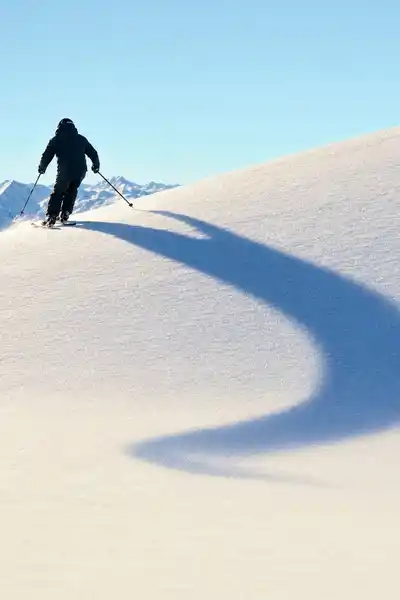
Picture the moment a skier freezes at the top of a run that looks steeper than it did from the lift. The legs know the movements — edge, weight, turn — because they've done them a hundred times on gentler terrain. And yet the body stiffens, the shoulders lock, the skis chatter. Nothing on the mountain has changed. What's changed is the running commentary in the skier's head, the voice narrating everything that could go wrong. W. Timothy Gallwey built a whole philosophy around that voice, and in Inner Skiing he turns it loose on the slopes.
Gallwey had already made his name with The Inner Game of Tennis in the mid-1970s, a slim book that argued most of what holds an athlete back happens between the ears, not in the muscles. Skiing was the natural next frontier. Here was a sport where fear is physical and immediate, where a single tense thought can send a body sprawling, where beginners and experts alike spend more energy fighting themselves than fighting gravity. If the inner game held up anywhere, it would hold up on a cold slope with a drop below.
What makes the book more than a sports manual is its quiet claim that we've misunderstood how improvement works. We tend to believe that getting better means trying harder, thinking more, correcting constantly. Gallwey suggests something close to the opposite — that the mind, left to instruct and criticize, is usually the obstacle, and that the real skill is learning to let it go quiet.
The question we’re asking : Why does a skier who knows exactly what to do so often get in the body's way — and what would it take to stop?What we’ll see : How Gallwey's inner game reads fear, effort, and learning on the slope, and what it says about performing at all.
Table of contents
01 Chapter 1 — The enemy on the chairlift is the one in your head
Gallwey opens Inner Skiing with a diagnosis that will sound familiar to anyone who has ever taken a lesson. The skier stands at the top of a slope, and before a single turn is made, the mind is already busy. Keep your weight forward. Don't lean back. Remember what the instructor said about the poles. Bend the knees more. The instructions pile up, each one true, each one useless in the moment, because a body cannot execute a checklist and flow down a mountain at the same time.
This inner noise, in Gallwey's telling, is the real difficulty of the sport. The mechanics of skiing are not that complicated, and most people's bodies learn them faster than they give themselves credit for. What slows learning down is the constant self-interference — the doubting, the second-guessing, the harsh judgment after every awkward turn. A skier who wipes out and mutters that they're hopeless has just made the next run harder, not because the snow changed but because the mind tightened its grip.

02 Chapter 2 — Self 1, Self 2, and the trouble with trying
The engine of Gallwey's whole approach is a distinction he draws between two selves. Self 1 is the talker — the conscious, verbal mind that instructs, evaluates, worries, and never shuts up. Self 2 is the doer — the body and its vast, wordless intelligence, the part that actually balances, senses the snow, and adjusts a thousand times a second without being told how. Most of us, Gallwey argues, mistake Self 1 for the one in charge. In truth it's often the saboteur.
Watch what happens when Self 1 takes over. It doesn't trust Self 2 to ski, so it micromanages: too much edge here, not enough there, you're doing it wrong. Self 2, perfectly capable, gets crowded out and starts to falter — which Self 1 reads as proof that its meddling was needed all along. The loop feeds itself. The tense skier tries harder, the trying introduces more tension, and a movement that should be smooth turns rigid and jerky.
03 Chapter 3 — Fear is data, not a verdict
Skiing raises a problem tennis rarely does — real, well-founded fear. A steep pitch or an icy traverse can genuinely hurt you, and Gallwey doesn't pretend otherwise. What he refuses to accept is the way fear usually operates: as a verdict that freezes the body and shuts down learning. The trembling legs and clenched jaw don't make anyone safer. They make a fall more likely, because a rigid body can't absorb the terrain or react in time.
His approach is to treat fear as information rather than command. Gallwey encourages the skier to observe the fear directly — where it sits in the body, how the breath shortens, what exactly the mind is imagining. Naming the sensation, without fighting it or being swept away by it, tends to shrink it. Much of what we call fear on a slope, he suggests, is not the danger itself but Self 1's catastrophic story about the danger, and stories loosen their grip the moment we look at them squarely.
04 Chapter 4 — Awareness as the quiet engine of change
Step back from the snow and Inner Skiing turns out to be making a claim about skill itself. Gallwey's wager is that awareness, not instruction, is what changes behavior. When a skier simply notices, without judging, what their body is actually doing — where the weight falls, how the knees bend, what a good turn feels like against a bad one — change tends to follow on its own. The body gravitates toward what works once it can clearly feel the difference. No one has to be told to correct. They just have to be allowed to perceive.
This quietly overturns the usual model of coaching, and of self-improvement more broadly. We assume progress comes from being told what's wrong and ordered to fix it. Gallwey suggests that criticism mostly adds tension, and that the better instructor points attention rather than issuing commands — asking a skier to feel their edges, not to fix them. The teacher's real job is to help someone see clearly, then trust that clear seeing does the work. It's a humbler role than the expert barking corrections, and in his account a far more effective one.
05 Conclusion
Bring the skier back to the top of that intimidating run. The mountain is unchanged, the legs still know their business, and the only real variable is the voice in the head. Gallwey's whole project is to turn the volume down on that voice — not to silence thought, but to stop it from smothering the body's own intelligence. Watch the snow, feel the edges, breathe, and let the well-trained part of you ski. The improvement that follows can look almost like a trick, but it isn't one. It's what was available all along, once the interference cleared.
Related books