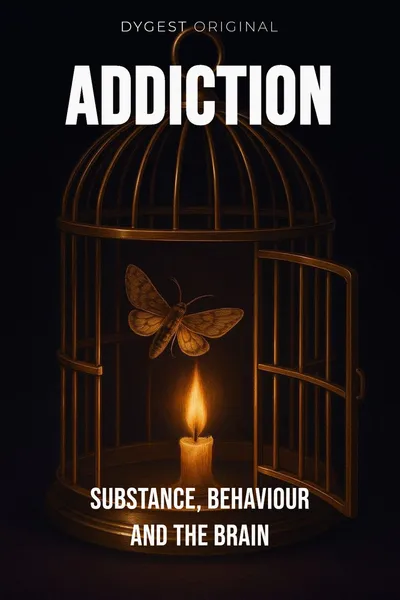
Addiction
Substance, behaviour and the brain
Description
In the early 1970s, a researcher named Bruce Alexander noticed something odd about the rats used to prove that drugs were irresistibly addictive. In the classic experiments, a rat alone in a bare cage, with a lever that delivered morphine, would press it again and again until it died. Alexander wondered whether the drug was doing the work, or the cage. So he built what came to be called Rat Park: a large enclosure with room to run, wheels to spin, other rats to mate and fight with. The rats there could take the morphine too. Mostly, they didn't bother. The finding didn't overturn everything we thought we knew, and it has been argued about ever since. But it planted a question that still sits at the centre of the field.
Because addiction refuses to stay in one box. We talk about heroin and alcohol in the same breath as gambling, and lately as phones, food and pornography. Some of these involve a chemical crossing the blood-brain barrier; some involve nothing but a screen and a thumb. Yet the people caught in them describe the same trap almost word for word: the promise that this is the last time, the shrinking of a whole life down to a single craving, the strange split between wanting the thing and no longer even liking it.
That overlap is the puzzle. If a substance and a habit can hollow out a person in the same way, then whatever addiction is, it can't simply be the chemistry of a particular drug. Something in the brain is being recruited — the same something, whether the trigger arrives in a bottle or a notification.
The question we’re asking : If a drug and a behaviour can trap a person the same way, what is addiction actually a disorder of?What we’ll see : How the brain's reward machinery gets hijacked, why the pull outlasts the pleasure, and what it takes to loosen the grip.
Table of contents
01Chapter 1 — The pleasure chemical that isn't about pleasure
Almost every drug that people get hooked on ends up doing the same thing in one small region of the brain: it floods the nucleus accumbens with dopamine. Cocaine blocks its reuptake, so it lingers. Amphetamines force more of it out. Heroin and alcohol get there by a longer route, quieting the neurons that normally hold dopamine in check. The details differ, but the destination is shared, which is the first clue that addiction is less about any one substance than about a circuit these substances all happen to reach.
For decades dopamine was described as the brain's pleasure signal, and the story wrote itself: drugs feel good, so we chase them. The trouble is that the story turned out to be wrong in an important way. When researchers like Wolfram Schultz tracked dopamine neurons in the 1990s, they found the cells didn't fire hardest at the moment of reward. They fired at the moment of prediction — the cue that reward was coming. And when the reward arrived exactly as expected, the neurons went quiet. Dopamine, it seems, isn't the taste of the sugar. It's the lean toward it.

02Chapter 2 — When the behaviour is the drug
If addiction were purely chemical, gambling would be a bad habit and nothing more. No molecule enters the bloodstream at a slot machine. And yet in 2013 the American Psychiatric Association did something quietly radical: it moved gambling disorder into the same diagnostic chapter as substance addictions, on the grounds that it looks the same in the brain, responds to the same treatments, and wrecks lives the same way. It was the first time a behaviour had been officially recognised as an addiction rather than an impulse-control problem.
The machinery it hijacks is the prediction system from the first chapter. A slot machine is, in effect, a device engineered to keep dopamine neurons firing by never letting the outcome become predictable. The near-miss — two cherries and a lemon — lights up the reward circuit almost as brightly as a win, even though it pays nothing. Casinos know this, and so, it turns out, do the designers of a great many apps. Variable, unpredictable reward is the most powerful schedule for locking in a behaviour, a fact demonstrated on pigeons by B. F. Skinner long before anyone put it in a phone.
03Chapter 3 — The brain that learns too well
If dopamine is a teaching signal, addiction is what happens when the lesson is learned far too well and cannot be unlearned. Repeated hits of an artificially strong reward carve the association deep, and over time the brain adapts. The reward circuits, hammered by too much dopamine, turn down their own sensitivity. This is tolerance: the same dose does less, so the dose climbs. And the ordinary pleasures — a meal, a conversation, a walk — go grey by comparison, because the system that would register them has been recalibrated around something much louder.
Meanwhile a second shift is happening in the prefrontal cortex, the region behind the forehead that handles judgement, planning and the boring but vital work of overruling an urge. Brain-imaging studies, many led by Nora Volkow at the U.S. National Institute on Drug Abuse, show this region running weaker in people with addictions. So the craving grows stronger at the exact moment the brakes grow softer. It is a cruel arrangement, and it explains why willpower, invoked so confidently from the outside, so often fails from the inside.
04Chapter 4 — A disease that treatment keeps outgrowing
Step back and the shape of addiction changes. Seen through the dopamine story, it is not a failure of character but a disorder of learning and prediction — the reward system, which exists to help us pursue what keeps us alive, captured and turned against the person it was meant to serve. That reframing matters, because how we explain addiction decides how we treat the people caught in it. For most of the last century we treated it as vice, and answered it with shame and prison. Neither shame nor a cell repairs a reward circuit.
The reframing also explains why the treatments that actually work rarely look like the ones we imagine. For opioid addiction, the strongest evidence by a wide margin is for medication — methadone or buprenorphine — that occupies the same receptors without the chaos, quieting the craving so the rest of a life can be rebuilt. It offends the intuition that recovery means total abstinence, which is precisely why it was resisted for so long, and why people died waiting for a purity that biology doesn't require.
05Conclusion
Bruce Alexander's rats mostly left the morphine alone, and the debate over exactly what that proves has never really ended. But the intuition behind Rat Park has aged well. Whether the trigger is a drug crossing into the bloodstream or a machine engineered to keep the outcome uncertain, the thing that gets captured is the same: a reward system built to make us pursue what matters, retuned to pursue one thing above all else, while the brakes wear thin and the ordinary world loses its colour.
Related books