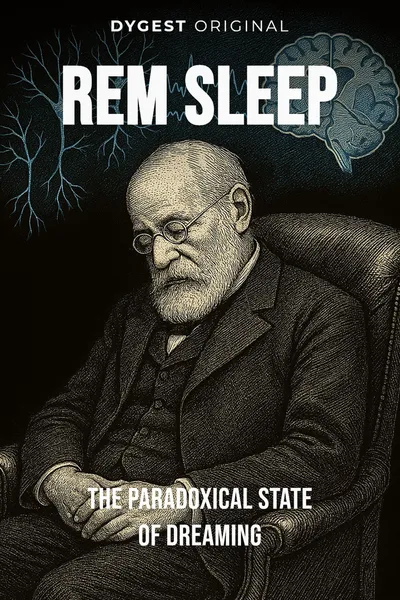
REM Sleep
The paradoxical state of dreaming
Description
In a University of Chicago lab in 1953, a graduate student named Eugene Aserinsky sat watching a machine scratch ink across a rolling drum of paper. He had wired his young son up to electrodes and left him to sleep, expecting the pens to go flat and stay flat, the way everyone assumed a sleeping brain behaved. Instead, several times through the night, the pens jumped to life. The boy's eyes were darting back and forth under closed lids, quick and coordinated, as if he were following a fast game of tennis nobody else could see. Aserinsky thought the equipment was broken. It wasn't.
What he had stumbled onto, working under the physiologist Nathaniel Kleitman, was a recurring phase of sleep in which the body lies still and slack while the brain lights up almost exactly as it does when awake. Wake a person during one of these episodes and they will, more often than not, tell you they were in the middle of a dream. The French neuroscientist Michel Jouvet later gave the state its most fitting name: paradoxical sleep. Deeply asleep, and yet, by the readings, intensely alert. The two facts sit together and refuse to resolve.
We spend roughly a fifth of every night in this condition, cycling through it four or five times before morning, and for most of human history nobody knew it was happening. The discovery didn't just add a line to the biology textbooks. It reopened the oldest question we have about the sleeping mind — what dreams are for — and handed it to people with electrodes instead of couches.
The question we’re asking : Why does the brain switch itself back on while the body stays paralyzed, and what work is it doing down there?What we’ll see : How a stray reading on a lab drum became a window into what the sleeping brain is quietly rehearsing.
Table of contents
01 Chapter 1 — The sleeper who was wide awake
The paradox is right there in the physiology. During REM sleep — the R and E and M stand for rapid eye movement, those darting flicks Aserinsky first spotted — the brain's electrical activity looks strikingly like wakefulness. The slow, rolling waves of deep sleep vanish. In their place come fast, low, desynchronized patterns, the signature of a mind that is processing rather than idling. If you only had the brain readout in front of you, you might guess the person was awake and thinking hard.
Then you look at the body, and the story flips. During REM, the major muscles go almost completely limp. The brain sends a signal down the spinal cord that switches off the motor neurons controlling the arms, legs, and trunk, leaving us essentially paralyzed. Breathing turns irregular, heart rate wanders, and the eyes keep moving — but a sleeper in REM cannot get up and walk. This isn't a glitch. It's a safety mechanism, and we can see what happens when it fails.

02 Chapter 2 — A stage nobody had been looking for
Before 1953, sleep was treated as a single, passive thing — a nightly power-down, the brain unplugged until morning. Aserinsky and Kleitman's finding cracked that assumption. Sleep turned out to be structured, cycling through distinct stages in a repeating arc across the night. We drift down through progressively deeper non-REM stages, the ones with the big slow waves, and then, roughly ninety minutes in, the brain climbs back up into REM. Then the cycle starts again.
The shape of the night matters. Early cycles are heavy on deep non-REM sleep; the last stretch before waking is dominated by REM. This is why the most vivid dreams tend to come in the hours just before the alarm, and why cutting a night short lops off a disproportionate chunk of dreaming. It also explains a stubborn everyday fact — that we forget almost all of it. Dreams live in a state that isn't built to hand its contents cleanly over to the waking, remembering brain.
03 Chapter 3 — What the brain rehearses in the dark
So what is that process? The most durable answer points at memory. Across the night, the brain seems to sort through the day's experiences, strengthening some connections and pruning others, deciding what to keep. Deep non-REM sleep does much of the heavy filing — moving fresh memories into longer-term storage. REM appears to handle a different part of the job: weaving new material into what we already know, and doing something with the emotional charge attached to it.
The evidence is circumstantial but it stacks up. People who learn a demanding new skill and then sleep on it perform better the next day, and the improvement tracks with how much REM they got. Deprive someone of REM specifically — wake them each time they enter it — and certain kinds of learning suffer, particularly the emotional and procedural kinds. The brain, it seems, doesn't just record. It rehearses. The darting eyes may even correspond to the brain scanning through its own generated imagery, running the scenes.
04 Chapter 4 — The mind that keeps working after we clock out
The deepest thing REM sleep unsettles is our intuition that the mind is something we operate. We tend to imagine the self as a driver who clocks off at night, leaving an empty vehicle in the garage until morning. REM says otherwise. The most demanding cognitive work — integrating experience, filing memory, metabolizing emotion — carries on while the person supposedly in charge is unconscious and immobilized. The self isn't running the show. It's a passenger who wakes up to find the work already done.
This flips how we might think about a good night's sleep. The value of the night isn't only that the body recovers. It's that a hidden process is stitching who we were yesterday into who we'll be tomorrow — consolidating skills we practiced, folding new facts into old ones, deciding what our experiences will mean once we've slept on them. Continuity of self, the sense that we are the same person across days, seems to be partly manufactured in the dark, by machinery we never consciously touch.
05 Conclusion
Aserinsky assumed his equipment was broken because he, like everyone, expected a sleeping brain to do nothing. The pens jumping across the paper were the first sign that we had the whole thing backwards. The sleeping brain is not idling. Several times a night it powers back up, pins the body in place, and runs a process intense enough that a person freed from the paralysis will get up and fight the air.
Related books