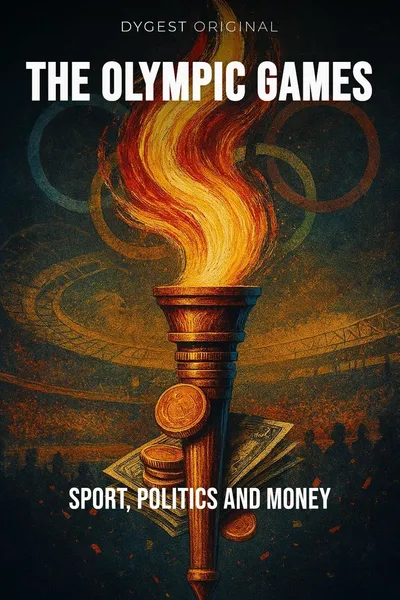
The Olympic Games
Sport, politics and money
Description
On April 6, 1896, in a marble stadium rebuilt for the occasion in Athens, a crowd of roughly eighty thousand watched the first modern Olympic Games open. The competitors were an odd assortment: a few serious athletes, a handful of tourists who happened to be in town, university students, a Harvard man who entered on a whim. There were 241 of them, all men, from fourteen nations. The marathon was won by a Greek water-carrier named Spyridon Louis, and the country lost its collective mind with joy. The whole thing cost a fraction of a modern opening ceremony and nearly didn't happen at all, because the money kept running out.
A little over a century later, the picture had changed beyond recognition. The Games now draw more than ten thousand athletes, broadcast to billions, and cost host cities figures that routinely run past ten billion dollars. Tokyo 2020, delayed a year by the pandemic, ended up somewhere north of $13 billion by official counts, and considerably more by independent ones. Somewhere between Spyridon Louis and the modern spectacle, a modest revival of an ancient festival turned into one of the largest recurring commercial and political events on the planet.
The interesting thing is how tangled the three forces became. Sport was supposed to be the point. But almost from the start, politics used the Olympic stage, and eventually money reshaped everything around it. The rings that were meant to symbolize five continents in friendly rivalry became, in practice, a contested space where governments performed and corporations bought their way in.
The question we’re asking : How did a low-budget athletic festival become an event where sport, national politics and enormous sums of money are impossible to separate?What we’ll see : We follow the modern Games from a struggling Athens revival to the spectacle they became, and what that transformation costs the cities that host it.
Table of contents
01Chapter 1 — A baron's idea, revived for a modern century
The modern Olympics owe their existence largely to one determined Frenchman. Pierre de Coubertin, a young aristocrat born in 1863, became convinced that organized sport could reform character, strengthen nations, and knit the world together in peaceful competition. He had been impressed by the athletic culture of English boarding schools and troubled by France's military defeat to Prussia in 1871. Reviving the ancient Greek Games, he thought, might do for the modern world what he imagined they had done for antiquity. It was a romantic idea, and like most romantic ideas it needed a great deal of practical pushing to become real.
In 1894, Coubertin gathered delegates at the Sorbonne and founded the International Olympic Committee, the private body that still owns and runs the Games today. The first edition landed in Athens two years later, a nod to the ancient origins. The Greeks were enthusiastic but broke; the event was rescued in part by a wealthy benefactor, Georgios Averoff, who paid to rebuild the stadium in marble. Even at the very beginning, the Games needed a patron with deep pockets to survive.

02Chapter 2 — The rings become a stage
It did not take long for governments to notice that the whole world was watching. If billions of eyes turn toward one city every four years, that city, and the nation behind it, has a chance to say something. The Games became a stage, and the performances were rarely just athletic. The most infamous early example was Berlin 1936, which the Nazi regime engineered into a propaganda showcase for a supposedly resurgent Germany. Jesse Owens, the Black American sprinter who won four gold medals, complicated the intended message considerably, but the intent was unmistakable: the Olympics could be used.
The Cold War turned the Games into a proxy battlefield. Medal counts became a scoreboard for competing systems, with the United States and the Soviet Union each treating gold as evidence of national superiority. The rivalry produced boycotts on a grand scale. The United States and its allies stayed away from Moscow in 1980 over the Soviet invasion of Afghanistan; the Soviet bloc returned the favor by skipping Los Angeles in 1984. For two consecutive Games, the world's two strongest sporting nations were largely absent, and everyone understood exactly why.
03Chapter 3 — When the money arrived
For most of their history, the Games were amateur in principle and modest in budget. That began to change decisively in the 1980s, and the pivot point has a fairly precise address: Los Angeles, 1984. After Montreal 1976 left its host with a debt so large it took the city three decades to pay off, few places wanted the Games at all. Los Angeles was essentially the only serious bidder, which gave its organizers unusual leverage to run things on their own terms.
Peter Ueberroth, the businessman who led the Los Angeles organizing committee, reinvented the financial model. He used existing venues instead of building new ones, sold exclusive sponsorship categories to a limited number of major corporations at premium prices, and negotiated hard on television rights. The result was a Games that turned a surplus of roughly $215 million, an outcome that stunned an Olympic world used to red ink. Suddenly hosting looked less like a civic sacrifice and more like a business opportunity.
04Chapter 4 — The bill that arrives after the closing ceremony
The commercial success of the Games created a strange asymmetry. The IOC and its sponsors reliably profit; the host city usually does not. When the flame is extinguished and the athletes fly home, what remains is a city holding an invoice, and the invoices have grown alarming. Studies of Olympic budgets have found that essentially every modern Games has run over its original estimate, often by large multiples. The cost overruns are not occasional accidents; they are the norm, a structural feature of the way the Games are built.
The reasons are fairly consistent. A city bids years in advance with an optimistic figure, wins, and then discovers that stadiums, transport, security and villages cost far more than promised, with an immovable deadline removing any leverage to control spending. Much of what gets built has little use afterward. Athens 2004 left Greece with venues that fell into disrepair within years, a burden that looked especially cruel when the country's debt crisis arrived soon after. Rio 2016 left behind shuttered arenas and an Olympic Park that struggled to find any purpose.
05Conclusion
The distance from Spyridon Louis, the water-carrier who ran into Athenian legend, to the multi-billion-dollar spectacle of today is not just a story of growth. It is a story of what happens when an idea catches on completely. Coubertin wanted sport to build character and bring nations together, and in a sense he got his wish: the whole world does gather, every couple of years, around the same events. But the gathering attracted everything that gathers where the world is watching, governments with messages, corporations with logos, and the enormous machinery of money that follows attention wherever it goes.
Related books