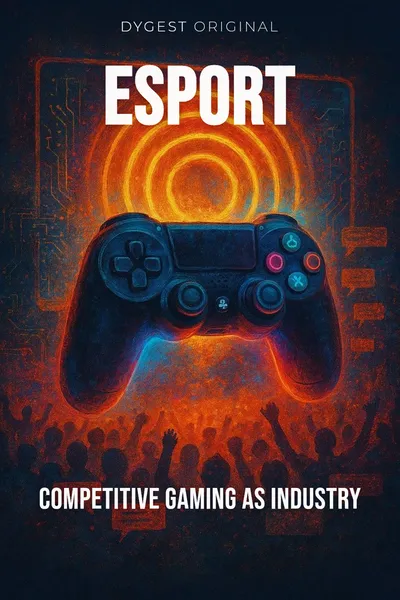
Esport
Competitive gaming as industry
Description
In July 2013, the United States government did something that quietly reset how a whole industry saw itself: it agreed to grant a professional League of Legends player a P-1 visa, the category reserved for internationally recognized athletes. Danny "Shiphtur" Le, a Canadian gamer, entered the country to compete on the same paperwork a foreign soccer striker would use. It was a bureaucratic footnote, but it carried weight. A young man who played a video game for a living was now, in the eyes of an immigration office, an athlete. The people who had spent years insisting that competitive gaming was a real profession finally had a stamp to point at.
By then the numbers were already outgrowing the joke. That same year, the League of Legends world final filled the Staples Center in Los Angeles, and within a few seasons a single tournament could draw an online audience larger than the Super Bowl's, at least by the counts the organizers preferred. Investment poured in from traditional sports owners, private equity, energy-drink brands, and eventually the game publishers themselves. Franchise slots in top leagues sold for tens of millions of dollars. Then, somewhere around the turn of the decade, the mood shifted. Teams that had raised fortunes started cutting rosters. The phrase "esports winter" began appearing in the same breath as the growth charts.
So esport is not really one thing. It is a sport, a media product, a marketing channel, and a piece of software owned by a company that can change the rules overnight. Those layers rarely pull in the same direction, and the tension between them is where the whole business either holds together or comes apart. Understanding esport as an industry means asking who built it, who funds it, and who ends up paying when the funding cools.
The question we’re asking : Once competitive gaming became a genuine industry, could it actually pay for itself?What we’ll see : How esport got built, who bankrolls the spectacle, what it costs the people at the center of it, and whether the whole structure can stand on its own.
Table of contents
01Chapter 1 — A South Korean lesson nobody planned for
Long before venture capital discovered esport, South Korea had already run the experiment. In the late 1990s, the country was rebuilding after the Asian financial crisis, rolling out some of the fastest broadband in the world and filling its cities with PC bangs — internet cafés where a few thousand won bought an hour of gaming on good machines. Into that infrastructure landed StarCraft, a real-time strategy game from Blizzard released in 1998. It sold millions of copies in Korea specifically, far out of proportion to anywhere else, and it became something closer to a national pastime than a product.
What happened next was not planned by any single company. Television channels dedicated entirely to gaming appeared in the early 2000s, most notably OGN, broadcasting matches with commentators, replays, and studio production borrowed straight from traditional sports. Star players became household names. Corporations like Samsung and SK Telecom fielded salaried teams the way a bank might sponsor a cycling squad. A generation grew up watching two people move armies of digital soldiers across a map and treating it as legitimate spectator entertainment.

02Chapter 2 — Who actually pays for the show
Follow the money in esport and you quickly notice how little of it comes from the obvious place. In a traditional sport, the core revenue is fans — through tickets, television subscriptions, and merchandise. In esport, watching is almost entirely free. The tournaments stream on Twitch and YouTube at no cost, which is exactly why the audiences got so large so fast, and also why converting that audience into revenue has been the industry's central headache from the start.
So the bills get paid elsewhere. The largest single stream, for most teams, has long been sponsorship: logos on jerseys, branded content, and partnerships with hardware makers, energy drinks, and increasingly banks and car companies wanting to reach a young audience that skipped cable. On top of that sit media rights, prize money, and the money publishers themselves inject to keep their leagues alive. Riot Games, which owns League of Legends, and Valve, which runs the Dota 2 circuit, are not neutral hosts. They are the landlords, and they decide how much rent the ecosystem can charge.
03Chapter 3 — The player is the product, and the product burns out
Strip away the arenas and the sponsor logos and esport sells one thing: people who are astonishingly good at a game, doing it live. The players are the product, and the industry has never quite figured out how to treat them accordingly. A professional in a top League of Legends or Counter-Strike team practices with a schedule that would exhaust an athlete in any discipline — often ten to twelve hours a day, six days a week, much of it scrimmaging the same maps against the same opponents until muscle memory does the work.
The careers are also brutally short. Reflexes and reaction speed, which matter enormously in most competitive titles, tend to peak young and decline early. A player who turns professional at seventeen may find themselves considered past their prime by their mid-twenties, an age at which a soccer player is only entering their best years. Compressed careers mean compressed earning windows, and for every star pulling a large salary and streaming income, there are dozens on modest contracts hoping to break through before the game itself changes under them.
04Chapter 4 — The bill nobody has paid yet
Step back from the arenas and the visa stamps, and esport starts to look less like a new sport and more like a familiar kind of bet — one made across most of the last decade of cheap money. Investors poured capital into teams not because those teams were profitable, but because the audience was growing and the assumption was that profitability would follow, the way it eventually did for streaming and social media. Valuations were built on projected attention rather than banked revenue. It was a growth story, and growth stories work beautifully until the funding that sustains them gets more expensive.
When interest rates rose and speculative capital dried up around 2022 and 2023, the gap became visible fast. Teams that had raised tens of millions found that the sponsorship market, especially the crypto money that had flooded in, could evaporate overnight. Organizations that had bought franchise slots discovered those slots were only as valuable as the league's health, and several tried to sell or exit. The talk of an "esports winter" was really the sound of an industry being asked, for the first time, to fund itself from what it actually earned rather than from what it hoped to earn.
05Conclusion
A decade after an immigration office decided a gamer could be an athlete, esport has most of the trappings of a mature industry: leagues, franchises, salaried players, support staff, and audiences that dwarf plenty of traditional sports. What it has struggled to build is the thing underneath the trappings — a business that reliably makes more than it spends, on money that comes from the people watching rather than the people investing. The Korean pioneers proved the audience was real. The years since have been a long argument about whether the audience is enough.
Related books