Antibiotics
A resource we are spending down
Description
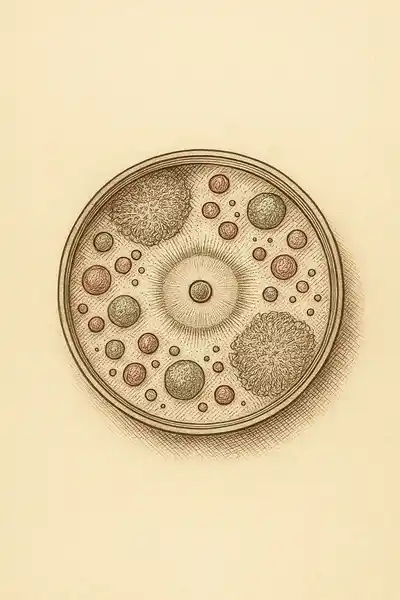
In 1928, Alexander Fleming came back from holiday to find a mold had killed the bacteria on one of his forgotten petri dishes. The discovery of penicillin is one of the founding stories of modern medicine, and the myth usually stops there — a lucky accident that saved millions. What gets left out is the second half, the part Fleming himself said out loud. In 1945, accepting the Nobel Prize, he warned that bacteria exposed to too little penicillin would learn to resist it, and that careless use would eventually make the drug useless. He was describing, before anyone had the vocabulary for it, a resource that could be used up.
He was right on the timing, too. Penicillin reached wide use in the mid-1940s; the first penicillin-resistant staph infections were showing up in hospitals within a few years. Each new antibiotic since has followed the same arc — introduction, wide use, and then, sooner or later, the appearance of bacteria that shrug it off. We tend to picture medicine as a ladder that only goes up. Antibiotics are the rare case where the rungs can rot behind us, where a cure that worked reliably for a generation quietly stops working.
The numbers now describe a slow-moving problem that most of us never think about until we, or someone close, run into an infection that won't clear. Drug-resistant bacteria are associated with well over a million deaths a year worldwide, and the trend points the wrong way. Meanwhile the supply of genuinely new antibiotics has thinned to a trickle. To understand how we got here, it helps to stop thinking of antibiotics as a technology and start thinking of them as something we have been spending down.
The question we’re asking : How did drugs that once beat almost any infection become a resource we're running out of?What we’ll see : How resistance is written into the biology of bacteria, and why the shelf that once refilled itself no longer does.
Table of contents
01 Chapter 1 — The drug that stopped working
Before antibiotics, a scratch could kill you. A cut that turned septic, an infected tooth, pneumonia after the flu, a routine childbirth — any of these could tip into a death that no doctor could stop. The arrival of penicillin, and then a wave of other antibiotics through the 1940s and 1950s, changed the basic terms of being alive. Surgery became survivable because infections could be managed. Chemotherapy and organ transplants, which leave patients wide open to infection, became possible only because there was something to fall back on.
For a stretch of maybe three decades, the pace of discovery outran the problem. Streptomycin, tetracycline, erythromycin, the cephalosporins — the pharmacy kept filling with new families of drugs, each attacking bacteria in a different way. When one stopped working, another was waiting. The confidence of that era was so complete that in 1969 the US Surgeon General is often quoted as saying it was time to close the book on infectious disease. Whether he said it in exactly those words is debated, but the mood was real. Infection felt like a solved problem.

02 Chapter 2 — How bacteria learn to survive
Resistance isn't the bacteria getting cleverer, and it isn't the individual germ toughening up because it met a drug. It's evolution, running at a speed we can actually watch. A single bacterium can divide every twenty minutes or so; a population of billions can turn over dozens of generations in a day. In any population that large, random mutation guarantees that a few cells will happen to carry a change — a slightly altered protein, a pump that spits the drug back out — that lets them survive a dose that kills the rest.
Then the antibiotic does exactly what natural selection needs. It clears out the susceptible cells and leaves the field to the survivors, which multiply into a population that the drug no longer touches. The drug doesn't create the resistant trait; it selects for it. This is why finishing a course matters, and why using antibiotics for viral infections they can't touch is so costly: every exposure that doesn't finish the job is a training session, handing an advantage to whatever happened to survive.
03 Chapter 3 — The way we spent the surplus
For most of the antibiotic era, the surplus felt infinite, and we treated it that way. Doctors, facing an anxious patient and an uncertain diagnosis, wrote prescriptions for infections that would have cleared on their own or that no antibiotic could reach — a sore throat, a cold, a cough. The drug felt free and harmless, so the default was to reach for it. Multiplied across billions of prescriptions, that habit became one of the main engines of resistance, spending down a shared resource one reasonable-seeming decision at a time.
The larger drain is harder to see because it happens on farms. Globally, a large share of all antibiotics produced — by many estimates the majority — goes not to sick people but to healthy animals, mixed into feed to prevent disease in crowded conditions and to make animals grow faster. The same drugs, or close cousins of them, are used at enormous volume in settings where the whole point is low-level constant exposure. From an evolutionary standpoint, this is close to a worst-case design: exactly the conditions that select for resistant bacteria, which then move through the environment and into people.
04 Chapter 4 — A commons no one is refilling
What kept the antibiotic era going wasn't restraint — it was resupply. As long as new drugs kept arriving, resistance to the old ones was survivable. The shelf refilled itself. The reason the situation feels newly urgent is that the shelf has largely stopped refilling. Since the late 1980s, the number of genuinely new classes of antibiotics reaching patients has dwindled to almost nothing. We are still relying, in large part, on chemistry discovered decades ago, against bacteria that have had decades to adapt.
The cause is less scientific than economic, and it's a peculiar trap. A new antibiotic that works well is one a responsible health system will use as little as possible, holding it in reserve precisely because overuse would burn it out. So the better the drug, the smaller its market. Compare that with a medication for a chronic condition, taken daily for years, and the math is brutal: a drug company can spend a billion-plus dollars developing an antibiotic that, by design, it is discouraged from selling. Several firms that specialized in new antibiotics have gone bankrupt even after getting drugs approved. The reward structure actively points away from the thing we most need.
05 Conclusion
Fleming's warning in 1945 turned out to be less a prediction than a description of the whole system in miniature. Use too little, use it carelessly, and the bacteria come back stronger — he saw the evolutionary logic before it had a name. What he could not have seen was the second failure: that decades later the pipeline of replacements would run dry not for lack of science but for lack of a business case. The drug that stopped working, in the end, stopped being replaced.
Related books