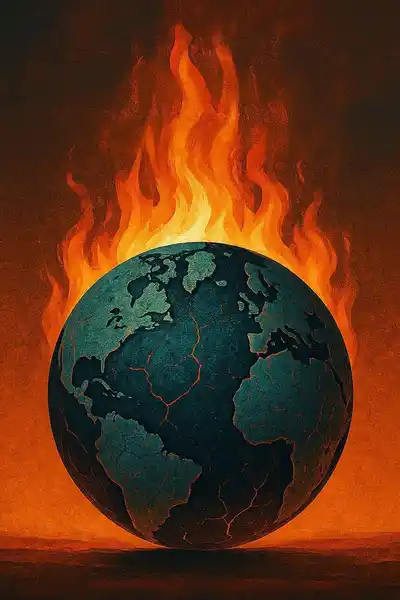
The Anthropocene Event
A geological epoch as political claim
Description
In February 2000, at a scientific meeting in Cuernavaca, Mexico, a Dutch atmospheric chemist named Paul Crutzen interrupted a discussion about the Holocene — the warm, stable epoch that had held for roughly the last 11,700 years. He said, more or less, that the term no longer fit. We were not in the Holocene anymore. Humans had changed the composition of the atmosphere, the chemistry of the oceans, the sediment of rivers so thoroughly that a new geological chapter had begun. He reached for a word he had not planned, one already floating loosely in a few obscure papers: the Anthropocene. The epoch of humans.
Crutzen, who had shared a Nobel Prize five years earlier for his work on the ozone layer, was not proposing a slogan. He meant it as stratigraphy — a claim that future geologists, digging into the rock, would find a clear signature of our species. Within a decade the word had escaped the geology journals entirely. It turned up in art biennials, philosophy seminars, UN reports, museum shows. Something about it felt true and enormous at once, a single term that seemed to name the whole situation we had backed ourselves into.
The French historians Christophe Bonneuil and Jean-Baptiste Fressoz took the word seriously enough to ask an awkward question about it. If we are going to name a geological epoch after ourselves, they argue, we had better be careful about what that name quietly asserts — and about the tidy, flattering story it tends to tell.
The question we’re asking : What does it actually mean to name a geological epoch after our own species — and what does that name conceal?What we’ll see : How a single word travelled from a Mexican conference room into a fierce argument about history, blame, and who the "we" in this story really is.
Table of contents
01Chapter 1 — A word coined at a conference
The formal machinery of geology moves slowly, and for good reason. Epochs, periods and eras are drawn on the basis of markers preserved in rock — a shift in fossils, a spike in a chemical element, a layer of ash — that can be read the same way anywhere on Earth. The Holocene, our current official epoch, was defined by the warming that ended the last ice age. To add a new epoch is to argue that the planet has crossed a line deep and durable enough to leave that kind of trace. Crutzen's wager was that human activity had done exactly that.
The evidence he pointed to was not subtle. Since the late eighteenth century, the concentration of carbon dioxide in the atmosphere had climbed steeply; nitrogen fixed by industrial fertiliser now outweighed all the nitrogen fixed by nature; dams held back so much sediment that river deltas were starving. Crutzen initially suggested the epoch had begun around 1784, the year James Watt patented an improved steam engine — a neat, almost too neat, origin story that placed the coal-fired factory at the centre of the tale.

02Chapter 2 — The story humanity tells itself
Once it went public, the Anthropocene arrived wrapped in a particular narrative, and Bonneuil and Fressoz spend much of the book gently pulling that narrative apart. In its popular form the story goes like this: humanity, long innocent of its own power, unwittingly became a force of nature. We burned coal, we cleared forests, we multiplied — and only recently, thanks to science, did we wake up to the damage. It is a tale of accidental sleepwalking followed by dawning awareness, and it flatters everyone in it.
The trouble, the authors argue, is that it is mostly false. The idea that earlier generations were blind to what they were doing does not survive contact with the archive. As far back as the eighteenth and nineteenth centuries, foresters worried about deforestation, doctors warned about coal smoke, naturalists described species vanishing, and colonial administrators debated whether clearing land dried out the climate. People knew. They measured, they complained, they published. The knowledge existed alongside the destruction; it simply lost the argument, again and again, to profit, empire and power.
03Chapter 3 — Who exactly is the anthropos
The Anthropocene means, literally, the epoch of anthropos — of the human, the species, all of us. And that, for Bonneuil and Fressoz, is precisely where the word starts to mislead. It dissolves an unequal history into a single collective subject. "Humanity" changed the atmosphere. But humanity does not burn coal; particular economies, classes and nations do, in wildly different amounts.
The figures make the point hard to dodge. A large share of historical carbon emissions traces to a handful of early-industrial and then wealthy nations. Well into the twentieth century, the bulk of the world's population contributed almost nothing to the accumulating stock of greenhouse gases, while feeling its consequences first and worst. To bundle a subsistence farmer and a coal magnate into the same guilty "we" is not just imprecise; it is a way of spreading responsibility so thin that it disappears.
04Chapter 4 — Naming as a way of deciding
Step back from the stratigraphy and the golden spikes, and the argument Bonneuil and Fressoz are really making comes into focus. To name a geological epoch after ourselves is not merely to describe the Earth. It is to make a claim — about causes, about history, about who owes what to whom. The Anthropocene looks like a fact discovered under a microscope. It behaves, in the world, like a political statement.
This is what gives the naming fight its heat. A name is a compression of a story, and whichever story wins tends to distribute responsibility along with it. "Anthropocene" spreads the burden across the whole species and, in doing so, lightens it for those who carried most of it. "Capitalocene" or "Plantationocene" refuse that comfort and hand the invoice to particular systems and their beneficiaries. None of these is neutral. Each is a way of deciding, in advance, what kind of problem we think we are facing and therefore what kind of answer counts.
05Conclusion
Crutzen died in 2021, before the geological establishment reached any final verdict on his word. The formal committees kept deliberating, weighing the plutonium spike of the atomic age against the steam engine and the Great Acceleration, and in 2024 a key body declined to ratify the Anthropocene as an official epoch at all. Yet the term had long since outrun that ruling. Whether or not it is ever engraved into the official timescale, it has become the name a whole culture reaches for when it tries to grasp the scale of what is happening to the planet.
Related books