Staying with the Trouble
Living with damage, not solving it
Description
In 2016, the feminist theorist and biologist Donna Haraway published a strange, dense, generous book called Staying with the Trouble. She was in her early seventies, a long career at UC Santa Cruz behind her, best known for a 1985 essay about cyborgs that had rewired how people thought about bodies and machines. This new book arrived into a moment thick with dread about the planet, and it refused, almost aggressively, to behave the way books about the planet were supposed to behave. It would not scare us straight. It would not promise a fix. It offered instead a phrase, repeated like an instruction: stay with the trouble.
The trouble, for Haraway, is the ecological damage already done and still unfolding — extinctions, poisoned water, warming oceans, the whole tangle we've come to file under crisis. Most responses to that tangle, she noticed, split into two moves. One says it isn't really that bad, or that clever technology will save us in time. The other says it's over, we've broken everything, all that's left is to grieve. Haraway found both moves to be forms of leaving — ways of exiting the present rather than inhabiting it.
What she proposed instead is harder to summarize because it is deliberately not a solution. It's a way of being present to damage without denial and without collapse, a practice of living and dying well with others on a wounded Earth. To get there she builds a vocabulary that sounds odd at first and starts to feel necessary: creatures that make each other, kin that isn't blood, stories that do real work in the world.
The question we’re asking : What does it mean to face ecological damage without either pretending it away or giving up on it?What we’ll see : How Haraway builds a whole way of thinking out of the refusal to take either easy exit.
Table of contents
01Chapter 1 — A word against the two easy exits
Haraway's title is doing more than it looks. "Trouble," she notes, comes through an old French root, troubler — to stir up, to make cloudy, to disturb. Trouble is not a problem waiting for an answer. It's turbulence, the churned-up state of things, and her verb of choice is stay. Not fix, not flee. Stay with. The whole book is an argument for a posture most of us find almost unbearable: remaining present inside a situation we cannot resolve, without reaching for the exit in either direction.
The first exit she names is what she calls comic faith in technological fixes — the assurance that human ingenuity, or the market, or some future machine, will handle the mess before it costs us anything real. This isn't denial in the crude sense. It's a subtler dodge that lets us keep living exactly as we do while outsourcing the trouble to a solution that hasn't arrived. The second exit is its mirror image: a fatalism that treats the game as already lost, so that the only honest response is mourning. Haraway takes despair seriously as a feeling. As a stance, she finds it just as evasive, because it too excuses us from the ongoing work of the present.

02Chapter 2 — Nobody makes themselves alone
The first tool is a word Haraway borrows and champions: sympoiesis, meaning "making-with." She sets it against autopoiesis, the older idea of systems that make and maintain themselves as bounded, self-producing units. The trouble with self-making, she argues, is that nothing actually does it. Nothing is self-organizing all the way down. Everything that lives, lives through and with other things, in arrangements too entangled to sort into neat individuals.
Her favorite evidence comes straight from biology, and she leans on the work of researchers like Lynn Margulis and Scott Gilbert to make it. Consider that a cow is not really one organism but a walking collaboration with the microbes in its gut that let it digest grass. Consider that our own bodies carry more microbial cells than we once believed were properly "ours," that many creatures cannot develop at all without partners folded into their tissue. The lichen on a rock is a fungus and an alga living as one thing. At the level where life actually operates, the self-contained individual turns out to be a convenient fiction.
03Chapter 3 — Making kin, not babies
From sympoiesis comes the book's most provocative slogan: Make Kin Not Babies. It's the kind of line that gets Haraway into arguments, and she means it to. Kin, in ordinary use, means family by blood or marriage — the people you're tied to by birth and law. Haraway wants to pry the word loose from ancestry entirely. Kin, for her, is a category of care and obligation you build, not one you inherit. It can include people you're unrelated to, and it deliberately reaches past the human to include other creatures, other kinds of life.
The slogan has two edges. One touches the delicate matter of human numbers on a finite planet, and Haraway is careful and contested here. She's not issuing a coercive population program; she's aware, painfully, of how such arguments have been used against poor and racialized communities. Her point is about reorienting desire — loosening the grip of the pronatalist assumption that flourishing means more of us, and asking whether the intensity we pour into producing and raising our own genetic children might be spread wider, toward relations we choose and creatures we're bound to.
04Chapter 4 — When the story is the tool
Underneath the biology and the slogans runs Haraway's deepest wager, the one that makes the whole book cohere: that stories are not commentary on reality but instruments that help build it. "It matters what stories tell stories," she writes, turning the sentence over and over in variations, "what thoughts think thoughts, what worlds world worlds." The claim is that the figures we live by — the metaphors, the myths, the shapes we give to what's happening — quietly determine what we can imagine doing. Change the story and you change the range of possible action.
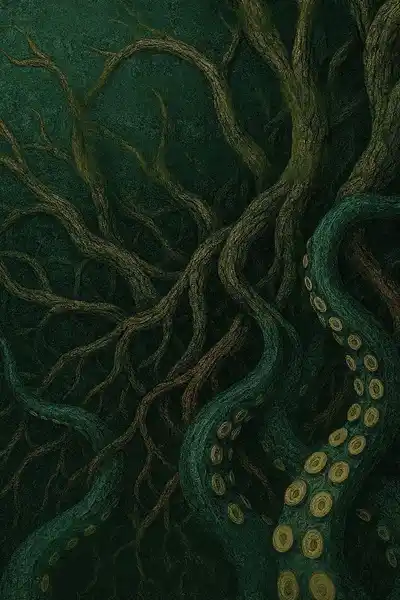
This is why she spends so much of the book on figures that seem playful, even eccentric. She reaches for spiders, for the tentacled and the many-limbed, for what she calls the Chthulucene — an awkward name meant to displace the more familiar Anthropocene. Where "Anthropocene" tells a story of one species as the lone geological hero-villain, standing apart and above, the Chthulucene tells a story of Earthbound powers all tangled together, humans among them but never in charge. The name is ugly on purpose. It refuses the flattering drama of human centrality that even our darkest crisis-talk tends to preserve.
05Conclusion
Staying with the Trouble ends not with a plan but with a fable — a many-generations story Haraway invents about humans learning to live bound to a threatened species — because a fable is exactly the kind of tool the book has been arguing for. Having refused both the promise of rescue and the comfort of despair, she needed somewhere for the reader to stand, and what she offers is a way of imagining forward that includes the damage rather than erasing or surrendering to it. The point was never to make the trouble go away. It was to make it livable, and shared.
Related books