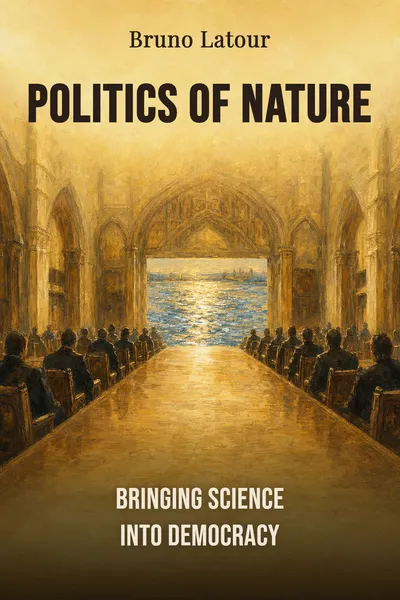
Politics of Nature
Bringing science into democracy
Description
In 1999, the French philosopher and sociologist Bruno Latour published a book with a title that reads like a provocation: Politics of Nature. The provocation is real, but it points the other way from what most readers expect. Latour was not proposing that we finally listen to nature and let it settle our arguments about rivers and forests and climate. He was proposing, in a phrase he repeats like a refrain, that political ecology has to let go of nature altogether. For decades, activists had been saying the opposite — that if only politics would bow to ecological reality, our quarrels would end. Latour looked at that hope and called it a trap.
His argument came out of a career spent watching scientists at work — in laboratories, on expeditions, around instruments — and noticing that what they produced was never a clean fact handed down from outside human affairs. Facts were built, slowly, through controversy, apparatus, and negotiation, and then presented as if they had always been there. That observation, harmless enough in a study of soil samples, becomes explosive when applied to environmental politics, where one side keeps invoking Nature with a capital N to stop the conversation cold.
So Latour set out to redesign the whole arrangement — the way we sort the world into a realm of mute objects studied by experts and a realm of noisy humans arguing over values. He wanted a single assembly where both could be represented, where a river or a virus or a warming atmosphere could have a seat, and where no one gets to end debate by claiming to speak for reality itself.
The question we’re asking : If invoking nature is what keeps ending our environmental arguments prematurely, what would a politics look like that brought science inside democracy instead of above it?What we’ll see : How a philosopher of science dismantled the split between facts and values, and sketched an assembly where things themselves are heard.
Table of contents
01Chapter 1 — The trouble with the word nature
Latour begins by turning the tables. Political ecology, he argues, keeps failing not because it loves nature too little but because it leans on the idea of nature too much. Every time a movement declares that we must respect the laws of nature, obey ecological balance, or return to what is natural, it borrows a weapon that was forged to shut politics down. Nature, in the Western tradition, is precisely the name we give to whatever is supposed to be beyond dispute — the settled, the given, the not-up-for-debate. Wheeling it into a democratic argument is like ending a vote by revealing the answer was fixed in advance.
The catch is that nature has never been one thing. Latour points out how conveniently it multiplies. There is the wilderness nature of hikers, the harsh nature of survival, the harmonious nature of the ecologists, the resource nature of the economists — and each faction claims theirs is the real one. What passes for an appeal to a single external reality is, on closer inspection, a crowd of rival natures, each carrying a political program smuggled inside a fact. Calling something natural doesn't settle the question; it hides the question.

02Chapter 2 — The old settlement: two houses, one gag order
Behind the everyday word, Latour sees an old constitutional arrangement, one he traces back to the founders of modern thought. Reality gets divided into two chambers. In one sits the world of objects — mute, law-governed, knowable only through science. In the other sits the world of humans — speaking, valuing, quarreling, the proper stuff of politics. The genius of the arrangement is a strict division of labor: scientists have privileged access to the first house, citizens to the second, and the two are not supposed to mix.
This bicameral setup looks like a peace treaty, but Latour reads it as a gag order dressed up as epistemology. Under it, only scientists may report what the world is really like, and they do so, crucially, without needing anyone's consent — nature does not vote. Once a fact is certified in the house of objects, it descends into the house of humans as an order that cannot be contested, only obeyed. Politics is left to squabble over values while the facts arrive pre-decided from the other room.
03Chapter 3 — A parliament that seats things
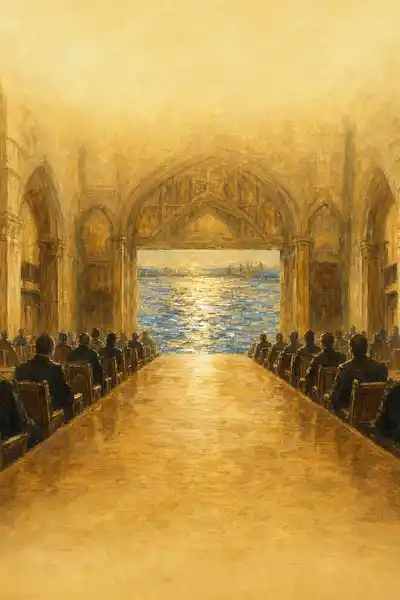
What Latour proposes in place of the two houses is a single collective — an assembly charged not with obeying a nature already known but with slowly composing a common world out of humans and nonhumans together. His striking image is a parliament of things: a chamber where a river, a chemical, a species, an ocean current can be admitted into the conversation as a party with interests, not merely as a resource to be allocated or a fact to be cited.
This does not mean the salmon rise to give speeches. Nonhumans, like many humans, need spokespersons — and here scientists reappear, no longer as oracles delivering verdicts from the other house but as delegates who represent the things they study, arguing on their behalf the way a lawyer argues for a client. Their claims carry weight, but they can be questioned, challenged by rival delegates, sent back for more inquiry. Representation replaces revelation. The scientist speaks for the ozone layer rather than as the ozone layer.
04Chapter 4 — From matters of fact to matters of concern
Step back from the machinery and the deeper wager becomes visible: Latour is trying to describe an ecology that no longer needs nature to work. This sounds paradoxical until you notice how much of environmental argument runs on the appeal to a settled outside — a balance we have disturbed, a limit we have crossed, a truth that will vindicate us if only people would face it. That appeal feels powerful, but it keeps ecology permanently on the back foot, forever waiting for reality to end the argument on its behalf. It never does.
Latour's alternative reframes the objects of concern themselves. A fact, in his vocabulary, is best understood not as a matter of fact — inert, finished, imposed — but as a matter of concern: something gathered, attached to instruments and institutions and stakes, held together by work that could always come apart. Climate change is not a bare truth waiting outside the door of politics; it is a dense assembly of measurements, models, disputes, and consequences that has to be built and defended and continually re-earned. Seeing it that way does not weaken it. It makes clear why defending it takes a whole apparatus, and who is doing the defending.
05Conclusion
The provocation of the title turns out to be its argument. Politics of Nature does not urge us to submit politics to nature; it urges us to stop using nature as the thing that ends politics, and to build instead an assembly where facts and values, humans and nonhumans, enter through the same contested door. The two houses that modern thought kept apart — mute objects over here, speaking citizens over there — are folded into one collective that is always composing itself, admitting new members, dropping old certainties, letting its scientists argue as delegates rather than pronounce as oracles.
Related books