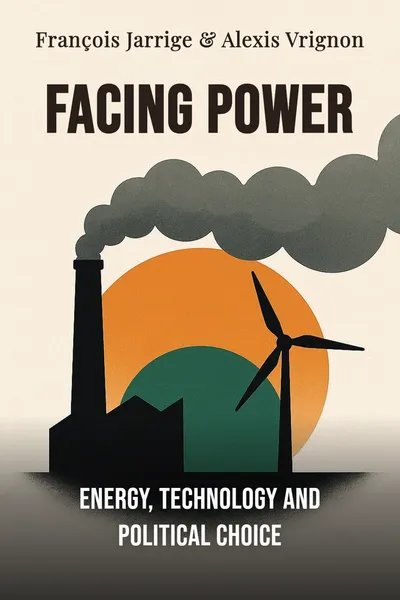
Facing Power
Energy, technology and political choice
Description
In the years around the turn of the twentieth century, electricity could have gone several ways. Small municipal plants, cooperative networks, decentralized generation close to where people lived and worked — all of these existed, were tried, and in some places worked well. What won out, in France as elsewhere, was something else: large interconnected grids, high-voltage lines running across the country, generation concentrated in a handful of enormous plants and, eventually, a fleet of nuclear reactors. That outcome tends to be remembered as the natural result of technical progress, the obvious form energy was always going to take. François Jarrige and Alexis Vrignon, in their history of French energy, argue that it was nothing of the kind.
Their subject is the long entanglement of energy and power — power in both senses, the watts and the politics. Coal, oil, hydroelectricity, the atom: each of these did not simply arrive and get adopted. Each was fought over. Engineers, industrialists, state administrators, unions, local councils and ordinary users all pushed the system toward the shape that suited them, and the shape it took reflected who had the leverage to impose it. The grid we treat as infrastructure, as the neutral backdrop to modern life, is in this reading a record of decisions — many of them contested, some of them barely visible now that the concrete has been poured and the lines have been strung.
That is an uncomfortable idea, because infrastructure is designed to feel inevitable. A pylon does not announce that it could have been otherwise. Jarrige and Vrignon spend their book prying that inevitability back open, tracing how technical choices were also social and political ones, and how the alternatives that lost did not lose because they failed.
The question we’re asking : When a country builds a giant, centralized energy system, is it obeying technical necessity — or making a political choice that only looks like necessity afterward?What we’ll see : How France's energy machine was assembled decision by decision, who did the assembling, and what got left out along the way.
Table of contents
01Chapter 1 — The grid was never neutral
We tend to imagine a power grid the way we imagine a river system — a natural feature that engineers merely channeled. Jarrige and Vrignon start by dismantling that intuition. When electricity spread across France in the first decades of the twentieth century, there was no single blueprint and no consensus about scale. Cities ran their own plants. Rural cooperatives strung their own lines. Private companies carved up territories and squabbled over standards, so that current from one network could not always feed into another. The country was a patchwork, and the patchwork worked, more or less, for the people it served.
What turned the patchwork into a unified national machine was not a technical revelation but a series of pushes from those who stood to gain from bigness. Large industrial producers wanted vast, interconnected networks that would let them sell power at scale and smooth out demand across regions. The state, especially after the Second World War, wanted the coordination and control that a centralized system offered. Interconnection was framed as rationality itself — waste eliminated, efficiency maximized — and framed that way, it became very hard to argue against. Who defends inefficiency?

02Chapter 2 — The road not taken
One of the book's central moves is to recover the alternatives — the energy futures that were genuinely on the table and then closed off. This matters, because the standard story of technical progress runs on a kind of retrospective inevitability: whatever happened, happened because it was the best available option. Jarrige and Vrignon show that the losing options were often not inferior on their own terms. They lost because they served the wrong interests, or lacked a powerful enough constituency, or ran against the grain of what the state was trying to build.
Decentralized and small-scale generation is the clearest example. Local plants, cooperatives, and modest hydroelectric installations gave communities a degree of control over their own energy and kept the profits and the decisions nearby. They were not primitive stepping-stones toward the grid; they were a different model of how a society might power itself. As the national network expanded, these forms were absorbed or squeezed out, not because they stopped functioning but because the larger system offered cheaper standardized power and, crucially, because concentration suited both big industry and a centralizing state.
03Chapter 3 — Resistance written out of the story
If energy systems were chosen, they were also contested, and the book is at its sharpest when it recovers the opposition that official histories tend to smooth away. Big infrastructure has never been welcomed everywhere it went. Dams flooded valleys and displaced the people who lived in them. Transmission lines cut across landscapes and farms. Power plants imposed themselves on communities that had not asked for them. At each step there were people who said no, and their refusals were real political events, not sentimental footnotes.
Jarrige and Vrignon give particular attention to the wave of opposition that met the nuclear program. The 1970s saw substantial anti-nuclear mobilization in France, sometimes drawing large crowds, occasionally met with force — the confrontation at Creys-Malville in 1977, where a demonstrator was killed, marked how hard the state was prepared to push. These movements are often remembered, when remembered at all, as marginal or naive, the reflexive fears of people who did not understand the technology. The authors reject that framing. The opponents understood perfectly well what was at stake: not just safety, but who got to decide, and whether a handful of experts should be able to commit a whole society to a path for half a century.
04Chapter 4 — Who gets to decide
Step back from the particular French story and a broader argument comes into view. Energy systems, in this telling, are political settlements that have hardened into infrastructure. A settlement is a resolution of a conflict — a decision about who gets what, who controls what, whose priorities prevail. Most political settlements stay somewhat visible; we can see the law, argue about the policy, vote the government out. But when a settlement is poured into concrete and strung across the countryside, it acquires a permanence and an apparent neutrality that ordinary politics never has. The grid does not look like a policy you could reverse. It looks like the ground you stand on.
That is precisely what makes energy infrastructure so politically consequential, and so quietly anti-democratic when it is decided narrowly. A nuclear fleet built in a decade constrains the options of everyone who lives for the next several decades. It shapes what forms of energy get investment, what expertise gets funded, what futures are even conceivable. The alternatives are not just rejected; they are foreclosed, made to seem unrealistic, expensive, or crankish, because the whole system has been optimized around a single path. The choice, once made, works to prevent future choices — which is the deepest sense in which technology is political.
05Conclusion
Return to that moment around 1900, when electricity could still have gone several ways. The point of recovering it is not nostalgia for the small municipal plant or the rural cooperative. It is to hold open, against the pressure of accomplished fact, the recognition that the giant centralized machine France ended up with was assembled, not discovered. Coal, oil, hydro, the atom — each was carried into place by identifiable interests, argued over, resisted, and then quietly naturalized once the building was done. Jarrige and Vrignon spend their book refusing that naturalization.
Related books