Argonauts of the Western Pacific
Fieldwork invented as a method
Description
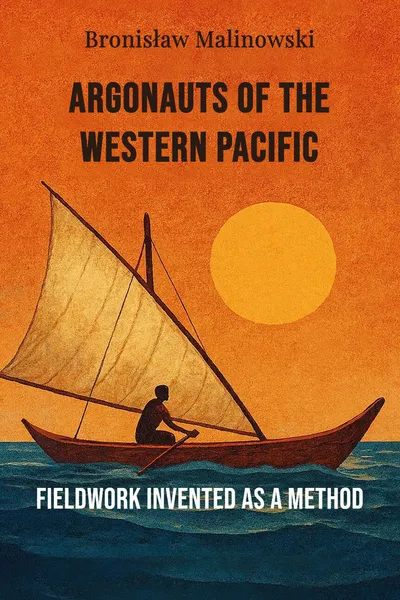
In 1914, a young Polish anthropologist named Bronislaw Malinowski arrived in the Trobriand Islands, a scatter of coral atolls off the eastern tip of New Guinea. He was, strictly speaking, stranded there — an Austro-Hungarian subject caught in British territory when the First World War broke out, free to move but unable to go home. He pitched a tent among the villagers of Omarakana, and he stayed. Not for a few weeks of interviews funneled through an interpreter, but for stretches that ran into years across several visits, learning the language, watching gardens get planted, attending funerals, following canoes out to sea.
What came out of those years, published in 1922, was a book called Argonauts of the Western Pacific. On its surface it is about a strange economic institution: a ceremonial exchange of shell ornaments that loops across hundreds of miles of open ocean, carried by men in canoes who risk their lives to give away objects they will never keep. But the book is remembered less for what it describes than for how it was made. Malinowski wasn't reporting what travelers and missionaries had told him. He had been there, inside the thing, for a very long time.
Before him, the people who wrote about so-called primitive societies mostly sat at a distance and collected other people's observations. Malinowski argued that this produced a picture that was both detailed and completely wrong about the one thing that mattered — how it felt to live that life from the inside. His book is an argument, carried by a thousand small facts, that you cannot understand people you have not lived among.
The question we’re asking : How does a single institution of shell exchange turn into the founding case for an entire way of doing social science?What we’ll see : A ring of gifts that obeys no central will, a method built out of a tent on a beach, and the quiet claim that changed how we go about understanding anyone at all.
Table of contents
01 Chapter 1 — A tent on the beach, not a verandah
The anthropology Malinowski inherited had a posture, and he came to despise it. The typical investigator — the "verandah anthropologist," as the dismissive phrase went — set himself up at the mission station or the district officer's house and summoned informants to come and answer questions. He wrote down customs the way a collector pins butterflies: neat, labeled, dead. The reports were often accurate about particular rituals and useless about everything connecting them. They treated a society as a list of quaint practices rather than a living arrangement that hung together.
Malinowski's alternative sounds almost too simple. Move your tent into the village. Live close enough that people stop performing for you and start ignoring you, which is the moment real observation begins. He wrote that the ethnographer should be close enough to see the "imponderabilia of actual life" — the tone of a conversation, the way a quarrel is settled, who sits next to whom at a meal, the thousand small things that never get mentioned because everyone already knows them. These are exactly the things no informant will think to report, because to them they are not facts at all. They are just how the world is.

02 Chapter 2 — The ring that moves on no one's command
The institution Malinowski chose to anchor the whole book is the kula. Across a wide arc of islands, men exchange two kinds of ceremonial valuables: long necklaces of red shell discs, which travel clockwise around the ring, and armbands of white shell, which travel counter-clockwise. The two streams flow in opposite directions, forever, passing from partner to partner. No one keeps a valuable for long. To hold one is to be, temporarily, its custodian, before the obligation to pass it on comes due.
What makes the kula strange to an outsider is that it is not trade in any sense we would recognize. The objects have no practical use. You cannot wear the famous ones in daily life; many are too precious to be worn at all. They are not currency, not hoarded as wealth in the ordinary way. A man gives a necklace to his partner and receives, eventually, an armband in return — but the return is not a payment, and haggling is unthinkable, even faintly disgraceful. The gift is given with a show of casual generosity, and the counter-gift comes in its own time as a matter of honor.
03 Chapter 3 — The native's point of view
Malinowski set himself a target that he repeated like a refrain: to grasp "the native's point of view, his relation to life, to realise his vision of his world." The kula was the test case. A verandah anthropologist, handed a dry account of men paddling across the sea to swap useless shells, would file it under primitive irrationality. Why risk drowning for an armband you must immediately give away? Malinowski's answer was that the question only looks absurd from outside the system. Inside it, every move makes sense.
He showed that the kula was not an isolated custom but the spine of an entire social order. It organized alliances between distant communities, gave chiefs a theater for prestige, structured magic and myth, drove the building of canoes and the timing of voyages. The spells recited over a canoe, the taboos observed before departure, the elaborate etiquette of arrival — all of it hung on the exchange. Pull the kula out and much of Trobriand life would lose its coordinating thread. The seemingly pointless act turned out to be the one around which a great deal of meaning was organized.
04 Chapter 4 — What it means to watch by living
The lasting weight of Argonauts has less to do with shells than with a bet about how knowledge of other people gets made. Malinowski's wager was that the distance which had always been thought to guarantee objectivity — the detached observer, the collected testimony — was in fact the thing that guaranteed error. You could not understand a life you had only heard about. You had to inhabit it, submit to its rhythms, be bored and confused and gradually at home in it, until its logic became legible from within. Participation was not the opposite of observation. It was its precondition.
This reversed the usual relationship between the knower and the known. The ethnographer was no longer a neutral recording instrument standing outside the scene. He was a person inside it, changed by the long immersion, using his own slowly acquired intuition as part of the apparatus of understanding. That is a strange kind of science, and Malinowski knew it. His answer was rigor of a different sort: write down everything, keep the firm skeleton of institutions separate from the flesh of actual behavior, and show your working so the reader can see how the picture was assembled. The famous opening still reads as an instruction — imagine yourself set down alone on a tropical beach, your dinghy sailing away.
05 Conclusion
The kula still turns, in the sense that the book made it permanent. A circuit of named shell valuables, passing hand to hand around a ring of islands, carried by men who gain nothing material and everything in reputation — Malinowski rescued it from the condescension that would have filed it as a curiosity and showed it to be a fully reasoned social world. The Argonauts of his title were those canoe voyagers, and the Homeric echo was deliberate: he wanted their expeditions to read as epic, not as primitive antics.
Related books