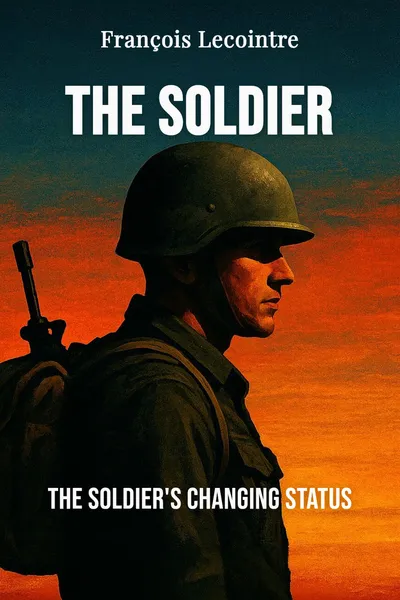
The Soldier
The soldier's changing status
Description
François Lecointre spent his career as an officer in the French army before becoming its chief of staff, fighting in places most citizens could barely place on a map — Rwanda in 1994, Sarajevo in 1995, where he led a bayonet charge on the Vrbanja bridge that would follow him for life. He writes about the soldier not as a theorist but as someone who has carried the uniform, buried comrades, and given orders that sent people toward their deaths. His short book is less a defense than a quiet accounting of what being a soldier actually asks, in a country that has largely stopped thinking about it.
The question feels sharp because the soldier has become a strange figure — honored in ceremonies, invisible the rest of the year. France ended conscription in the late 1990s, and most of continental Europe followed. Armies are now manned by volunteers and professionals who chose the trade, while the vast majority of citizens will never wear a uniform or know anyone who does. The bond that once ran through every household has thinned to a handshake at a parade.
Lecointre writes from inside that gap. He is interested in what the soldier agrees to, what the nation owes in return, and what happens to that exchange when the army turns into a profession among others — with its recruitment problems, career ladders, and human-resources vocabulary. The soldier he describes is not a statue. He is a man or woman asked to do something no other job asks, in a society that would rather not look too closely.
The question we’re asking : What does being a soldier actually ask, and what becomes of that demand when the army turns into a profession like any other?What we’ll see : A career officer's reckoning with what the uniform commits a person to, and with a bond between arms and nation that peacetime keeps quietly loosening.
Table of contents
01 Chapter 1 — The figure that war keeps, peace forgets
There is a rhythm to how societies regard their soldiers, and Lecointre names it plainly. In war, the soldier is everything — the face on the recruitment poster, the name read aloud at the memorial. In peace, which is most of the time, he slides out of view: a line in the budget, a logistics problem, occasionally an embarrassment when an operation goes wrong and the coffins come home on the news. The figure that seemed indispensable in 1944 becomes, by the quiet decades, something closer to furniture.
Lecointre lived this oscillation. He came of age in an army still shaped by Algeria and the colonial wars, then served through the 1990s, when French soldiers were sent into UN missions with rules of engagement so tangled they could watch atrocities and not fire. The soldier was present at some of the worst moments of the era — Srebrenica, the Rwandan genocide — and often constrained to be a witness rather than an actor. That constraint, he suggests, marked a generation of officers with a particular bitterness.

02 Chapter 2 — What a soldier agrees to that no one else does
At the center of Lecointre's account is a single commitment that separates the soldier from every other profession. In French military tradition it is the esprit de sacrifice — the acceptance, built into the contract, that one may be ordered into a situation where death is likely, and that one will go anyway. No other worker in a modern society signs up for that. A firefighter runs risks, a police officer runs risks, but the soldier agrees in advance to an obedience that can cost everything, for reasons he may not fully know, decided by people he will never meet.
Lecointre is careful not to romanticize this. He describes it as a transaction with specific terms. The soldier surrenders much of his autonomy — where he lives, when he deploys, whether he comes home — in exchange for belonging to something that gives his risk a meaning. That meaning matters enormously. A soldier who dies for a cause the nation believes in is mourned as a hero; one who dies in a mission the public has already written off dies, in a sense, twice. The relationship between the soldier and the society that sends him is not a detail. It is the whole thing.
03 Chapter 3 — The contract of trust between arms and nation
If the soldier gives the nation an extraordinary thing, Lecointre argues, the nation owes something extraordinary in return. He frames it as a contract, though not one written on paper. The soldier agrees to obey, to risk, to kill and perhaps die on command. The nation, in exchange, undertakes to send him only toward ends worth it, to equip and protect him, to honor his dead, to care for his wounded, and above all to remember what he did. When one side frays, the other cannot hold for long.
He is unsparing about the ways the civilian side has defaulted. Soldiers have been sent into operations with unclear objectives and impossible constraints, then blamed when ugly results followed. Budgets have been cut in peacetime by governments confident that peace would last, leaving armies hollowed out. Veterans have come home from brutal deployments to a society with no idea where they had been or why. Each of these is, in Lecointre's reading, a breach of trust — and trust, once broken with people trained to risk their lives, is extraordinarily hard to rebuild.
04 Chapter 4 — When the army becomes a job like the others
The end of conscription changed the terms of the whole exchange, and Lecointre returns to it as the central fact of the modern soldier's condition. For most of the twentieth century, the army was the nation in uniform — ordinary men pulled from farms and factories, a cross-section of the country that bound every family to its defense. The professional army that replaced it is smaller, more skilled, more deployable, and far more separate. It recruits, competes with the private sector for talent, offers careers, and speaks the language of human resources and retention.
This professionalization brings real gains — better-trained soldiers, better-executed missions, fewer scandals. But Lecointre sees a risk hidden inside the efficiency. When the army becomes a job like the others, the willingness to die for the nation sits uneasily beside the logic of a career. You cannot run the esprit de sacrifice through a spreadsheet. If the soldier starts to see himself as a well-paid technician of violence, and the state treats him as such, the extraordinary commitment at the heart of the trade quietly loses its justification.
05 Conclusion
Lecointre began as a young officer on a bridge in Sarajevo and ended at the top of the French army, watching the soldier's place in society quietly shift beneath him. The figure he describes is not the heroic statue of national memory, nor the technician of the recruitment brochure, but a person who agrees to an impossible thing — to risk everything on command — and who depends, for that agreement to mean anything, on a nation willing to hold up its end. The book is his attempt to put words to a bargain that most people never think about and that the professional era has made easy to forget.
Related books