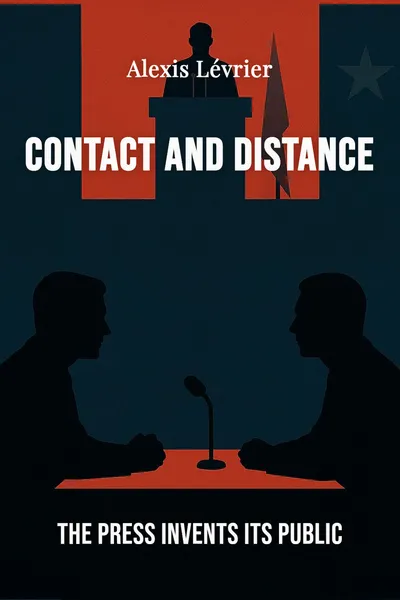
Contact and Distance
The press invents its public
Description
At the start of the eighteenth century, if you picked up one of the first printed gazettes in France, you would have found no "readers" in it at all. There were dispatches, court news, items copied from foreign sheets, laid out with the flat neutrality of a ledger. Nobody was being addressed. Nobody was imagined sitting across a café table, coffee cooling, waiting to be spoken to. The newspaper existed, but its public did not yet exist as a thing the newspaper acknowledged — let alone courted. That gap is the quiet subject of Alexis Lévrier's "Contact and Distance," a history of how the French press slowly learned to see, name, and finally fabricate the crowd it claimed only to inform.
Lévrier is a historian of the press, and his argument runs against a comfortable intuition. We tend to assume the public came first — people wanting news — and that newspapers simply rose to meet an existing appetite. His account reverses the order. The readership we picture, with its tastes and loyalties and sense of belonging to a title, was not discovered. It was built, decade by decade, through editorial choices about how close to stand and how far to keep back. Contact and distance are the two levers, and the whole history is their adjustment.
What makes this more than an archival curiosity is how modern it feels once we look. The devices journalism uses to say "we're talking to you, specifically" were not invented for the smartphone. They were worked out in ink, over two centuries, by editors who understood that a paper without a public is just paper — and that a public, conveniently, can be summoned into being by the right turn of phrase.
The question we’re asking : How did the press stop merely printing news and start constructing the very readers it claimed to be serving?What we’ll see : How French journalism, across two centuries, built its audience out of nothing — and made closeness its most reliable instrument.
Table of contents
01 Chapter 1 — The reader who did not exist yet
The earliest French periodicals, in Lévrier's telling, were strange things to us because they addressed no one. The Gazette founded under Théophraste Renaudot in 1631, the learned Journal des sçavans of 1665, the lighter Mercure galant that followed — these were compilations. They gathered and relayed. The tone was that of a notice posted on a wall: here is what happened, make of it what you will. There was no "we," no implied "you," no sense that the text was performing for anyone in particular. The public was a hypothetical, not a presence.
This was partly a matter of control. Under the French monarchy, the right to print news was a privilege, granted and policed. A gazette was closer to an official instrument than to an independent voice, and official instruments do not flatter their audience — they inform subjects. The distance between the sheet and its reader was not a flaw to be closed; it was the natural posture of a text that spoke from above, or at least from a sanctioned remove. Intimacy would have been almost improper.

02 Chapter 2 — Letters, surveys, and the engineered intimacy
The first great instrument of contact was the letter. From the Mercure galant onward, periodicals began printing correspondence — real or staged — from readers who wrote in with questions, complaints, poems, confessions. Lévrier shows how quickly this became a technique rather than a simple courtesy. A printed letter does two things at once: it proves the paper has readers, and it invites more of them to join the conversation. The reader who sees another reader addressed starts to feel addressable. The letters column is, in effect, a mirror the paper holds up so the public can see itself existing.
Whether the letters were authentic mattered less than the effect. Editors wrote some themselves, dressed as readers; others were real but heavily reshaped. The genre of the fictional correspondent let a paper voice the questions it wanted to answer and model the ideal reader it wanted to attract. It was intimacy as stagecraft — a warmth that felt spontaneous and was in fact carefully arranged. The reader was being invited into a room that had been built specifically to make them want to stay.
03 Chapter 3 — Closeness as a selling point
By the nineteenth century, the stakes changed. The press became an industry. With Émile de Girardin's La Presse in 1836, the cheap daily financed by advertising arrived, and the logic flipped: a paper now needed a large, stable, loyal readership not as a civic ideal but as a commercial necessity. Advertisers paid for attention, and attention had to be secured. Suddenly the relationship Lévrier has been tracing was worth money, and the devices of contact were refined accordingly.
Proximity became, in a real sense, a product. Papers competed on how close they could seem — how directly they spoke, how well they knew their readers' lives, how reliably they showed up each morning like a familiar voice. The feuilleton, the serialized novel running at the bottom of the page, kept readers coming back for the next installment; it was pure habit engineering, closeness measured in return visits. The daily rhythm itself became a form of intimacy: a paper you read every morning is a companion, and companions are not easily abandoned.
04 Chapter 4 — The public as the press's own invention
Step back from the chronology and Lévrier's larger claim comes into focus. The public of a newspaper is not a pre-existing body that the paper serves. It is something the paper calls into being and keeps alive through the constant adjustment of contact and distance. "Public opinion" — that phrase invoked so solemnly, as if it were weather the press merely reports — is in large part a construction the press itself produced, by addressing a crowd until the crowd began to recognize itself as one. The newspaper does not find its readers. It authors them.
This reframes what proximity actually is. When a title speaks to us warmly, directly, as if it knew us, we read that as generosity or respect. Lévrier's history suggests reading it instead as a device — a technique with a two-century pedigree, designed to convert scattered individuals into a loyal, nameable public that can be counted, sold, and spoken for. The warmth is sincere and strategic at once; the two have never been separable in the history of the press.
05 Conclusion
Return to that first gazette, speaking to no one. What separates it from the paper that greets us by name is not technology or even talent, but a discovery: that a readership can be summoned. Over two centuries, French editors learned to print the reader's letter, answer the reader's question, keep the reader's morning appointment — and in doing so they conjured the very public they claimed to serve. Lévrier's "Contact and Distance" follows that conjuring trick through its archive, patient device by patient device, until the crowd that was once hypothetical has become a loyal, self-aware body.
Related books