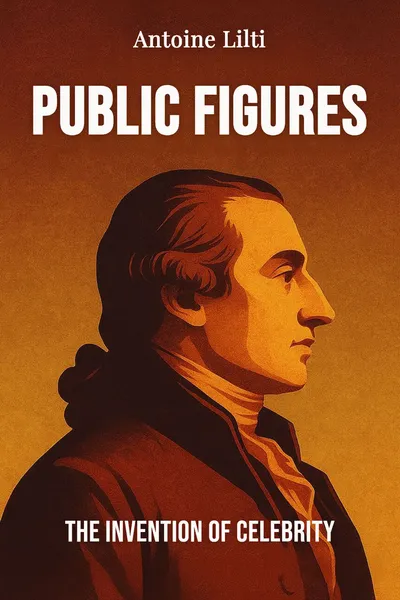
Public Figures
The invention of celebrity
Description
In the spring of 1769, the young Wolfgang Amadeus Mozart was thirteen, touring the courts of Europe as a prodigy. A few years later, when Jean-Jacques Rousseau walked the streets of Paris, strangers turned to stare; some followed him, some wrote him letters confessing their souls as if they had always known him. Rousseau found it unbearable. He had become, without quite consenting to it, a man whose face and name belonged to people he would never meet. This was something newer than fame in the old sense — newer than the glory of a general or the renown of a king. It was the sensation of being personally familiar to thousands of anonymous admirers.
We tend to assume celebrity is a child of the twentieth century — that it arrived with photography, cinema, the tabloid, the screen. The historian Antoine Lilti argues the opposite. The mechanism was already running in the eighteenth century, in the theatres of London, the salons of Paris, the print shops that churned out engraved portraits of actors and writers and sold them to people who hung them on their walls. Voltaire, Garrick, Marie-Antoinette, Byron: each was a public figure in a way that had no real precedent, and that we would recognize instantly.
What this history unsettles is the comfortable idea that modern media invented our obsessions. The appetite came first; the technology only fed it. And once we see celebrity as a relationship rather than a status — a bond between a famous individual and a crowd that feels it knows him — the story stops being about the stars at all.
The question we’re asking : If celebrity existed a full century before mass media, what exactly was invented, and by whom?What we’ll see : How a new bond between the famous and the anonymous took shape in the age of Voltaire — and what it asked of the crowd.
Table of contents
01 Chapter 1 — The famous man nobody could reach
Start with the distinction Lilti insists on, because the whole book turns on it. There is glory, and there is celebrity, and they are not the same thing. Glory is what a civilization grants to the great dead: the general, the saint, the king whose name is carved into memory and meant to outlast him. It is posthumous, moral, earned through deeds judged worthy. Celebrity is something flatter and stranger. It is being widely known, now, by people who have no particular reason to know you — and it carries no verdict about whether you deserve it.
The eighteenth century is where the second thing breaks loose from the first. Before, to be renowned was to belong to a small circle of courts, academies, and patrons who recognized merit. Then a market appeared. Printers, theatres, newspapers, and portrait sellers discovered that the public would pay to know about certain individuals — their faces, their habits, their loves, their quarrels. The famous person became a commodity that circulated far beyond any room they could ever enter.

02 Chapter 2 — A machine older than the photograph
The reflex is to credit the machines. Surely celebrity needed cameras, film reels, the printing of millions of identical images. Lilti's point is that an earlier media system did the same work with cruder tools, and did it thoroughly. Eighteenth-century Europe already had an industry devoted to reproducing and selling the images and lives of famous people, and it was commercial, competitive, and hungry.
Consider the engraved portrait. A successful actor or author sat for a painting; engravers copied it; print shops sold the copies cheaply, by the hundreds. Ordinary people who would never attend a salon could own the face of Voltaire or the actress of the moment, and display it. The newspapers, growing fast across the century, reported not only on the works of famous people but on their persons — where they were seen, what they wore, whom they were rumored to love. Gossip acquired a printed, public, durable form.
03 Chapter 3 — The private life that became public property
Here the book turns to the most modern-feeling piece of the whole phenomenon: the hunger not for the work but for the person. What distinguishes celebrity from mere reputation is that the public wants the private life. It wants the famous individual stripped of their official role and glimpsed as an ordinary human — eating, grieving, falling in love, making mistakes. This appetite, Lilti shows, was fully formed in the eighteenth century.
Marie-Antoinette is the extreme case. She was a queen, yet the libels and pamphlets that swarmed around her treated her less as a sovereign than as a celebrity whose intimate life was fair game. Her supposed affairs, her spending, her body were discussed in print with a prurience that had nothing to do with statecraft and everything to do with the public's demand to know the woman behind the crown. The monarchy's old sacred aura could not survive this exposure, and Lilti suggests the erosion mattered politically.
04 Chapter 4 — The crowd that learned to adore
Step back from the famous and look instead at the people watching them, because that is where Lilti's argument ultimately points. Celebrity is not a quality a person possesses. It is a relationship, and the genuinely new party in that relationship is the public — the vast, anonymous, scattered body of individuals who, without knowing one another, converge their attention and emotion on the same distant figure.
This is a strange kind of intimacy, and the eighteenth century is where people first learned to feel it. Readers wept over Rousseau as though he were a friend. Spectators adored Garrick as though they knew him. Admirers mourned famous strangers, wrote to them, dreamed of them, felt betrayed by their choices. None of these feelings makes sense within the older order of glory, where the great were revered from below. Celebrity invited something more horizontal and more personal: identification, attachment, the sense of a private connection to someone who had no idea you existed.
05 Conclusion
Rousseau, hounded by the devotion of strangers, grasped something his admirers did not: that celebrity had turned him into a mirror for people he would never meet. He wanted to be read; he did not want to be possessed. But the two had fused, and there was no undoing it. The public that felt it knew him was not going to release its grip, because that grip was the whole point — the pleasure of intimacy with the unreachable.
Related books