A History of Blasphemy in the West
Policing what may be said of God
Description
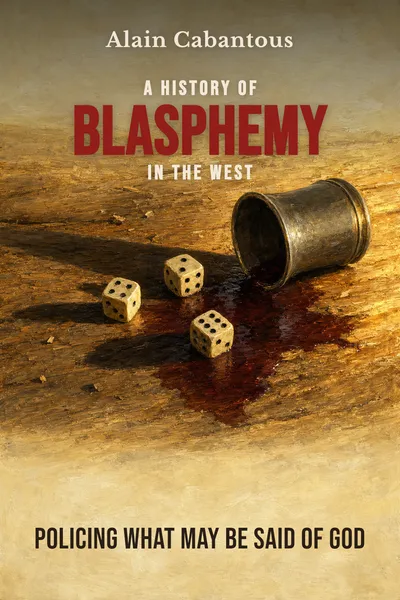
There is a moment in the sixteenth century when a French peasant, dice game gone wrong, curses God's blood in a tavern — and a tribunal decides this is not merely coarse talk but an assault on the divine order itself. The man could be fined, pilloried, have his tongue pierced, in the worst cases lose his life. What strikes the historian Alain Cabantous, who spent years tracking these cases across the archives of Western Europe, is not the cruelty of the sanction but its logic. A few words, spat out in anger or drink, were treated as a wound inflicted on God — and, through God, on the community and the sovereign who governed in His name.
Blasphemy, in Cabantous's account, is one of those categories we assume has always meant roughly the same thing and always faded on the same schedule. It hasn't. For centuries it sat at the intersection of the sacred and the political, a crime that magistrates and theologians could never quite define with precision yet punished with remarkable persistence. The word itself was elastic: it covered oaths, insults, denials, mockery, the wrong opinion voiced in the wrong place. And the machinery built to police it — courts, informers, ordinances, executioners — outlasted every prediction of its disappearance.
Cabantous follows this long arc from the medieval codification of the offense through its bloody early-modern enforcement to its strange half-life in our own time. The story he tells is less about God than about who claims the right to speak of God, and what happens to those who speak of Him badly. It is a history of authority as much as of faith — and it does not end where we expect it to.
The question we’re asking : How did saying the wrong thing about God become a crime the West spent centuries prosecuting — and never fully abolished?What we’ll see : An offense that traveled from the pulpit to the scaffold to the tavern, and refuses to stay in the past.
Table of contents
01 Chapter 1 — The sin that became a crime
Blasphemy begins, Cabantous reminds us, as a religious wrong long before it becomes a legal one. In the Hebrew scriptures, cursing the divine name carried the death penalty, and the early Church treated blasphemy as a grave sin against the second commandment. But sin is a matter between the soul and God; it belongs to the confessional, to penance, to the slow economy of salvation. What Cabantous traces is the moment this private wrong is captured by public power — when secular and ecclesiastical authorities decide that words offending God are also offenses the state must punish.
The turning point falls across the late Middle Ages. As monarchies consolidated and defined themselves as Christian, protecting the honor of God became indistinguishable from protecting the honor of the crown. In France, a series of royal ordinances from the thirteenth century onward, notably under Louis IX and later kings, laid out escalating penalties for those who blasphemed. Saint Louis is said to have wanted blasphemers branded on the lips, a punishment so severe that even the pope reportedly urged restraint. The logic was territorial: a kingdom that tolerated insults to God invited divine retribution — plague, famine, defeat in war — upon everyone.

02 Chapter 2 — The theatre of punishment
If blasphemy was a crime against the community, its punishment had to be seen by the community. Cabantous is especially attentive to the choreography of these sanctions, which were designed less to reform the offender than to reinscribe the sacred order in front of a watching public. The blasphemer might be made to kneel bareheaded before a church, candle in hand, begging pardon of God and the assembled crowd. He might be pilloried in a market square, a placard naming his offense. In the gravest cases the tongue — the offending organ — was pierced or cut, and execution was not unknown.
The severity, Cabantous shows, was uneven and often more spectacular in statute than in practice. Judges frequently softened the letter of the law, converting corporal penalties into fines or public penance, especially when the accused was respectable or the words could be blamed on drink and heat of the moment. The famous cases that reached the scaffold were exceptional — and precisely because they were exceptional, they were staged with maximum visibility. The point was deterrence through display: the crowd was meant to internalize the boundary the blasphemer had crossed.
03 Chapter 3 — When the everyday mouth offends God
The most original thread in Cabantous's work is his refusal to treat blasphemy as the province of philosophers and heretics alone. The overwhelming mass of prosecuted blasphemy was ordinary, verbal, and popular — the oaths of gamblers, soldiers, sailors, artisans, and drinkers. Men who never doubted God's existence for a second cursed His body, His blood, His wounds, in moments of rage or bad luck. This was blasphemy as reflex, woven into the texture of daily speech, and it accounts for the great volume of cases in the archives.
Cabantous reads these oaths not as declarations of unbelief but as their opposite: they only wound because everyone believes. To curse God's blood is to reach for the most powerful language available, precisely because it is sacred. The blasphemer and the judge shared the same cosmos. This gives the early-modern prosecutions their peculiar intimacy — the offense drew its force from a faith the offender rarely rejected. Popular blasphemy was, paradoxically, a symptom of how thoroughly the sacred saturated everyday life.
04 Chapter 4 — The crime that would not die
Stepping back, Cabantous's larger argument is that blasphemy did not simply expire with the Enlightenment and the coming of secular states. It migrated. The French Revolution abolished the crime as such; through the nineteenth and twentieth centuries most Western legal codes quietly retired it or let it fall dormant. The confident secular narrative held that once God ceased to be a legal person, no one could injure Him in law, and the whole category would dissolve into folklore.
But Cabantous resists this tidy ending. What dissolved was the theological foundation — the idea that words could wound God and provoke His wrath. What survived was the underlying question the crime had always encoded: who decides what may be said, and what may not, about the things a community holds sacred? Once that question is detached from God, it does not disappear. It reattaches to new objects — the feelings of believers, public order, the dignity of communities, the offense given rather than the offense to heaven. The crime against the divine becomes a crime against sensibility.
05 Conclusion
The peasant cursing God's blood in a tavern and the cartoonist provoking outrage centuries later are separated by everything — the collapse of a shared cosmos, the disappearance of divine retribution from the statute books, the whole machinery of secular law. Yet Cabantous's long history binds them together. Both stand accused of saying what a community insists may not be said, and both find themselves at the point where private speech meets public power. What changed was not the tension but the language used to name it.
Related books