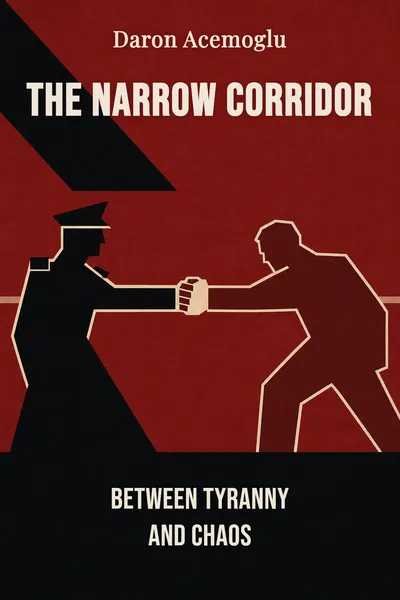
The Narrow Corridor
Between tyranny and chaos
Description
In 1651, Thomas Hobbes published Leviathan with a simple, bleak claim: without a powerful state to hold us in awe, life is a war of all against all, and it ends up solitary, poor, nasty, brutish and short. His answer was a sovereign strong enough to frighten everyone into peace. For centuries that logic set the terms — either you accept a mighty state, or you fall into chaos. Daron Acemoglu and James Robinson, two economists who spent decades studying why some nations prosper and others collapse, think Hobbes only saw half the picture. A state powerful enough to end the war of all against all is also powerful enough to become the thing you most need protection from.
Their book, The Narrow Corridor, published in 2019, is built around that trap. On one side sits the absent or captured state, where no one keeps order and the strong prey on the weak — Hobbes's nightmare, still very real in failed states and stateless zones. On the other sits the state that grew so strong nobody can check it — the despotic cage, from imperial China to the modern surveillance regime. Freedom, they argue, lives only in the thin space between the two, and getting there is far harder than either Hobbes or his critics imagined.
What makes the argument bite is that this space is not a destination you reach and settle into. It is a corridor a society walks, and can be pushed out of, at any point in its history. The authors range across two and a half thousand years — Solon's Athens, the collapse of Rome, Lagos slums, the American founding, China under the Communist Party — to ask what keeps a nation inside that narrow band, and what throws it out.
The question we’re asking : What lets some societies build a state strong enough to protect them without building one strong enough to crush them?What we’ll see : How a state and its society come to hold each other in balance — and how easily that balance breaks.
Table of contents
01Chapter 1 — The two ways a society goes wrong
Acemoglu and Robinson start by refusing the choice Hobbes offered. Liberty, in their telling, is not the gift of a benevolent sovereign, nor the natural state we enjoy once the state gets out of the way. It is a fragile balance between two forces that both want to dominate: the state, with its officials, armies and rules, and society, with its norms, communities and collective power. When one crushes the other, freedom dies — and it can die in two completely different directions.
The first way is what they call the Absent Leviathan. Where no state has the capacity to enforce laws and settle disputes, order does not vanish so much as get privatized. Feuds, warlords, clans and strongmen fill the vacuum. The authors point to places like Lebanon during its long conflicts, or the stateless stretches of the Democratic Republic of Congo, where the absence of a capable state does not produce a garden of liberty but a cage of a different kind — the cage of norms, custom and violence that keeps people just as trapped as any dictator would.

02Chapter 2 — Why liberty needs a leviathan it can fight
The intuition most of us carry is that freedom means less state. Acemoglu and Robinson argue the opposite is closer to the truth. A weak state cannot protect you from your neighbours, your employer, your landlord or your own community's suffocating traditions. Real liberty requires a Leviathan capable of enforcing rights, resolving conflicts and stopping the strong from crushing the weak. The trick is that this same capacity, unchecked, is exactly what tyranny is made of.
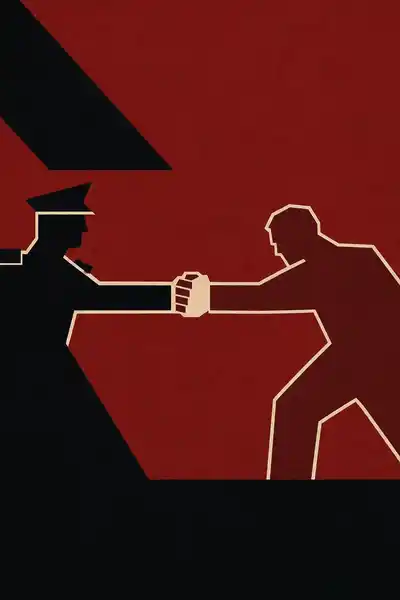
So the corridor is defined by a strange condition: the state has to grow strong and society has to grow strong alongside it, each pushing against the other. They call this the Red Queen effect, after Lewis Carroll's character who has to keep running just to stay in the same place. A state that expands its power forces society to mobilize to keep it in check; a mobilized society forces the state to build more capacity to respond. Both run; the balance holds because neither can rest.
03Chapter 3 — The corridor is a race, not a resting place
If liberty is a balance that has to be actively maintained, then entering the corridor is only the beginning of the problem. Acemoglu and Robinson are insistent on this: the corridor is not a room you lock behind you. It is a race you keep running, and the terrain keeps shifting. New technologies, new economic shocks, new concentrations of wealth all threaten to tip the balance one way or the other, and each shift demands that both state and society adapt.
This is where the authors part company with the idea that some cultures or constitutions simply have freedom baked in. The United States is their sharpest illustration. The 1787 constitution, with its checks and balances, is often treated as the machine that guarantees American liberty. But Acemoglu and Robinson show it was also a bargain with slavery — a federal structure deliberately weak enough to leave Southern states' brutal domination untouched. Liberty for some rested on a Leviathan too shackled to reach into others' lives. The corridor held for parts of the population and not at all for others.
04Chapter 4 — When the corridor narrows
Step back from Athens, Rome and the American founding, and the framework says something uncomfortable about the present. If freedom is a balance that has to be re-won continuously, then the strain visible across today's democracies is not an aberration to be waited out. It is what the corridor looks like when the running gets harder. Acemoglu and Robinson do not treat modern liberal democracy as a finished achievement drifting off course; they treat it as a Shackled Leviathan under the same pressures that have pushed societies out of the corridor before.
The forces they worry about are concrete. Economic inequality concentrates resources in fewer hands, and concentrated wealth translates into political leverage that society struggles to match. Automation and technological change hollow out the middle, weakening the associations and shared expectations that let ordinary people push back. And the state's new capacities — mass surveillance, data, algorithmic control — hand it powers that no previous Leviathan could dream of, without any guarantee that society's ability to check it grows at the same pace.
05Conclusion
Hobbes wanted a sovereign strong enough to end the war of all against all. Acemoglu and Robinson agree we need the Leviathan — but they add the half of the story he missed: that the same power capable of protecting us is capable of devouring us, and the only thing standing between the two is a society organized enough to keep pushing back. Freedom is not the absence of the state, nor its gift. It is the tension between a strong state and a strong society, each running to keep the other in check, neither ever allowed to win.
Related books