

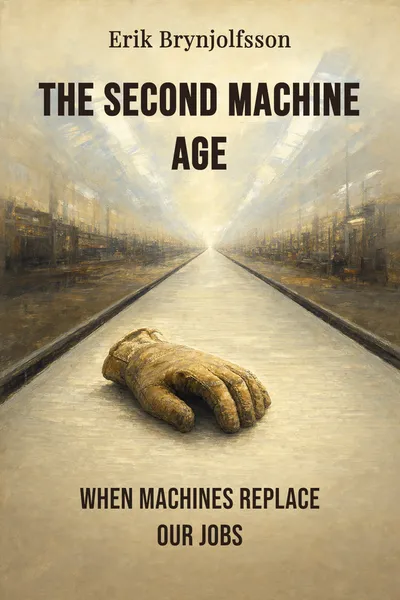
The Second Machine Age
When machines replace our jobs
Description
In 2004, two economists writing about the limits of automation used a specific example to make their point: driving a car in traffic, they argued, was exactly the kind of task machines would struggle to handle, because it required split-second judgment in messy, unpredictable conditions. Six years later, Google had a fleet of self-driving cars logging thousands of miles on public roads. The thing that was supposed to be safely out of reach had arrived almost as soon as the ink was dry. For Erik Brynjolfsson and Andrew McAfee, both at MIT, that reversal was the whole story in miniature — a signal that something had shifted in the pace at which machines were catching up to us.
Their book, published in 2014, gives that shift a name: the Second Machine Age. The first machine age was the Industrial Revolution, when steam and electricity multiplied our muscle power. The second is what happens when digital technology starts to multiply our mental power — when software, robotics and machine learning begin doing cognitive work that used to be ours alone. The crucial word is exponential. Computing power has been roughly doubling every couple of years for decades, and doublings that once produced trivial results eventually cross into territory that looks like science fiction.
The book is optimistic about what all this can produce and clear-eyed about who might get left out. Machines that translate languages, diagnose illness and drive trucks promise genuine abundance. They also threaten the paycheck of anyone whose work they can now do. Brynjolfsson and McAfee spend the book holding those two truths together, refusing to let either one cancel the other out.
The question we’re asking : When digital machines start doing the cognitive work that used to be ours, who gets richer and who gets left behind?What we’ll see : How Brynjolfsson and McAfee read the arrival of thinking machines — as a source of real abundance and real disruption at once, and as a problem no algorithm will solve on its own.
Table of contents
01Chapter 1 — The steam engine and what it took two centuries to learn
Brynjolfsson and McAfee open with a long view, because they want the reader to feel the size of what they are claiming. For most of human history, they note, the line tracking human progress — population, life expectancy, output — was almost flat. Things got a little better across a lifetime, but not dramatically. Then, in the late eighteenth century, the line bends sharply upward and never comes back down. Their argument is that this single bend, more than any war or empire or ideology, is the defining event of modern history. Its cause was a machine: James Watt's improved steam engine, refined in the 1760s and 1770s.
The steam engine mattered because it broke a ceiling. Until then, the work of the world was done by muscle — human or animal — plus a bit of wind and water. Watt's engine turned coal into usable mechanical power at a scale muscle could never reach, and everything downstream, from factories to railways to steamships, followed. The first machine age is simply the story of humanity learning to overcome the limits of its own physical strength.

02Chapter 2 — Bounty is not the problem, spread is
To keep the argument honest, Brynjolfsson and McAfee split the effects of digital technology into two words they use throughout: bounty and spread. Bounty is the good news — the sheer increase in quantity, quality and variety of what technology makes available. Spread is the complication — the growing gap between those who benefit and those who don't. Their claim is that the second machine age delivers enormous bounty and, simultaneously, widening spread, and that most public arguments go wrong by noticing only one of the two.
The bounty is easy to undersell because so much of it is free or nearly so. Wikipedia, mapping, video calls across continents, a phone with more computing power than a 1990s supercomputer — none of this shows up cleanly in GDP, which struggles to price a thing that costs nothing. The authors argue our standard economic dashboard is quietly understating how much better off digital abundance has made us, precisely because the best of it carries a price tag of zero.
03Chapter 3 — Racing with the machine, not against it
Given all this, the obvious question is whether machines will simply take the jobs. Brynjolfsson and McAfee are careful here, and their answer is more interesting than a yes or a no. They reject the old comfort that new technology always, automatically, creates as many jobs as it destroys — that faith, they argue, rests on a history that may not repeat when machines do cognitive work. But they equally reject the panic that humans are about to be made redundant. The truer picture is a race, and the question is whether we run it with the machines or against them.
Their favorite illustration comes from chess. After IBM's Deep Blue beat Garry Kasparov in 1997, it looked like machines had simply surpassed humans at the game. But in a format called freestyle chess, where any combination of humans and computers can compete, the winners were neither the strongest computers alone nor the strongest grandmasters alone. The winners were amateur players skilled at working with software. The authors take this as the central image of the book: the future belongs less to people who compete with computers than to people who collaborate with them.
04Chapter 4 — What a technology bends when it bends an economy
Step back from the specific fixes and the deeper argument comes into view. Brynjolfsson and McAfee are not, in the end, making a claim about technology so much as a claim about choice. The machines set the range of what is possible — they widen the frontier of what can be produced and by whom. But nothing in the silicon decides how the gains get shared. That decision is made elsewhere, by tax codes and school budgets and labor law and the institutional habits that add up to how a society distributes what it makes.
This is why the authors insist the second machine age is not a forecast to be awaited but a situation to be managed. A technology this powerful can produce widely shared prosperity or a sharply divided one, and the same underlying hardware is compatible with either outcome. The 'great decoupling' they document is not a law of physics; it is the trace of choices made over preceding decades. Which means it can be chosen differently — though not automatically and not without friction.
05Conclusion
The book that began with a self-driving car doing the impossible ends up somewhere less about cars than about us. Brynjolfsson and McAfee never let go of their opening wonder at what digital machines can now do, and they never pretend that wonder settles anything. Bounty and spread arrive together, and the arrival of one does not soften the other. A world with more abundance and more inequality is not a contradiction; in their reading, it is simply the world we already live in, only more so.