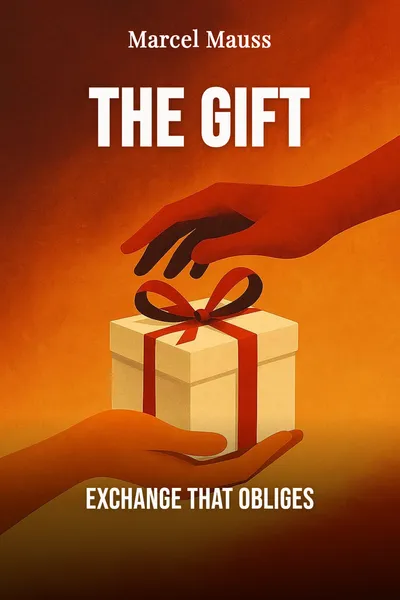
The Gift
Exchange that obliges
Description
Somewhere around 1925, a French ethnologist who had almost never left Europe sat in his study in Paris, reading reports sent back from the Pacific, the American Northwest, and ancient Rome, and noticed something that kept repeating. Across societies that had no contact with one another, a present was never quite a present. When a Maori elder handed over a treasured object, when a Trobriand Islander paddled for days to deliver a shell necklace, when a chief on the coast of British Columbia set fire to his own possessions in front of a rival, the same strange logic surfaced. A gift was given, yes, freely and with ceremony. And then it had to be returned. Marcel Mauss, nephew and pupil of the sociologist Émile Durkheim, pulled these threads together into a short, dense book he called Essai sur le don — the essay on the gift.
The puzzle he set himself sounds almost childish at first. Why, in so many societies, is there an obligation to give, an obligation to receive, and an obligation to give back? We tend to think of a gift as the opposite of a transaction — something we hand over precisely because nothing is owed in return. Mauss spent his book dismantling that intuition. The societies he studied did not separate the generous from the obligatory, the spiritual from the economic, the free from the required. A gift bound the giver and the receiver together, and the knot it tied was anything but optional.
What Mauss was after, in the end, was not an exotic custom but a mirror. The archive he assembled described a way of circulating goods that was older, and stranger, and more widespread than the thing we now call the economy. It raised a question that still has teeth: before there were prices, what held exchange together?
The question we’re asking : Why, across unconnected societies, does a gift carry an obligation to give it back — and what does that obligation hold together?What we’ll see : How Mauss read the archive of giving and found, underneath our idea of the free present, the older grammar that bound people before contracts did.
Table of contents
01 Chapter 1 — The present that was never free
Mauss opens with a provocation aimed at his own civilization. We like to believe we have two clean categories: on one side, the market, where things are bought and sold and nobody owes anybody anything once the price is paid; on the other, the gift, which is pure, disinterested, outside all calculation. The archaic societies he studied, he argues, drew no such line. There, the same act could be generous and binding, religious and commercial, sentimental and interested, all at once. Our neat separation is the anomaly, not theirs.
The evidence came from fieldwork he himself had not done — Mauss worked from the reports of others, above all Bronisław Malinowski among the Trobriand Islanders and Franz Boas on the Northwest Coast of North America. What struck him was the vocabulary. In Polynesia, some languages had no single word that meant simply "to give," without a return already implied. The free gift, in the sense of a one-way transfer that ends the relationship, barely existed as a concept. A thing handed over opened an account rather than closing one.

02 Chapter 2 — Three obligations, one chain
At the heart of the essay sits a structure so simple it is easy to underrate. Mauss argues that gift exchange rests on three linked obligations: the obligation to give, the obligation to receive, and the obligation to reciprocate. Remove any one of them and the whole system collapses. Together they form a chain that keeps goods, and with them people, in perpetual circulation.
The obligation to give is the least obvious to us, because we imagine giving as spontaneous. In the societies Mauss describes, a chief who hoarded his wealth, who hosted no feasts and offered no gifts, forfeited his authority. Rank had to be continually re-earned through generosity. To give was to demonstrate that one had the means and the spirit to give — a kind of display that could not be faked and could not be skipped. Refusing to give was refusing to be somebody.
03 Chapter 3 — The thing that carries a soul
Why must the gift come back at all? The purely economic answer — self-interest, the expectation of future benefit — did not satisfy Mauss, because the people themselves gave a different account. To explain the obligation, he reached for a Maori concept recorded by an informant named Tamati Ranapiri: the hau, often translated as the spirit of the gift. The thing given, the Maori said, is not inert. It carries something of the person who gave it, and it wants to return to its source.
The idea is that when you give an object, a part of you goes with it. The object is not fully separable from the giver — it holds a trace of their identity, their mana, their presence. To keep it indefinitely, to absorb it into your own possessions and let it rest, would be dangerous; the hau of the thing, severed from its origin, could turn against you. So the gift must move on, must eventually find its way back, carrying its spirit home. Reciprocity, in this telling, is not a social convention imposed from outside. It is in the thing itself.
04 Chapter 4 — Before the market, the gift
Step back from the Pacific and the Northwest Coast, and Mauss's argument stops being a catalogue of curiosities. His claim is that the gift is not a primitive stage humanity passed through on the way to proper economics. It is the older and deeper grammar of exchange, the thing that organized human relations long before price, contract, and money arrived to do the job more impersonally. The market did not replace the gift so much as grow up alongside it, and never fully displaced it.
Mauss found the traces everywhere he looked in the deep past of his own tradition. In archaic Roman law, in Germanic custom, in ancient Hindu texts, the same logic of obligated giving kept surfacing — the pledge, the sacred bond created by a thing handed over, the idea that to receive is to be held. What we now treat as the natural, self-evident form of exchange, the clean transaction between strangers who owe each other nothing afterward, turns out to be a late and local invention, not the universal baseline we imagine it to be.
05 Conclusion
Mauss never travelled to the islands and coasts his essay made famous. He built the whole argument from the desk, out of the reports of others, out of languages and legal codes and the stray word of a Maori sage recorded decades earlier. From that paper archive he drew a map of something that no single society could show on its own: a way of circulating goods in which to give was to oblige, to receive was to be bound, and to return was to keep the bond alive rather than to end it. The gift, in his telling, was never the opposite of exchange. It was its first form.
Related books