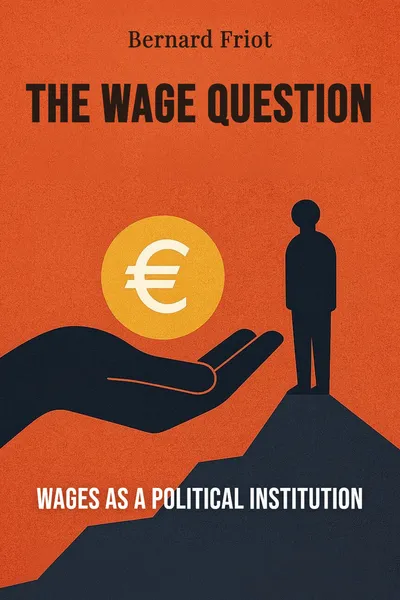
The Wage Question
Wages as a political institution
Description
Once a month, a number lands in a bank account, and almost no one looks past it. We call it a wage, treat it as the price our labour fetched, and move on. The French sociologist Bernard Friot spent his career refusing that shrug. For him, the line on the pay slip is one of the most misread documents in modern economic life — not a receipt for hours sold, but a settlement in a long political fight. In his book The Wage Question, he takes the thing we handle every month and turns it over to look at the back.
What he finds there is not a market at all. The wage, Friot argues, is an institution — built, contested, and partly won by the twentieth-century labour movement, especially in postwar France. Half of what employers pay never reaches the worker's account directly; it flows into pensions, health care, family benefits, unemployment funds. That half, in his reading, is not a deduction from our pay. It is pay — organised differently, detached from the market, and pointing toward a way of financing work that doesn't run through profit at all.
That is a provocative thing to say when most economics textbooks treat wages as a price like any other, set where supply meets demand. Friot's whole project is to argue they were never that, and that treating them as that is itself a political move. The stakes are large: if wages are an institution, they can be rebuilt. If they are a market outcome, we are stuck with whatever the market says a person is worth.
The question we’re asking : Is a wage the price of our labour, or something a society decides to institute — and if it's the latter, who gets to do the deciding?What we’ll see : How Friot reads the pay slip against the grain, and what his quarrel with the market reveals about where economic power actually sits.
Table of contents
01 Chapter 1 — The paycheck that isn't what we think it is
Start with the object itself. A French pay slip is a dense, slightly absurd document: a gross figure at the top, a thicket of lines in the middle, a smaller net figure at the bottom. The usual story is that the top number is your real pay and everything between it and the bottom is loss — tax, charges, the state and its intermediaries taking their cut before you get what's left. Friot's first move is to reject that story completely. The gap between gross and net isn't leakage. It's the part of the wage that the labour movement managed to pull out of the employer's control and put to collective use.
Those middle lines fund social security: pensions, health insurance, family allowances, unemployment compensation. Money that never touches the worker's account still pays for the worker's retirement, the worker's doctor, the worker's children. Friot calls this the socialised portion of the wage — cotisation, the contribution. En vrai, it behaves nothing like a tax. A tax disappears into a general budget; a contribution is wage that has been collectivised and earmarked, financing work and life outside the circuit of the market.

02 Chapter 2 — The strange case of the civil servant and the retiree
To show that wages can run on a logic other than the market, Friot points to figures who already live outside it. Consider the French civil servant, the functionary. Their pay is not the price of a service sold to an employer who could have shopped around. It is attached to a grade, a statut, a position in a public scale that rises with seniority and qualification. The functionary cannot be laid off because labour got cheaper elsewhere. Their pay tracks who they are recognised to be, not what their output would fetch on an open market.
The retiree is the case Friot presses hardest, because it is the one most of us misunderstand. A pension, in the dominant view, is deferred saving: you set money aside during your working life and draw it down after. Friot says that is simply false about how the French system works. The pension-as-continued-wage model pays today's retirees out of today's production, and it recognises the retiree as someone who still holds their qualification and still, in a real sense, counts as a producer — just one no longer bound to an employer.
03 Chapter 3 — Qualification versus the job
At the centre of Friot's argument sits a quiet but decisive distinction: between the qualification of a person and the qualification of a job. In the standard arrangement, value is attached to the post. A job is evaluated — its tasks, its responsibilities, its place in the org chart — and a wage is attached to that slot. The person who fills it earns the rate of the slot and loses it the moment they leave. Your worth is really the post's worth, rented to you while you occupy it.
Friot wants to flip this. In the model he draws from the civil service and defends as a general principle, qualification belongs to the person, permanently. You are recognised at a certain level, and that recognition is yours for life, portable across whatever work you do and surviving periods when you do no paid work at all. The wage follows the person, not the position. This is what makes the retiree's lifelong pension coherent: the qualification didn't retire, so neither did the pay.
04 Chapter 4 — Who decides what work is worth
Step back from the pay slip and the argument widens into one about sovereignty. The real question in Friot's work is never only how much we are paid, but who holds the power to decide what counts as productive work and what it is worth. In the market model, that power sits with whoever owns the capital and hires the labour; value is whatever generates profit, and work that generates none is treated as cost, charity, or waste. The wage, read this way, is the instrument through which that ownership exercises its judgment on human activity.
Friot's reframing of wages as an institution is really a claim that this judgment can be socialised — taken from owners and vested in the collective of producers themselves. The socialised portion of the wage is his evidence that it already has been, partially. The money that funds a hospital, a pension, a parent's time with a child is money recognising work the market would never have paid for, decided through institutions the labour movement built. That these institutions are chronically described as unaffordable burdens is, for him, the clearest sign of a political struggle still very much live.
05 Conclusion
Return to the number that lands in the account each month. After Friot, it reads differently. The net figure is the part of our pay still governed by the market and the employer; the socialised figure, the part we were taught to see as loss, is the part a previous generation managed to take off the market and turn into pensions, care, and lifelong rights. The pay slip stops being a receipt and becomes a ledger of what has been won and what is still contested.
Related books