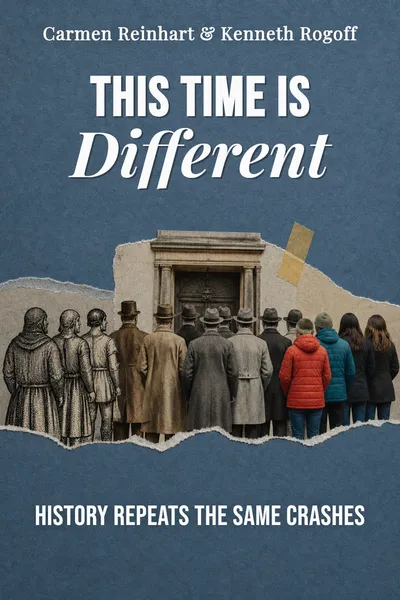
This Time Is Different
History repeats the same crashes
Description
In 2009, two economists published a book with a title that reads like a punchline. Carmen Reinhart and Kenneth Rogoff called it This Time Is Different, and the phrase is not theirs — it's the line they had heard, again and again, in the archives. Every generation of investors, bankers, and finance ministers, on the edge of a cliff they could not see, had reassured itself with the same four words. The rules had changed. Growth was permanent now. The old valuations no longer applied. Reinhart and Rogoff had spent years assembling the receipts, and the receipts told a different story.
What they built was less a book than a ledger. Sixty-six countries, five continents, roughly eight hundred years of financial data — government defaults, banking panics, currency collapses, inflation that ate savings overnight. Some of it came from medieval kings clipping their own coins to pay for wars. Some of it came from the subprime mortgages that had just cratered the American economy the year before the book appeared. Laid side by side, across centuries and cultures, the crises started to rhyme. The specifics changed; the shape did not.
The timing was almost cruel. The book landed while the wreckage of 2008 was still smoking, and it read like a forensic report written before the accident. Nobody in Washington or on Wall Street had wanted to hear that the meltdown was ordinary. But that was exactly the claim Reinhart and Rogoff were making, with the coldest possible evidence behind it.
The question we’re asking : Why do people who watch financial crises for a living keep believing the next one won't come?What we’ll see : How two economists turned eight centuries of ruin into a map, and what that map says about the stories we tell ourselves at the top.
Table of contents
01 Chapter 1 — Eight centuries, one database
The great weakness of financial memory is that it's short. A banking panic hits, a generation absorbs the lesson, the people who lived through it retire, and the next generation walks into the same trap convinced it's standing on new ground. Reinhart and Rogoff decided the antidote was data — not anecdote, not theory, but the longest run of numbers anyone had ever bothered to compile. They dug through central bank records, colonial archives, old bond prices, price indices going back to the fourteenth century. The result covered sixty-six countries and stretched across roughly eight hundred years.
What that scope let them do was compare things that are usually studied in isolation. A default in nineteenth-century Argentina and a default in twentieth-century Greece look unrelated if you only read the local history. Put them in the same table and the family resemblance jumps out. The book treats a medieval monarch debasing his currency — quietly mixing cheaper metal into the coins to stretch the treasury — as the same maneuver, in principle, as a modern government printing money to inflate away its debts. Different technology, identical instinct.

02 Chapter 2 — The four horsemen of a crash
Once the data was assembled, the crises sorted themselves into recognizable types. Reinhart and Rogoff spend the book working through them, and though the cast is large, four kinds do most of the damage. The first is sovereign default on external debt — a government simply failing to pay foreign creditors, the classic drama of nations that borrowed abroad and couldn't deliver. This is the oldest story in the ledger, running from Renaissance city-states straight through to Latin America in the 1980s.
The second is domestic default, which the book argues has been badly underappreciated. Governments default on their own citizens too — through outright non-payment, or more often through inflation that quietly wipes out the real value of what they owe. Inflation is the third horseman, and it's the sneakiest: a currency crisis that transfers wealth from savers to the state without anyone signing a default notice. The authors trace inflationary spikes across centuries, showing how debasement and money-printing are the same escape hatch dressed in different clothes.
03 Chapter 3 — The five most dangerous words in finance
The title is the argument. "This time is different" is the phrase Reinhart and Rogoff kept encountering, and it is always uttered at the top, always with an air of sober confidence, always just before the drop. The syndrome, as they describe it, is a belief that the historical rules of valuation no longer apply — that the current situation, for reasons of technology, policy, or global integration, bears little resemblance to the disasters of the past. It is not stupidity. It is a specific, recurring failure of imagination among people who are otherwise very smart.
The stories vary, and that's the point. In the run-up to the 1929 crash, the new economy of mass production and electricity supposedly justified permanently higher stock prices. Before the Asian crisis of 1997, the miracle of Asian growth was said to make the region's borrowing safe. Before 2008, financial engineering had supposedly sliced and repackaged mortgage risk so finely that it had all but disappeared — housing prices, everyone agreed, don't fall nationwide. Each rationalization was locally plausible. Each was, underneath, the same wish: that the debt could grow forever because the fundamentals had permanently changed.
04 Chapter 4 — What debt intolerance says about us
Step back from the individual crashes and the book is really about a trait of collective behavior — one Reinhart and Rogoff name debt intolerance. It's the observation that some countries can carry enormous debt loads without trouble while others buckle at levels that look modest by comparison. The difference isn't just the arithmetic of what's owed; it's a country's track record, its credibility, the memory embedded in how much creditors trust it to pay. Debt, in other words, is a relationship, and relationships carry history whether the borrower likes it or not.
That reframing is what makes the study more than a catalogue of disasters. The recurring failure the book documents isn't a lack of information — by 2008, the tools to measure leverage and asset bubbles were vastly better than anything a medieval treasury possessed. The failure is a matter of belief. Societies are extraordinarily good at generating reasons why the risk they can plainly see does not apply to them, precisely because acting on the warning would mean giving up the boom while it still feels good. The cost of caution is immediate and certain; the cost of the crash is deferred and deniable. Given that trade, denial usually wins.
05 Conclusion
The book closes the way it opens — with those four words hanging in the air. Reinhart and Rogoff never promise a formula for prevention, and that restraint is deliberate. What they offer instead is a long mirror: eight centuries of governments, banks, and investors making versions of the same mistake, each convinced their version was new. The subprime catastrophe that framed the book's publication turns out, in this light, to be neither exotic nor unprecedented. It's another entry in a very long ledger, distinguished mostly by how loudly everyone insisted it couldn't happen.
Related books