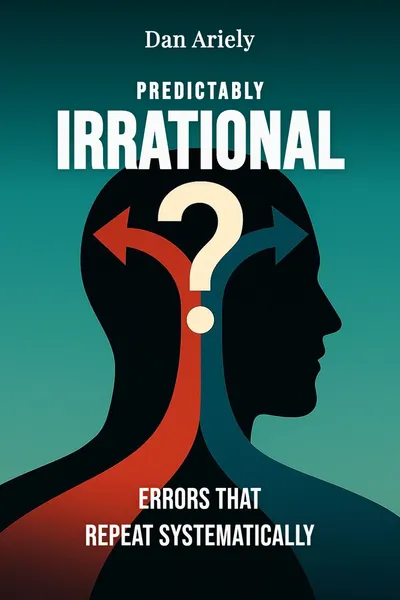
Predictably Irrational
Errors that repeat systematically
Description
Somewhere around 2007, Dan Ariely set up a stall at MIT and offered students two chocolates. There was a Lindt truffle, a genuinely good piece of chocolate, for fifteen cents. And there was an ordinary Hershey's Kiss for one cent. Faced with that choice, most people did the sensible thing and took the truffle — the quality was worth the extra fourteen cents. Then Ariely dropped every price by one cent. The truffle now cost fourteen cents, the Kiss cost nothing. Nothing about the relative deal had changed: fourteen cents still bought you a much better chocolate. And yet the crowd swung hard toward the free Kiss.
Ariely, who teaches behavioral economics and was burned over much of his body in an accident as a teenager, spent years running experiments like this one — small, almost silly set-ups that quietly dismantle the idea that we weigh costs and benefits and pick the best option. His book, published in 2008 under the title Predictably Irrational, collects them. The argument in the title is the whole point. We don't just make mistakes. We make the same mistakes, in the same direction, under the same conditions, again and again.
That second word carries the weight. Irrational on its own is a shrug — people are messy, who knew. Predictably is the part that should unsettle an economist, because standard economics is built on the assumption that we're rational agents nudging ourselves toward what's best for us. If the errors were random, they'd cancel out. They don't. They stack. And once you can see them stacking, a stranger possibility opens up.
The question we’re asking : If our mistakes repeat in the same direction every time, are they really mistakes — or something we could learn to work with?What we’ll see : A handful of Ariely's experiments, the hidden rules they expose, and what becomes possible once the patterns are visible.
Table of contents
01 Chapter 1 — Free is a feeling, not a price
The chocolate experiment is Ariely's cleanest demonstration that zero is not just another number. In strict economic terms, lowering both prices by a penny leaves the trade-off untouched — the truffle is still the better chocolate for its money. But when one option becomes free, something in us stops calculating and starts grabbing. A free thing carries no downside, no risk of regret, no cost to weigh against. And that absence of risk is so seductive that we'll walk away from a deal that's objectively better to get it.
Ariely chased the effect into more consequential territory. He ran a version with Amazon-style shipping: when a book order crossed a certain threshold, delivery became free, and people reliably added items they didn't want just to unlock that free shipping — spending more overall to avoid paying a few dollars they'd have gladly paid for the thing itself. France's version of the same study produced a telling wrinkle. When free shipping was offered at one Amazon location but a tiny charge remained at another, sales jumped everywhere the shipping was free and barely moved where a token fee survived. The word free did the work, not the math.

02 Chapter 2 — The anchor that sets the room
In one of his best-known studies, Ariely asked a room of MBA students to write the last two digits of their Social Security number at the top of a page, next to a list of items — wine, chocolate, a cordless keyboard, a book. Then he asked them whether they'd pay that two-digit figure, treated as a dollar amount, for each item. Finally, he asked them to name the actual maximum they'd pay. The Social Security number is random. It has nothing to do with the value of a bottle of wine. And yet students with high digits bid substantially more than students with low digits — the top group offering sometimes two or three times what the bottom group would.
The random number became an anchor. Once it was in people's heads, it quietly set the frame for everything that followed, even though everyone, if asked, would have sworn their Social Security number had no bearing on what wine was worth. Ariely calls this arbitrary coherence. The first price we encounter may be arbitrary, but once it lands, our later judgments stay coherent with it. We don't know what things should cost in some absolute sense; we know what they cost relative to the last anchor we were handed.
03 Chapter 3 — Why we behave when we read the Ten Commandments
Ariely's experiments on honesty are the ones that tend to stay with people. He gave participants a sheet of math problems, more than they could finish in the time allowed, and paid them per correct answer. One group handed their sheets to a proctor. Another group was told to score themselves, shred the evidence, and simply report how many they'd solved. The self-scoring group reported solving more — not wildly more, but consistently more. People cheated. What's interesting is how modestly they cheated. Nobody claimed to have aced the whole thing. They nudged their score up by a couple, took the small win, and kept their self-image intact.
That restraint is the discovery. We don't cheat as much as a cold calculation of risk and reward would predict, because we're also running a second ledger — the one that lets us keep thinking of ourselves as honest people. A small fudge survives that ledger. A big lie doesn't. So we skim a little off the top and stop before the number threatens our sense of who we are.
04 Chapter 4 — When arousal rewrites the ledger
If the honesty studies show how fragile our self-control is under moral pressure, another strand of Ariely's work shows how completely it can dissolve under a different kind of heat. He and a colleague asked young men a series of questions about what they would and wouldn't do sexually, and about their willingness to behave recklessly or coercively to get what they wanted. The men answered twice: once in a calm state, and once while sexually aroused. The two sets of answers came from what looked like two different people. Aroused, the men reported willingness to do things that, calm, they had flatly ruled out.
The point is not that arousal makes people worse. It's that the calm self badly predicts the aroused self — and, crucially, doesn't know it. Each of us plans our life from the cool state, deciding what we'll do in the heat of a moment we can't actually feel yet. Ariely's finding is that the cool state has almost no access to the hot one. We are, in effect, strangers to the version of ourselves that shows up when the temperature rises, whether the heat is desire, anger, hunger, or fear.
05 Conclusion
The free Kiss, the Social Security anchor, the Ten Commandments, the two selves split by arousal — read together, they stop looking like a collection of odd glitches and start looking like a map. Each experiment locates a bias, then shows it firing the same way for almost everyone, under the same conditions. Ariely's wager is that this reliability is the good news hiding inside the bad. A random error can't be planned for. A predictable one can.
Related books