Wealth inequality
Why Piketty's r > g matters
Description
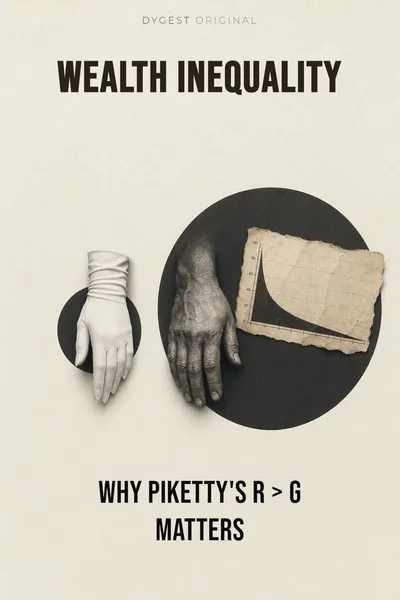
In 2013, a French economist named Thomas Piketty published a seven-hundred-page book called Capital in the Twenty-First Century. The book was dense, heavily statistical, and spent most of its pages documenting the long-run history of wealth distribution in Europe and North America over the past three centuries. It became an unlikely international bestseller. The reason was a single, provocative thesis, captured in an inequality Piketty wrote as r > g the rate of return on capital tends to exceed the growth rate of the economy. If this is generally true, then wealth concentrates over time, because the wealthy earn returns on their capital faster than the economy is expanding for everyone else.
The thesis landed in a political moment receptive to it. The 2008 financial crisis had exposed substantial gaps between the losses absorbed by ordinary people and the recoveries experienced by financial-sector executives. Occupy Wall Street had put the phrase "we are the 99 percent" into common usage. The Obama administration had campaigned on addressing inequality but produced modest results. Into this context came Piketty's book, with its claim that the inequality people were observing was not an anomaly of recent policy but a structural feature of capitalism, interrupted in the twentieth century by specific wars and policies but now returning to its long-run pattern. The book generated a decade of economic argument that is still ongoing.
The underlying question is one of the most consequential in modern political economy. If wealth concentrates automatically, without specific policy errors causing it, then the relative egalitarianism of the postwar decades was a historical exception that required specific conditions to maintain. If it does not, then the rising inequality of recent decades is a specific failure of policy that specific different policies could reverse. The answer has direct implications for tax policy, financial regulation, labor laws, and the broader question of what kind of society developed economies will be in the coming century.
The question we're asking: what does Piketty's r > g actually claim, and why does it matter for how we think about wealth distribution?
What we'll see: the historical pattern, the mechanism, the critiques, and the policy stakes.
Table of contents
01The historical pattern
Piketty's empirical contribution, which stands regardless of what one thinks of his theoretical claims, was the assembly of long-run wealth and income data across multiple countries going back in some cases to the eighteenth century. The data showed a specific pattern. In most European countries, wealth was extremely concentrated throughout the nineteenth and early twentieth centuries — the top decile holding eighty to ninety percent of total wealth in many places. This concentration fell dramatically during the first half of the twentieth century, reaching relatively low levels by the 1970s. Since then, concentration has risen again, approaching pre-WWI levels in some countries.
The twentieth-century compression was caused by specific events. World War I destroyed substantial portions of European wealth. The Great Depression wiped out additional financial wealth. World War II destroyed more, and also produced high wartime taxation that persisted afterward. The postwar period produced strong growth that disproportionately benefited wage earners rather than capital owners. Inflation eroded the real value of fixed-income holdings. The combination was a historically unusual set of circumstances that compressed wealth distribution substantially below its long-run pattern. The postwar era of relative equality was not natural; it was produced by specific catastrophes and the policies they generated.

02The mechanism
The r > g argument is conceptually simple. If the return on capital (r) exceeds the growth rate of the economy (g), then the wealth held by capital owners grows faster than the economy as a whole. In relative terms, their share of total wealth rises. If this dynamic persists over long periods, initial inequalities compound, and wealth becomes progressively more concentrated. Historical returns on capital have typically been in the four-to-five percent range, while long-run growth rates of developed economies have typically been one to three percent. The gap, compounded over generations, produces the concentration pattern Piketty documents.
Inheritance is the mechanism through which the concentration persists across generations. A wealthy family that earns five percent on its capital and consumes less than that passes the difference to the next generation. Over three or four generations, the accumulated wealth becomes very large, even without exceptional investment skill. Conversely, a family starting from zero, earning labor income and saving modestly, does not accumulate comparable wealth in the same period. The gap between heirs and self-made savers widens over time, and the society becomes one where prior wealth matters more than current effort.
03The critiques
Piketty's framework has attracted substantial critique from across the economic-political spectrum. Mainstream economists have argued that the r > g relationship is not as deterministic as Piketty suggests. Capital returns depend on supply and demand for capital, and as capital accumulates relative to labor, returns should fall. The historical pattern of roughly stable capital returns, on this view, is not a structural feature but a coincidence of specific conditions. If capital becomes abundant enough, returns will eventually fall below growth rates, and concentration will self-correct. The empirical question of how much returns fall with capital abundance is unresolved.
The measurement critique is more specific. Piketty measures wealth concentration using market values of assets, which include capital gains that have not been realized or taxed. Some critics argue this overstates concentration by including paper wealth that may not be sustainable. Others argue it understates it by excluding intangibles like human capital, pension rights, and social security entitlements that matter for economic welfare. The specific picture of how concentrated wealth really is depends on measurement choices that are contested by reasonable analysts.
04The policy stakes
Even with the critiques, the broad empirical finding that wealth concentration has risen substantially over the past forty years, reversing much of the twentieth-century compression is accepted by most analysts. The policy debate is about what, if anything, to do about it. The options include progressive taxation (income, capital gains, estates, wealth), regulatory intervention (antitrust, financial regulation, labor laws), and direct transfers (universal basic income, expanded social insurance). Each has tradeoffs, advocates, and sufficient empirical support to make informed debate possible.
The progressive-taxation approach has the strongest theoretical support. Raising marginal income tax rates on high earners, increasing capital-gains tax rates, and strengthening estate taxation would directly reduce the r > g dynamic by reducing after-tax returns on capital. The critics argue these policies reduce incentives to invest and produce work, slowing growth. The empirical evidence on how strongly taxes affect growth is mixed; the tax rates of the immediate postwar period were much higher than current levels, and growth was higher, suggesting the incentive effects are smaller than critics claim. The politics of raising taxes on the wealthy remain difficult regardless of the economics.
05Conclusion
Wealth inequality matters because it is not just a distributional question it is a question about what kind of society a country becomes. Societies with persistent high inequality develop specific features: more political polarization, less social mobility, reduced trust in institutions, and increasingly separate lives for the rich and everyone else. The specific level of inequality that a society can tolerate before these dynamics become severe is debated, but there is growing evidence that the current levels in many developed countries are producing visible social consequences. The distributional question and the stability question are the same question at a sufficiently long time horizon.
Related books