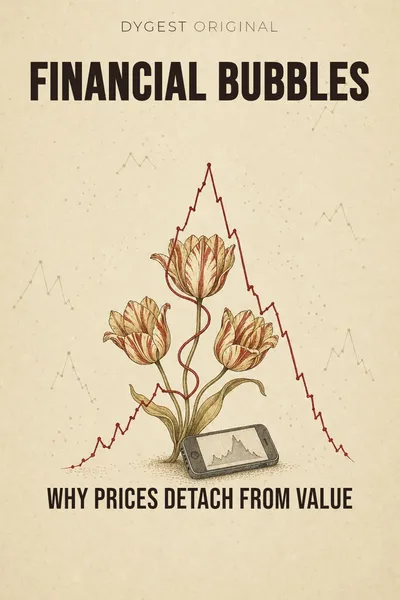
Financial Bubbles
Why prices detach from value
Description
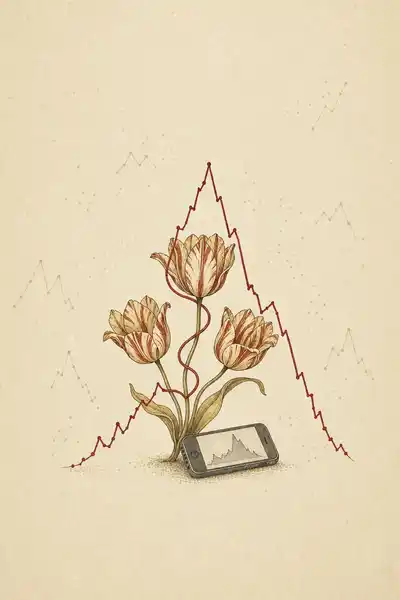
In the winter of 1637, in the Dutch Republic, a single bulb of a tulip variety called Semper Augustus was reportedly changing hands for the price of a canal-side house in Amsterdam. Not a garden's worth of flowers, not a plantation — one bulb, dormant in the cold ground, invisible until spring. Weavers, brewers and dockworkers had been trading contracts on bulbs they would never plant, in taverns, on paper, for months. Then, in the first days of February, at a routine auction in Haarlem, no buyers showed up at the asking price. Within a week the whole market for rare tulips had collapsed. Fortunes that existed only on scraps of paper simply evaporated.
The tulip story has been told and mangled for four centuries. The prices were probably not quite as insane as the legend claims, and the ruin was probably not as widespread. But the shape of the thing is real, and it keeps coming back: sugar, railways, radio stocks, Florida swampland, dot-com startups, subprime mortgages, crypto tokens. Each time, the object changes and the pattern does not. A price climbs far past anything the underlying thing could ever return, everyone can see it climbing, and for a while that is exactly the reason to keep buying.
What makes a bubble a bubble is not that prices are high. High prices can be perfectly justified. What defines a bubble is the moment price and value quietly divorce — when people stop buying an asset for what it produces and start buying it purely because it went up yesterday and might go up tomorrow. That divorce has a structure. It has an engine, a story, and a fairly reliable set of warning lights that flick on before the crash.
The question we’re asking : Why do prices, again and again across centuries, tear loose from the value of the thing being priced?What we’ll see : How a bubble actually assembles itself — the engine underneath the mania, the reasoning that always sounds new, and the tells that keep repeating.
Table of contents
01Chapter 1 — A flower worth a house
The Dutch tulip episode is the founding parable, so it is worth getting right. Tulips arrived in Europe from the Ottoman Empire in the sixteenth century, and in the wealthy, unusually literate Dutch Republic they became a status object. The most prized bulbs produced petals streaked with dramatic flames of color — an effect we now know was caused by a virus, though no one at the time did. Rarity plus beauty plus mystery is a good recipe for a high price, and for a while the high prices were genuinely about flowers.
The trouble started when the trading detached from the flowers. Bulbs are in the ground most of the year, so people began trading promissory notes for bulbs to be delivered later — a futures market, improvised in taverns, with no formal exchange and no regulation. Buyers who had no intention of ever growing a tulip bought contracts expecting to sell them on at a markup within weeks. New entrants, watching neighbors get rich, borrowed to join in. By late 1636 the price of a contract could double in a matter of days, and the number changing hands had less and less to do with any actual garden.

02Chapter 2 — The engine underneath the mania
Strip away the flowers and the radio stocks and the mortgage bonds, and every bubble runs on the same engine, with three moving parts turning together. The first is a genuinely good story. Bubbles almost never form around nonsense; they form around something plausibly transformative. Railways really did change everything. The internet really did change everything. The story is true enough that skepticism looks foolish, which is precisely what disarms the people who should be asking harder questions.
The second part is credit. Manias need fuel, and the fuel is borrowed money. When people can buy an asset with someone else's capital, they can bid it far higher than their own savings would ever allow, and the gains on the way up are magnified. The Dutch tulip traders bought on promissory notes. The 1929 stock buyers bought on margin, sometimes putting down as little as ten percent. The 2008 homebuyers bought with mortgages that required almost nothing down. Cheap, abundant credit is the accelerant that turns an enthusiasm into a bubble.
03Chapter 3 — New era, same arithmetic
The most durable feature of bubbles is the conviction, every single time, that this one is different. There is even a phrase that recurs across centuries of manias: the new era. In the 1920s it justified stock prices that had lost contact with corporate earnings — new technologies, new management science, a permanently higher plateau, as the economist Irving Fisher famously declared just before the 1929 crash. In the late 1990s it justified handing enormous valuations to dot-com companies with no profits, on the logic that the internet had rewritten the old rules and earnings no longer mattered.
The pattern is almost comic in its regularity. In 1720, the South Sea Company in Britain and John Law's Mississippi scheme in France both promised fabulous returns from colonial trade, and both drew in aristocrats and servants alike before collapsing within months of each other. In the 1840s, British railway mania sent hundreds of speculative rail companies public; most never laid a mile of track. In the 1980s, Japanese land and stock prices reached the point where the grounds of the Imperial Palace in Tokyo were said to be worth more than all the real estate in California. Each time, the specifics felt genuinely unprecedented to the people living through them.
04Chapter 4 — The signals that keep rhyming
Step back from any single episode and the recurring nature of bubbles starts to look less like a series of accidents and more like a property of the system itself. Markets exist to let people bet on each other's expectations. That is their genius — it channels capital toward what people believe will matter — and it is also the flaw that makes bubbles inevitable. Any mechanism that prices assets by aggregating expectations can, under the right conditions, aggregate a shared expectation that is simply wrong, and then reward everyone for holding it a little longer.
This is why the warning lights are so consistent across centuries that could hardly be more different in technology or culture. Prices rise faster than any plausible income the asset could generate. Ordinary people who never traded before start trading, often on borrowed money. New instruments appear specifically to let more capital chase the asset. And a story circulates explaining why traditional measures of value no longer apply. When several of these appear together, the divorce between price and value described at the outset is already well underway.
05Conclusion
Come back to that Haarlem auction in February 1637, where the buyers simply declined to show up at the asking price. Nothing had changed about the tulips overnight. No frost had struck, no news had broken. What changed was the one thing the entire structure depended on — the shared belief that someone else would pay more tomorrow. Once that belief hesitated, the prices had nothing left to hold onto, because they had long since let go of the flowers. A bubble does not burst when the truth arrives. It bursts when the story runs out of new believers.
Related books