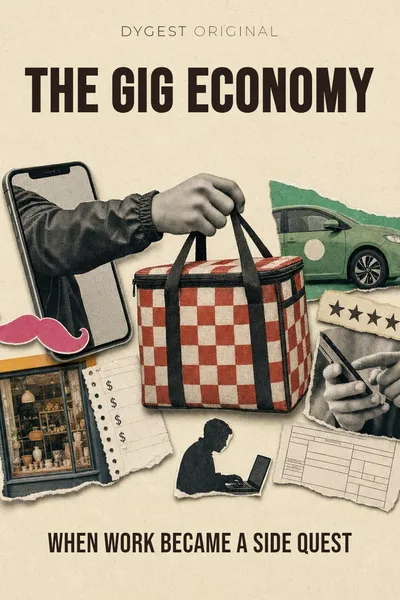
The gig economy
When work became a side quest
Description
In March 2009, two San Francisco entrepreneurs named Travis Kalanick and Garrett Camp launched a smartphone application called UberCab that allowed users to request rides from independent drivers using their personal vehicles. The service operated initially as a luxury black-car alternative in San Francisco, with a small number of professional drivers and a relatively wealthy user base. Across the subsequent five years, the company progressively expanded its service categories, geographies, and driver pool, with the cheaper UberX service launching in 2012 and the substantial expansion of the driver fleet to include ordinary people driving their own cars producing what came to be called the gig economy. By 2024, approximately 36 percent of American workers roughly 58 million people were participating in gig work either as primary income or as supplemental income, with the platforms that organize this work generating combined revenues of approximately $450 billion annually.
The reframing of work was substantial. The twentieth-century American framework full-time work for a single employer, with benefits, job security, predictable hours, and labor-law protections was substantially replaced by a framework in which workers performed discrete tasks for platforms that classified them as independent contractors. The classification mattered: independent contractors are not entitled to minimum wage, overtime, unemployment insurance, workers’ compensation, or employer-paid Social Security contributions. The platforms built their business models around this classification, with the cost savings being essential to the economics.
The framework has become central to how Millennials and Gen Z understand work. Approximately half of Gen Z workers have done some form of gig work. It has produced both real economic opportunities flexibility, supplemental income, employment for people who could not access traditional jobs and real costs: income instability, absence of benefits, exposure to platform decisions workers cannot contest.
The question we’re asking: what the gig economy actually is, who participates, and how it reshaped the basic framework of American work.
What we’ll see: the platforms that built the framework, the workers who participate, the regulatory conflict that has emerged, and what survives.
Table of contents
01The platforms that built the framework
The gig economy operates through digital platforms that match workers to discrete tasks. The principal categories are transportation (Uber, Lyft), food delivery (DoorDash, Uber Eats, Grubhub, Instacart), short-term rental (Airbnb), freelance services (Upwork, Fiverr, TaskRabbit), and the broader category of platform-mediated work that has emerged across the past decade. The platforms operate substantially as marketplaces connecting workers to customers while substantially controlling the terms of the work through their algorithms, pricing structures, and rating systems.
The technological infrastructure that the platforms required was substantial. The smartphone, which became widely adopted across 2007-2012, provided the basic interface through which workers could receive task assignments and customers could request services. The location services built into modern smartphones allowed the platforms to match nearby workers to customer requests. The payment infrastructure that emerged across the same period allowed cashless transactions between strangers. The combination of these technologies made possible a category of work that had not been operationally feasible before approximately 2010.

02The workers who participate
The gig workforce is substantially diverse and substantially difficult to characterize as a single category. Approximately one-third of gig workers do the work as their primary income source typically driving for ride-sharing or delivery platforms, with the work substantially functioning as a full-time job without the protections of full-time employment. Approximately two-thirds do gig work as supplemental income typically working a primary job and using gig work to fill gaps, supplement income, or fund specific goals.
The demographic distribution is uneven. Gig work is substantially more common among workers under 35, with approximately 50 percent of Gen Z workers reporting some gig work participation. The work is substantially more common among workers without college degrees, among immigrant populations, and among workers in metropolitan areas where the platform infrastructure is most developed. The framework substantially functions as both an opportunity for workers who have limited access to traditional employment and as a fallback for workers whose primary employment does not provide sufficient income.
03The regulatory conflict
The classification of gig workers has been the central regulatory conflict of the past decade. The legal distinction between employees and independent contractors is substantial employees receive minimum wage, overtime, unemployment insurance, workers’ compensation, employer-paid Social Security contributions, and protection from discrimination, while independent contractors receive none of these. The platforms have consistently maintained that their workers are independent contractors, while the workers and labor advocates have consistently argued that the actual conditions of the work including the platforms’ substantial control over pricing, ratings, and operational decisions are substantially more consistent with employee status.
The California experiment has been the most documented regulatory contest. The California Supreme Court’s 2018 Dynamex decision substantially established a stricter test for independent contractor classification, with the AB5 legislation of 2019 codifying the framework into state law. The legislation would have substantially required Uber, Lyft, DoorDash, and similar platforms to classify their workers as employees. The platforms responded with Proposition 22 a $200 million ballot initiative that substantially exempted gig drivers from the AB5 framework. The initiative passed in November 2020 with approximately 59 percent of the vote, substantially preserving the independent contractor classification for the major platforms in California.
04What survives, and what comes next
The gig economy has become a substantial and apparently durable feature of the American workforce. The platforms have continued to expand, the worker population has continued to grow, and the framework has continued to operate as one of the principal alternatives to traditional employment for substantial portions of the workforce. The pandemic of 2020-2021 substantially accelerated the framework, with delivery platforms in particular experiencing substantial growth that has substantially persisted.
The cultural reception has continued to be divided. The framework offers substantial advantages flexibility, accessibility, supplemental income that workers genuinely value. It also imposes substantial costs income instability, absence of benefits, exposure to platform decisions that workers genuinely experience. The two are not in contradiction; the same worker often values the flexibility and resents the absence of protections. The framework that emerges depends substantially on policy decisions that have not been fully resolved.
05Conclusion
The gig economy that emerged with Uber’s 2009 launch has substantially transformed the basic framework of American work. The classification battle continues, the worker protections continue to evolve, and the platforms continue to expand. The framework has become substantially central to how Millennials and Gen Z understand work itself.
Related books