Bretton Woods
The weekend 44 countries invented the postwar world
Description
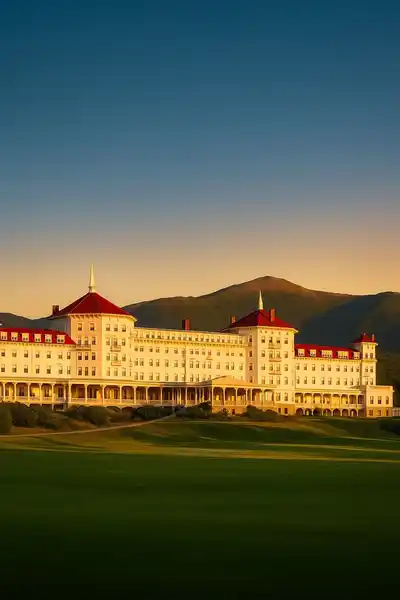
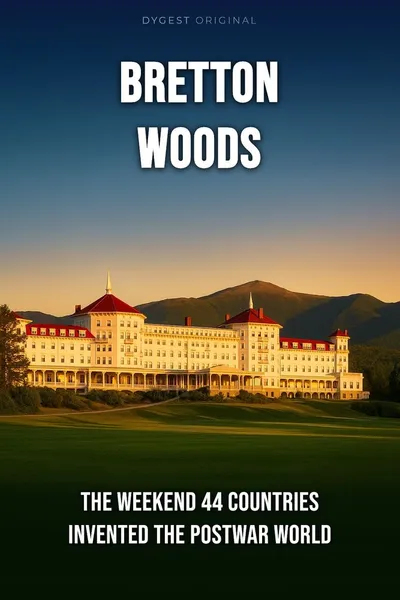
In the first three weeks of July 1944, while the Second World War was still being fought in Europe and the Pacific, 730 delegates from 44 Allied nations met at the Mount Washington Hotel in Bretton Woods, New Hampshire. It was a strange place to meet — a resort hotel in the White Mountains, hastily reopened for the conference after being closed during the war. It was also not a negotiation between equals. The outcome was mostly decided before the delegates arrived.
What the conference produced was a blueprint for the postwar economy. It created two institutions — the International Monetary Fund and the International Bank for Reconstruction and Development, which became part of the World Bank. It set up a system of fixed exchange rates, with every major currency pegged to the US dollar, and the dollar pegged to gold at $35 an ounce. It established the rules by which international trade and finance would operate for the next twenty-seven years.
The system the conference designed ran until 1971. When it collapsed — suddenly, on a Sunday night in August, when President Nixon unilaterally detached the dollar from gold — it shaped the world economy again, just by ending. The institutions it created are still with us, running much of what we now call globalization. Understanding what happened at Bretton Woods, and why the two men who disagreed about almost everything in the room still agreed on the basic shape of the answer, explains a lot about the world we still live in.
● The question we're asking: how did 44 countries, in three weeks at a New Hampshire resort, design the rules for the global economy that still govern us today?
● What we'll see: the lesson the war taught about economic fragmentation, the Keynes-vs-White negotiation that mostly happened before the conference, the system that ran until 1971, and why the institutions outlasted the mechanism that built them.
Table of contents
01 What the 1930s taught
The problem Bretton Woods was trying to solve was the problem of the 1930s. The Great Depression had torn the global economy apart, and the response of most major economies had been to make it worse. Countries raised tariffs against each other — the US Smoot-Hawley tariff of 1930 was the most famous example — and devalued their currencies to try to export their unemployment to their neighbors. Trade collapsed. The world fell into economic blocs, each one trying to solve its own problems at the others' expense. That economic fragmentation was widely understood, by 1944, to have contributed to the political fragmentation that led to the war.
The lesson the Allied economists drew from this was that the postwar system needed international rules. Specifically, it needed a way to prevent countries from devaluing their currencies in competitive beggar-thy-neighbor cycles, and a way to finance the reconstruction of economies that had been destroyed by the war. It also needed to be a system the United States was willing to run, because by 1944 the United States held roughly two-thirds of the world's gold reserves and had the only major economy that hadn't been bombed.

02 The deal
White won the argument, because the United States was holding most of the cards. The American economy had grown during the war while everyone else's had been destroyed. The US had most of the gold, most of the industrial capacity, and almost all the money the rest of the world needed to rebuild. Keynes knew this. His biographer Robert Skidelsky documents the long months Keynes spent trying to soften the American position, increasingly from a position of weakness as British finances collapsed. The final agreement was closer to White's proposal than Keynes's.
The system that emerged had several key pieces. Every member country would fix its currency to the US dollar at a specified rate. The dollar, in turn, was fixed to gold at $35 an ounce. Central banks of other countries could, in principle, redeem their dollars for gold at that rate. Exchange rates could be changed in cases of fundamental disequilibrium, but only with approval from the new International Monetary Fund. The Fund itself was a pool of currencies that countries in short-term trouble could borrow from, conditional on reforms.
03 What broke, what survived
The Bretton Woods system did broadly what it was designed to do. Between 1945 and 1971, world trade grew dramatically, exchange rates were relatively stable, and the industrialized world enjoyed one of the strongest growth periods in its history. Western Europe rebuilt. Japan rebuilt. The system was not uncontroversial — there were repeated currency crises, devaluations, and complaints about US dominance — but compared to the 1930s, it was a working order.
The flaw in the system became visible slowly. As the US economy grew more intertwined with the rest of the world, more dollars flowed out of the country to finance imports and overseas investment. Foreign central banks accumulated dollars at an ever-faster rate. By the late 1960s, the dollars held abroad exceeded the US gold stock by a wide margin. If all of them had been presented for redemption at $35 an ounce, the US would have run out of gold immediately. This tension had a name — the Triffin dilemma, after the economist Robert Triffin, who pointed out that the reserve-currency country had to run persistent deficits to supply the world with dollars, which eventually undermined confidence in the dollar itself.
04 Multilateral form, hegemonic substance
One of the odd features of Bretton Woods is how hierarchical it was. It looked multilateral on paper — 44 countries, weeks of conference sessions, committee votes on technical details — but the decisions that mattered had been made by two men in advance, and one of them was negotiating from a position of decisive advantage. The conference was a way to get the rest of the world to legitimize an agreement that was going to happen regardless.
This pattern — multilateral form, hegemonic substance — has become a standard way to describe the postwar international order. The United States built institutions that were genuinely international, with rules that often constrained American behavior at the margins. But on the questions that really mattered, those institutions reflected American preferences. The IMF was headquartered in Washington. The dollar was the reserve currency. American policymakers set the agenda for decades.
05 Conclusion
Over three weeks in July 1944, 44 countries met at a resort in New Hampshire and signed off on a blueprint that two men had mostly written in advance. The blueprint held for 27 years, then broke, then kept running in modified form through its institutions. The world economy we live in today is a direct descendant of that conference — more directly than almost any other single event of the 20th century.
Related books