WeWork
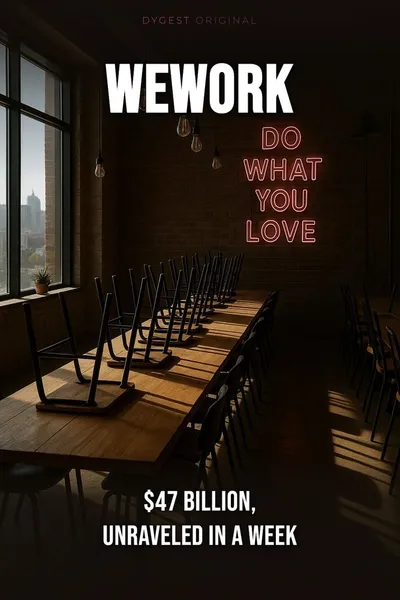
$47 billion, unraveled in a week
Description
In January 2019, WeWork was valued at $47 billion. It was one of the most valuable private companies in the world, ahead of SpaceX at the time, ahead of Airbnb. Its founder, Adam Neumann, was giving interviews about raising the world's consciousness through shared office space. SoftBank had put roughly $10 billion into the company. Investment banks were lining up to take it public. A few months later, the IPO was dead, the valuation had collapsed by more than eighty percent, and Neumann had been paid $1.7 billion to leave.
What happened in between was roughly six weeks. The S-1 — the prospectus companies file when they go public — was released to the public in August 2019. By late September the IPO had been pulled. By October, Neumann was out. By November, the company was surviving on a SoftBank rescue package at a valuation of about $8 billion, with thousands of layoffs to follow.
The WeWork story gets told as a story about Neumann, who was unusual enough — barefoot meetings, tequila at all-hands, a trademark on the word 'We' that he personally licensed back to his own company for $5.9 million. But the more interesting question isn't how Neumann got away with what he got away with. It's why an entire ecosystem of investors, banks, and journalists valued a real-estate sublease company at $47 billion, and what changed when one document, written in plain English, finally made them look.
● The question we're asking: how does a company get to a $47 billion valuation, and then collapse to $8 billion in six weeks without its underlying business changing?
● What we'll see: the real estate arbitrage sold as a tech platform, the S-1 that broke the spell, the SoftBank rescue that paid Adam Neumann almost two billion dollars to leave, and what private valuations actually measure.
Table of contents
01The tech company that wasn't
WeWork's business model was simple enough to explain in a sentence. The company leased commercial office space on long-term contracts — typically fifteen years — renovated it to look like a tech-friendly shared workspace, and then sublet it to smaller tenants on short-term memberships, often month to month. The difference between the long-term lease it paid and the short-term rent it collected was, in theory, the profit.
This is a real estate arbitrage, and it's not a new idea. Commercial subleasing companies have existed for decades. The tricky part is that it only works when rent is rising or at least stable, and when you're able to keep your buildings full. If the economy turns, tenants leave immediately — that's the whole point of a short-term membership — while you're still locked into a fifteen-year obligation at a fixed rent. You absorb the loss. This is what happened during every previous commercial real estate downturn, and it's what makes the business fundamentally risky.

02The document that killed the story
The thing that broke the spell was a legal requirement. When a company wants to go public in the United States, it has to file an S-1 document with the SEC. The S-1 is a detailed prospectus: financial statements, risk factors, a description of the business, biographies of key executives, related-party transactions, everything. It's written by lawyers, reviewed by the SEC, and becomes a public document as soon as it's filed. Private company marketing is a game of narrative. An S-1 is not.
WeWork filed its S-1 on August 14, 2019. It was widely read, and it did not survive contact with professional investors. The problems started on the first page. The document was full of language that read like a religious pamphlet — WeWork's mission was 'to elevate the world's consciousness.' Adam Neumann was described in nearly messianic terms. The company had renamed itself 'The We Company' and paid Neumann $5.9 million for the trademark on the word 'We.' Neumann had been buying buildings personally and then leasing them back to WeWork. His wife was named as a co-founder who would help appoint his successor, including in the event of his death.
03The collapse
Once the IPO was dead, the company ran out of options quickly. WeWork had been burning about $200 million a month. Without IPO proceeds, it had roughly enough cash to last into the end of the year. SoftBank, which had already poured billions in, had two choices: let the company fail and write off the whole investment, or put in more money to keep it alive. SoftBank chose more money.
The rescue package announced in October 2019 valued the company at about $8 billion. It included new funding from SoftBank, acceleration of already-committed capital, and a tender offer for existing shareholders. As part of the deal, Adam Neumann was pushed out as CEO. The terms of his exit became the most-discussed part of the whole episode. He received roughly $1.7 billion — a stock buyout, a consulting contract, and a loan forgiveness — to step down and leave the board. He had built a company that was about to fail and been paid almost two billion dollars to stop being in charge of it.
04What private valuations actually measure
The WeWork story is often framed as a story about fraud, or about Adam Neumann being an exceptional conman. That's not quite right. Neumann was eccentric and self-dealing, and the S-1 contained genuinely unusual arrangements. But WeWork wasn't a fraud in the usual sense. Its revenue was real, its buildings existed, its members were real members paying real rent. The problem wasn't that the numbers were fake. It was that the valuation was based on a story that the numbers couldn't support, and nobody demanded it until the SEC made them.
Private markets in the 2010s allowed companies to raise enormous amounts of money without the accountability of public disclosure. A founder could build a fifty-billion-dollar valuation through successive private rounds, each priced by a small number of investors who all had reasons to believe the next round would be priced higher. There was no outside auditor of the narrative, because the narrative was the asset. WeWork was the most extreme example, but similar dynamics played out at Theranos, at Uber for a long time, at a number of other companies whose valuations looked different once they had to meet public-market scrutiny.
05Conclusion
WeWork was valued at $47 billion in January 2019. By October 2019 it was valued at $8 billion. The company hadn't fundamentally changed in those nine months. What had changed was that it had tried to go public, and in doing so had been required to describe itself in the kind of document that public markets evaluate on their own terms rather than the company's.
Related books