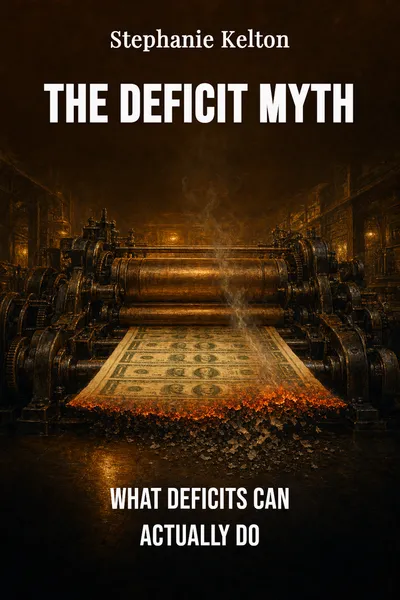
The Deficit Myth
What deficits can actually do
Description
Every year, more or less on schedule, a figure lands in the news and a familiar dread sets in. The United States ran a federal deficit of over a trillion dollars; the national debt has passed thirty-something trillion; commentators reach for the same images — a maxed-out credit card, a burden shoved onto our grandchildren, a country living beyond its means. The intuition is so widely shared that politicians of every stripe pledge to rein it in, and voters nod along. Spending more than you take in feels obviously reckless, because for a household it is.
Stephanie Kelton spent years inside that consensus before turning against it. An economist who advised the Senate Budget Committee and later Bernie Sanders's campaign, she is one of the more prominent voices behind Modern Monetary Theory, and in 2020 she laid out its case for a general reader in a book called The Deficit Myth. Her claim is blunt: almost everything the political class believes about federal deficits is wrong, not at the level of policy detail but at the level of basic mechanics. The government that issues its own currency, she argues, simply does not face the constraints a family faces.
That sounds like a magician's trick, or a licence to spend without limit, and Kelton knows it. Much of the book is spent heading off exactly that reading. The limit is real, she insists — it is just not the one printed on the front page. Understanding where it actually sits changes what we think a government can afford, and what it is choosing not to do.
The question we’re asking : If a currency-issuing government can never run out of its own money, what is actually stopping it from spending?What we’ll see : How Kelton takes apart the household analogy at its root, and where she says the true ceiling on public spending really lies.
Table of contents
01Chapter 1 — The household that isn't a household
The whole argument turns on a comparison that almost nobody thinks to question. When we talk about the federal budget, we reach instinctively for the language of the kitchen table: balancing the books, tightening the belt, not spending what you don't have. Kelton's opening move is to point out that this analogy, however comforting, describes the wrong kind of actor. A household uses a currency it cannot create. So does a business, a city, a state, even a country that borrows in someone else's money. All of them are, in her term, currency users. They have to earn or borrow dollars before they can spend them, and if they run short, they really can go broke.
The federal government of the United States is not in that category. It is the currency issuer — the monopoly source of the dollar. It does not need to collect dollars before it can spend them, because it is where dollars come from in the first place. Kelton likes to invert the usual order of operations: a household has to find money before it spends, but the issuer spends the money into existence first, and taxes some of it back afterward. Spending comes before taxing, not the other way around.

02Chapter 2 — Where money actually comes from
If the government spends money into existence, why do we pay taxes at all? Kelton's answer reorders the conventional story completely. In the standard picture, taxes fund spending: the state gathers revenue, then decides what it can afford. In her picture, taxes do something else. They create the demand for the currency in the first place — you need dollars because you owe dollars to the state — and they drain money back out of the economy to make room for public spending without overheating it. Taxes are less a piggy bank than a thermostat.
Government borrowing gets a similar reinterpretation. We imagine the Treasury going cap in hand to lenders because it has run short. Kelton describes the sale of Treasury bonds not as a desperate scramble for cash but as a policy choice — a way of offering savers a safe, interest-bearing place to park dollars the government has already spent into being. The bonds soak up money that already exists; they don't summon money the government lacked. Whether to issue them at all, she notes, is a decision, not a necessity imposed from outside.
03Chapter 3 — Inflation, not the deficit, is the real limit
Here is where Kelton draws her line, and it is a firm one. The limit on government spending is not the size of the deficit but the productive capacity of the economy — and the signal that you have hit it is inflation. This reframes the whole discipline of budgeting. Instead of asking whether we can afford a program in dollar terms, the relevant question becomes whether the country has the real resources to carry it out without bidding up prices. Can we staff the hospitals, pour the concrete, train the teachers? If the people and materials are available, the money can always be found. If they aren't, no amount of money conjures them, and the attempt shows up as rising prices.
This is why she rejects the reflex that deficits automatically stoke inflation. Inflation, in her reading, comes from an economy trying to buy more than it can produce, or from bottlenecks in particular resources — energy shocks, supply chains, a war economy running hot. She points to episodes where large deficits coincided with stable or falling prices, and to Japan, which has run enormous public debt relative to its economy for decades without the runaway inflation orthodox theory kept predicting. The relationship between deficits and prices, she argues, is far looser than the textbook line suggests.
04Chapter 4 — The deficit that belongs to someone else
Step back from the mechanics and one accounting identity does most of the work in Kelton's book. Every dollar the government spends and does not tax back does not vanish; it lands in the private economy and stays there. The government's deficit is, to the penny, a surplus for everyone else — the savings, bonds, and bank balances held by households, firms, and foreign holders of dollars. A government running a deficit is a government adding net financial wealth to the rest of us. Balance the budget, and you are, by the same arithmetic, draining that wealth away.
This is the reframing that gives the book its edge. The recurring political goal of eliminating the deficit, pursued as a mark of responsibility, turns out to mean removing money from the pockets of the public. Kelton points to the handful of times the United States actually ran budget surpluses; several were followed, before long, by recessions or depressions. She does not claim a simple mechanical cause, but she uses the pattern to unsettle the assumption that a surplus is self-evidently healthy and a deficit self-evidently sick. The two are the same coin seen from opposite sides.
05Conclusion
The dread that arrives with each new deficit figure, Kelton suggests, is misplaced not because the number is meaningless but because we have been reading it upside down. It measures how much money the government has added to the private economy, not how close the country is to bankruptcy. The household on the kitchen table can run out of dollars; the issuer of those dollars cannot. What the issuer can do is ask too much of an economy already at full stretch, and that — inflation, the exhaustion of real capacity — is the constraint she wants front and centre, in place of a fear that has quietly governed policy for decades.
Related books