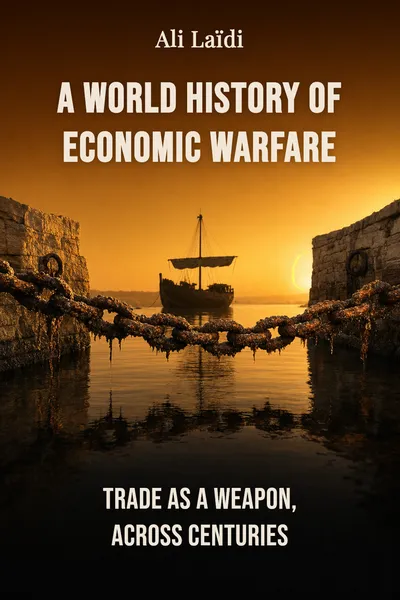
A World History of Economic Warfare
Trade as a weapon, across centuries
Description
In 432 BC, Athens issued a decree barring merchants from Megara, a small city allied with Sparta, from its markets and harbors across the empire. No army marched, no walls fell. The Megarian Decree simply cut a rival off from the trade that kept it alive. Historians have argued ever since about how much this measure lit the fuse of the Peloponnesian War, but the gesture itself is unmistakable. Long before economists had a word for it, a state had reached for commerce as a weapon and pointed it at an enemy. Ali Laïdi opens his sweep through the centuries by insisting on exactly this: the tactic is not modern at all.
His book gathers episodes that we tend to file under separate headings — ancient rivalries, the trading empires of the seventeenth century, the naval blockades of the Napoleonic wars, the sanctions of our own decade — and reads them as one continuous story. The claim is deceptively simple. Whenever states have competed, some of them have tried to win by starving, squeezing, or shutting out the other side rather than by fighting. Grain, spices, oil, dollars, semiconductors: the goods change, the reflex does not. What looks like a novelty of the globalized age turns out to have a very long pedigree.
Reading it that way changes how the present feels. The sanctions announced in press conferences, the export bans, the frozen reserves — they stop looking like the improvisations of a peaceful era and start looking like the latest entry in a ledger that runs back to antiquity. That is the frame Laïdi hands us, and it is worth following where it leads.
The question we’re asking : Has trade always been a weapon, and if so, what does its long career tell us about the way states really compete?What we’ll see : How economic coercion travels from ancient harbors to the present, mutating with each era but never disappearing.
Table of contents
01Chapter 1 — The blockade that was older than the empire
Laïdi begins where the intuition resists him most: in a past we imagine as too simple for economic strategy. The ancient world, in his telling, was already crowded with states that understood the value of cutting an enemy off. The Megarian Decree is the famous case, but it is not the only one. Grain was the pressure point of the Mediterranean, and whoever controlled the routes from Egypt or the Black Sea held a lever over cities that could not feed themselves. Rome grasped this completely. Its dominance was military, but it rested on the ability to move — or withhold — the wheat that kept its own population fed and its rivals dependent.
What Laïdi wants us to notice is that these were not blunt acts of plunder. They were calculated. To bar a city from your markets, to redirect a supply, to grant favorable terms to one partner and choke another, required a reading of who needed what and how badly. That reading is the beginning of economic warfare as a discipline, even without the vocabulary. The actors knew that prosperity and vulnerability were two faces of the same coin, and that a well-placed interruption could do the work of a siege.

02Chapter 2 — Mercantilism as a state at war by other means
With the rise of the modern state, economic warfare acquired something it had lacked: a doctrine. Laïdi devotes his central chapters to mercantilism, the body of thinking that dominated European statecraft from the sixteenth to the eighteenth century. Its premise was that wealth was finite, that world trade was a fixed pie, and that one nation's gain was necessarily another's loss. From that premise everything else followed. A country grew strong by accumulating precious metals, running trade surpluses, and denying rivals the markets and materials they needed to do the same.
This was not a peaceful philosophy dressed in commercial language. It was, Laïdi argues, a theory of permanent competition in which trade and war were continuous rather than opposed. The great chartered companies — the Dutch and English East India Companies above all — were the instruments. They were commercial enterprises with fleets, forts, armies, and the power to make treaties. They fought each other for monopolies over spices, textiles, and shipping lanes, and behind them stood governments that understood these battles as matters of national power. The line between merchant and soldier was not just blurred; it was often meaningless.
03Chapter 3 — The century of embargoes and blacklists
The nineteenth and twentieth centuries, in Laïdi's account, are where economic warfare becomes recognizably modern — larger, more bureaucratic, and increasingly the business of governments themselves rather than chartered companies. The pivot is Napoleon's Continental System, launched in 1806, an attempt to bring Britain to its knees by closing the entire European continent to British trade. It was economic warfare on a scale never before attempted, and its partial failure was as instructive as any success. Britain adapted, smuggling flourished, and the effort strained the very empire it was meant to serve. Coercion by commerce, Laïdi shows, is hard to sustain and easy to route around.
The lesson did not deter anyone. Industrialization raised the stakes, because modern economies depended on a widening list of critical materials — coal, oil, rubber, steel, later still the components of advanced weapons. Denying a rival access to these inputs became a central object of strategy. The two world wars turned this into an administrative machine. The Allied blockade of Germany during the First World War aimed to strangle its economy and its food supply, and the interwar and wartime periods saw the elaboration of blacklists, trading-with-the-enemy laws, and coordinated efforts to deny raw materials to opponents.
04Chapter 4 — When the weapon outlives the war
Step back from the individual episodes and a single pattern comes into focus, which is the real argument of Laïdi's book. Economic warfare is not a phase that states pass through on the way to peace, nor a substitute they adopt only when armies are too costly. It is a constant of statecraft, running underneath the more dramatic history of battles and treaties. What varies is the technology of coercion and the language used to dress it up. The impulse to win by controlling the flow of goods and money is as old as competing states themselves.
This is why the present looks less exceptional than we assume. We inhabit a world that officially prefers commerce to conquest, that celebrates open markets and global supply chains as forces for peace. Yet the same interdependence that binds economies together also multiplies the pressure points a determined state can exploit. The more a country depends on foreign oil, foreign chips, foreign banks, or the dollar system, the more it exposes a nerve that a rival can press. Globalization did not retire the weapon. It handed states a far more sensitive one.
05Conclusion
The story that began with Athens shutting its markets to Megara ends, for now, in a vocabulary that fills the news: sanctions, embargoes, export controls, frozen assets, decoupling. Laïdi's achievement is to make that continuity impossible to unsee. The measures announced today as bold responses to crisis belong to a lineage that runs through Colbert's tariffs, Napoleon's blockade, and the wartime blacklists of the twentieth century. The instruments are more sophisticated and the reach more global, but the reflex is the same one the ancients already knew.
Related books