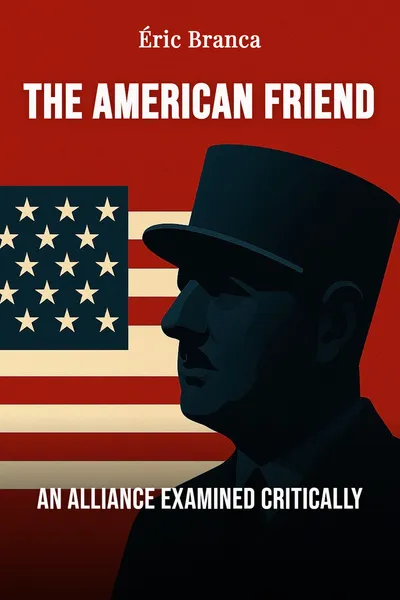
The American Friend
An alliance examined critically
Description
On August 25, 1944, General Leclerc's Second Armored Division rolled into Paris, and the city went delirious. The image froze into something close to a founding myth: America had crossed an ocean to give France back its capital, its republic, its honor. For two or three generations after, the storyline held. The United States was the friend who came twice, in 1917 and in 1944, who bled on the beaches of Normandy, who rebuilt a ruined continent with Marshall dollars. Gratitude became almost a civic reflex.
Eric Branca's book The American Friend takes that reflex and turns it over to look at the underside. His argument, built across a century of archives, cables and declassified memos, is that the warmth was mostly on one side. Washington, from Woodrow Wilson onward, treated France less as an ally to be courted than as a piece to be placed on a board. The affection France felt was real; the interest America pursued was colder, more consistent, and rarely about France at all.
This isn't a conspiracy story, and Branca isn't selling anti-Americanism. He's doing something more uncomfortable: reading a relationship that France experienced as friendship through the documents of the party that experienced it as strategy. What emerges is a long record of a tie that two countries were never quite living in the same way.
The question we’re asking : What did Washington actually want from France, across a century where Paris kept mistaking interest for affection?What we’ll see : How an alliance France remembers as friendship reads very differently from the other side of the Atlantic.
Table of contents
01 Chapter 1 — The friend who arrived in 1917
The story most often told starts with American soldiers stepping off ships in 1917, and an officer declaring "Lafayette, we are here" — repaying an old revolutionary debt. Branca doesn't deny the arrival or the dead; the American Expeditionary Force lost tens of thousands of men in 1918. What he questions is the framing. Woodrow Wilson entered the war late, reluctantly, and on his own terms. He refused to call France and Britain allies, preferring the cooler word "associates." The distinction was deliberate. Wilson wanted a free hand to shape the peace, not to be bound by the war aims of exhausted European partners.
That free hand showed itself at Versailles in 1919. Georges Clemenceau wanted guarantees against a future German attack — a buffer on the Rhine, a firm security commitment. He got Wilson's Fourteen Points and a League of Nations instead, and then watched the American Senate refuse to ratify even that. The promised security treaty evaporated when Washington walked away. France was left with a victory it couldn't defend, which is part of how the 1930s went the way they did. Branca lingers on that abandonment because it rhymes with so much of what comes later: an American commitment extended in principle, then withdrawn the moment domestic politics turned.

02 Chapter 2 — Roosevelt never trusted de Gaulle
The Second World War is where Branca's archives bite hardest, because the gap between the French memory and the American record is widest there. The French memory is Normandy and liberation. The American record, in Franklin Roosevelt's own correspondence, is a sustained distrust of Charles de Gaulle that bordered on contempt. Roosevelt did not see de Gaulle as the legitimate voice of France. He saw an ambitious general with no electoral mandate, prone to posturing, and for a long stretch he preferred to deal with almost anyone else.
That preference had consequences. For much of the war, Washington maintained relations with the Vichy regime, betting that figures compromised by collaboration might be more pliable than a proud Free French leader. When the Allies landed in North Africa in 1942, they cut a deal with Admiral Darlan, a Vichy man, rather than with de Gaulle. Roosevelt's real plan, documented in the planning around what was called AMGOT, was to govern liberated France as occupied territory under American military administration, printing its own francs, as if France were a defeated enemy rather than an ally to be restored.
03 Chapter 3 — The dollar as a quiet weapon
After 1945 the pressure changed register. It stopped being about armies and became about money, which is harder to see and harder to resist. The Marshall Plan, launched in 1947, poured billions into a wrecked Europe and did genuine good. It also tied the recipients into an economic order designed in Washington, oriented toward American exports, and conditioned on political alignment, which in practice meant keeping communists out of government. Aid was never only generosity; it was generosity with a direction of travel, and Branca is careful to show both halves at once rather than collapse one into the other.
Underneath it sat the dollar. The Bretton Woods arrangement had made the American currency the anchor of the whole system, and that anchor became a lever. It was de Gaulle, back in power, who said the quiet part out loud in the 1960s, denouncing what his finance minister Valéry Giscard d'Estaing called the "exorbitant privilege" — the fact that America could run deficits the rest of the world was obliged to finance simply because it issued the reserve currency. De Gaulle started converting French dollar reserves into gold, a pointed act of defiance, and pulled France out of NATO's integrated command in 1966.
04 Chapter 4 — An alliance that runs one way
Step back from the episodes and a shape appears that Branca wants us to sit with. The Franco-American relationship has never been a friendship between equals, because the two countries were never in a position to be equal. One is a continental superpower with the reserve currency, the dominant military, and the long reach; the other is a middle power with memory, prestige, and a seat at tables it no longer fully controls. Calling that a friendship isn't a lie, exactly. It's a courtesy that obscures the slope the ground is on.
The asymmetry is structural, not personal, and that's what makes it durable. It survived the warmth between specific leaders and the froideur between others. It outlasted Wilson, Roosevelt, de Gaulle, every handshake and every snub. When France aligned, as it mostly did after de Gaulle, it reaped the benefits of the American umbrella. When it broke ranks, as in 2003 over the invasion of Iraq, it felt the cost quickly, in diplomatic isolation and in the small humiliations like "freedom fries." The menu of choices was always set in Washington, and France's freedom amounted to picking from a list it had no hand in writing.
05 Conclusion
The crowds on the Champs-Élysées in 1944 weren't deceived about what they were feeling. The liberation was real, the dead were real, the relief was real. Branca's book doesn't take any of that away. It just sets the celebration next to the cables and the planning memos and asks us to hold both at once — the gratitude France felt and the calculation Washington ran, side by side, describing the same events from two incompatible angles.
Related books