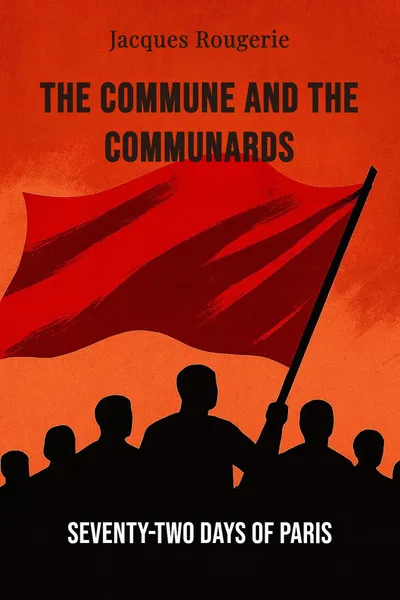
The Commune and the Communards
Seventy-two days of Paris
Description
On March 18, 1871, Parisians woke to find soldiers trying to haul away the cannons parked on the heights of Montmartre. The guns belonged, as far as the crowd was concerned, to the National Guard of Paris — paid for by public subscription during the siege the city had just endured. Women got there first, surrounded the troops, talked to the conscripts. By the end of the day two generals had been shot, the soldiers had refused to fire, and the government of Adolphe Thiers had fled to Versailles. Nobody had planned any of it. A disputed morning over artillery had become something much larger.
What followed was a city governing itself for a little over two months. Elections were held, a Commune was proclaimed at the Hôtel de Ville, decrees were passed on rent and workshops and schools, and a population that had spent the winter starving under Prussian siege suddenly held its own fate. Then, at the end of May, the Versailles army came back in. In one week, somewhere between ten and twenty thousand Parisians were killed — the figure is still argued over — in the streets they had been running days before.
The historian Jacques Rougerie spent a career refusing to let that week be the whole story. Behind the barricades and the executions there were tailors, laundresses, metalworkers and schoolteachers, and Rougerie wanted to know who they were and what they thought they were doing. The Commune has been claimed by so many causes since 1871 that the people inside it nearly vanished.
The question we’re asking : What actually happened in Paris during those seventy-two days, and who were the people who lived it?What we’ll see : A city improvising self-government, the ordinary lives behind the legend, and the long afterlife of a defeat.
Table of contents
01 Chapter 1 — A city left to itself
To understand March 1871, we have to start with the hunger. France had declared war on Prussia the previous summer, Napoleon III had been captured at Sedan in September, and the empire had collapsed into a republic almost overnight. By late September the Prussian army had encircled Paris. For four months the city ate through its horses, then its cats and dogs, then the animals of the zoo. When an armistice was finally signed in January 1871, Parisians who had held out through the siege watched the new government negotiate peace terms, let the Prussians stage a brief victory march through the capital, and prepare to disarm the very population that had suffered the worst of the war.
Thiers, the head of the new executive, governed from Versailles and distrusted Paris. The city was red, armed, and ungovernable from his point of view — hundreds of thousands of men enrolled in the National Guard, radical clubs meeting nightly, a working population furious at an assembly dominated by rural monarchists. The attempt to seize the Montmartre cannons on March 18 was meant to defuse all this quietly, before dawn. It did the opposite.

02 Chapter 2 — The men and women who made it
Rougerie's lasting contribution was to count and name the Communards, to turn a legend back into people. Drawing on the records of the military tribunals that judged thousands of them afterward, he built a portrait of who actually filled the barricades. They were overwhelmingly workers — not a factory proletariat in the later sense, but the skilled trades of a city of small workshops: metalworkers, cabinetmakers, shoemakers, printers, tailors, masons. Many were in their thirties and forties, married, settled, often literate. These were not society's outcasts. They were the artisan heart of Paris.
The elected Commune itself was a mix that would never cohere into a single program. There were old republican veterans of earlier risings, followers of the socialist Louis-Auguste Blanqui (himself arrested the day before the uprising and absent throughout), members of the First International influenced by Proudhon, and a scattering of journalists and professionals. They argued constantly. A "majority" leaning toward revolutionary dictatorship clashed with a "minority" defending liberty and municipal autonomy. The Commune was never one thing, and Rougerie resists tidying it into one.
03 Chapter 3 — What they actually did with power
For all the chaos of its birth, the Commune governed, and its decrees reveal what this improvised power valued. It abolished the rents that had piled up unpaid during the siege, a measure that mattered enormously to tenants facing eviction. It suspended the sale of goods pawned at the municipal pawnshops, where the poor had deposited tools and bedding to survive the winter. It postponed debts and banned nighttime work in bakeries. These were not abstractions; they were the daily anxieties of working Paris, addressed directly.
Other measures reached further. The Commune separated church and state and secularized schooling, pulling education out of clerical hands decades before the Republic would do the same nationally. It opened discussions on schooling for girls. It decreed that workshops abandoned by owners who had fled to Versailles could be handed to workers' cooperatives — a tentative gesture toward self-management rather than a full socialist expropriation. Rougerie stresses the word tentative: the Commune improvised under siege, with no time to build a system.
04 Chapter 4 — The dead and the memory they left
The end came in the last week of May 1871 — the semaine sanglante, the bloody week. Versailles troops entered through an undefended gate on the 21st and fought street by street toward the east of the city. The Communards burned public buildings as they retreated, the Tuileries palace among them; Versailles executed prisoners by the thousand against walls and in courtyards. The fighting ended at the Père-Lachaise cemetery, where the last defenders were shot at a wall that would become a place of pilgrimage. The number of dead has never been settled — Rougerie, weighing the evidence, points toward figures in the thousands rather than the tens of thousands some once claimed, but the scale of the killing is not in doubt.
05 Conclusion
It began with a quarrel over cannons on a hill and ended at a cemetery wall. In between, a city that had been starved, bombarded, and nearly disarmed decided for seventy-two days that it would run itself — capping salaries, freeing rents, opening schools and public life to people who had been kept outside them, all while an army gathered to destroy it. The Commune never got the time to prove whether any of it could last. It was improvisation under siege, carried by solidarity rather than doctrine, and it was drowned in a week of killing whose toll is still contested.
Related books