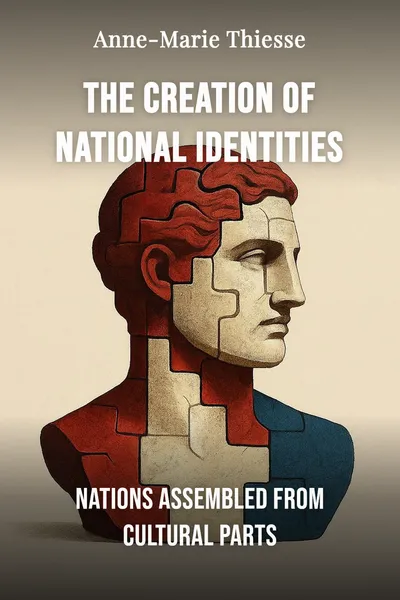
The Creation of National Identities
Nations assembled from cultural parts
Description
Pick almost any European country and you can list what makes it itself: a founding ancestor, a glorious past, a national language, a set of heroes, a landscape on the postcards, folk songs, traditional costumes, a typical dish or two. The list feels natural, almost eternal — as if each nation had simply inherited these things across the centuries. That intuition is exactly what the historian Anne-Marie Thiesse set out to take apart in her book on how national identities were made. Her claim is blunt and well-documented: that familiar list is not an inheritance. It is a construction, assembled mostly in the nineteenth century, by identifiable people doing identifiable work.
What makes the argument land is that the same list turns up everywhere. Thiesse works across France, Germany, Italy, the Nordic countries, Central and Eastern Europe, and she keeps finding the same ingredients being gathered in the same order. Scholars hunt for epics. Linguists standardize a tongue. Composers polish peasant melodies into concert pieces. Painters fix the landscape that will stand for the homeland. Each nation presents these as proof of its singular essence — and yet the method of producing that singularity is shared from one country to the next.
This is the paradox the book keeps circling. Nations spend enormous effort insisting they are unlike all the others, and they do it by following a procedure that is almost identical from Lisbon to Helsinki. The identity feels ancient; the fabrication is recent and, in large part, collaborative across borders. Scholars in one country borrowed the recipe from scholars in the next, and sometimes from the very neighbors they were learning to define themselves against.
The question we’re asking : If national cultures feel timeless, who actually assembled them, and from what parts?What we’ll see : How a continent built its unmistakably singular nations from one shared kit of parts.
Table of contents
01 Chapter 1 — The checklist every nation filled in
Thiesse's central image is almost mundane: becoming a nation means ticking boxes on a list. A people that wants to exist as a nation needs, she argues, a certain set of things, and the striking part is how stable that set turns out to be across Europe. There is a history that reaches back to a founding moment. There are ancestors and heroes. There is a language, ideally with its own literature. There are monuments, a capital, a set of landscapes that stand in for the whole territory. And then the everyday register: folklore, costumes, songs, cuisine, a few typical character traits the people supposedly share.
None of this emerges on its own. Each item has to be found, or when it cannot be found, made. The history gets written; the language gets codified and taught; the heroes get statues and street names; the folklore gets collected, printed, and often tidied up in the process. Thiesse describes this as the work of cultural entrepreneurs — scholars, writers, musicians, collectors, teachers — who understand that a nation is not simply declared but furnished.

02 Chapter 2 — The scholars who dug up the ancestors
The first box to tick is the past. A nation needs ancestors, a lineage, a sense that it was always there waiting to wake up. So the nineteenth century became a golden age of national historiography, with historians recasting the record as the long biography of a people rather than of kings or dynasties. The story needed a cradle, a decline, and a promised reawakening — and historians across Europe obligingly supplied that arc.
Alongside history came the search for the founding text, the ancient epic that would prove the nation had a soul long before it had a state. Here Thiesse points to a figure like James Macpherson, who in the 1760s published what he presented as the poems of Ossian, an ancient Gaelic bard. The work was largely his own composition, dressed as antiquity, and it was a sensation across Europe — precisely because every emerging nation wanted an Ossian of its own. The forgery mattered less than the appetite it revealed.
03 Chapter 3 — The folk song that had to be invented
If the epic supplied the nation's deep past, folklore supplied its living texture. The people needed not only glorious ancestors but a visible, audible, everyday culture — songs, dances, costumes, proverbs — that marked them off from their neighbors. And so a great harvesting began. Collectors fanned out into the countryside to record the authentic voice of the folk, convinced they were preserving something pure and threatened.
The collecting was rarely neutral. When a melody was written down, it was often smoothed, harmonized, and arranged for performance in a city far from the village it came from. When costumes were catalogued as the national dress, they were frequently standardized out of regional variety into a single approved version. Thiesse shows how composers took peasant material and lifted it into the concert hall, producing a national music that felt rooted in the soil but was shaped for bourgeois audiences and symphony orchestras.
04 Chapter 4 — A European product sold as ancient soil
Step back from the individual cases and the deeper argument of Thiesse's book comes into focus. National identities present themselves as the most particular things imaginable — this soil, this tongue, this unrepeatable people — and yet they were built from a template that was thoroughly international. The kit of parts, the order of assembly, even the rhetoric of restoration were shared across the continent. The very thing that was supposed to prove radical difference was produced by a common method.
This has a consequence that cuts against national self-understanding. The builders of one nation studied the builders of others. Herder's ideas about the genius of peoples travelled far beyond the German lands that first received them. Ossian inspired imitators everywhere. A Hungarian or a Serbian or a Catalan movement could learn its craft from the French and German precedents, including from rivals they were straining to differentiate themselves from. National cultures were, in this sense, a cooperative European enterprise dressed up as a hundred separate miracles of rootedness.
05 Conclusion
Return to that opening list — the ancestor, the language, the costume, the song, the typical dish. After Thiesse, it reads differently. Each item still belongs to its nation, but each also bears the fingerprints of the people who gathered it, the century that demanded it, and the neighboring example it was copied from. The list is not a family heirloom passed down intact; it is an inventory compiled, and the compilers can often be named and dated.
Related books